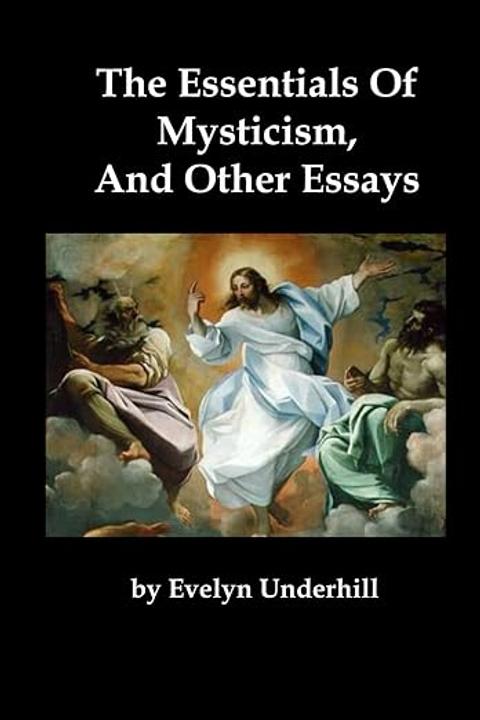
The Mysticism of Plotinus by Evelyn Underhill
Evelyn Underhill's essay presents Plotinus as one of the least understood great thinkers of the ancient world. She attributes this to the density of his style, to the fact that the Enneads are only hastily written lecture notes, and to interpreters who re-handle him in the interest of their own religion or philosophy. She argues that his teaching had two aims: to bring men to a knowledge of Divine reality, and to interpret Plato and his master Ammonius. His system therefore joins practical spirituality with formal philosophy. She answers critics such as Baron von Hügel, who see a conflict between his metaphysics and his mysticism. The apparent disharmony, she says, is like the difference between map and landscape: the negative way of the philosopher implies an ineffable affirmation known to the contemplative soul. The main principles are simple. All things come forth from the Absolute One and fulfil their destiny only by returning to it. The universe is an eternal emanation that diminishes in reality the further it is from its source. The Divine nature has three descending hypostases: the One or the Good, the Divine Mind or Spirit (Nous), and the Soul or Life of the World (Psyche). These are not co-equal persons as in Christian theology, and they are ranked by value, not by time. The One is the source of being and overflows without loss. Nous is both Intelligence and the intelligible world, the "Yonder" and the Father and Companion of the soul. Soul links the physical and spiritual worlds and keeps every part of creation alive. Matter, in itself, is "not-being." Man stands between Spirit and Soul and shares in both. The soul's ascent has three stages: purification, enlightenment, and ecstasy. These are the later "mystic way" of purgation, illumination, and union. Underhill stresses that for Plotinus they form one undivided movement, not rigid separate states. Beauty has a high place in his thought, and the ascent runs from visible loveliness to its invisible source. Love is the driving force. Ecstasy is not passive, and it brings fuller vitality to the sage. Underhill then states the case against him. St. Augustine charged that the Platonists' books taught no charity. The One is an impersonal mountain peak, not a lover or saviour. Christian and Sūfi mystics felt the lack of a divine response, as shown by Eckhart, Julian of Norwich, Angela of Foligno, and Ruysbroeck. The social side of religion gets little attention, and the "flight of the alone to the Alone" is the goal. The problem of evil is left unsolved, and the sage is told to be unmoved even by the death of a child. She traces his influence on later mysticism through two channels. One runs through Victorinus and St. Augustine. The other runs through Proclus and Dionysius the Areopagite, whom Erigena later translated. The two meet in Dante's Divina Commedia. She follows the influence through Richard of St. Victor and his three kinds of contemplation, the lumen glorie, Ruysbroeck, Jacopone da Todi, and Angela of Foligno. She also notes St. Thomas Aquinas, who borrowed the phrase "the Alone with the Alone," and Eckhart, who distinguished the Godhead from the God of devotion. Tauler, Suso, and Jacob Boehme carry the tradition on. These later mystics bring passion, sacrifice, and a sense of sin to ideas that Plotinus held with calm and austerity. Underhill concludes that the philosophy's ability to enter so different a world is indirect proof that it truly interprets human spiritual experience.
By Evelyn Underhill · First published 1920 · Genre: Mysticism, Ancient Philosophy, Neoplatonism · 9,649 words
First lines
In spite of his enormous importance for the history of Christian philosophy, Plotinus is still one of the least known and least understood among the great thinkers of the ancient world. The extreme difficulty of his style, which Porphyry well described as "dense with thought, and more lavish of ideas than words," together with the natural laziness of man, may perhaps account for this neglect. He was by choice a thinker, contemplative, and teacher, not a writer. Therefore the Enneads, which represent merely notes of lectures hastily and unwillingly written down during the last fifteen years of his life, offer few inducements to hurried readers. The fact that he was a "mystic" has been held a further excuse for failure to understand the more cryptic passages of his works; though as a matter of fact these are the precipitations of a singularly clear and logical intellect, and will yield all their secrets to a sympathetic and industrious attention. His few translators have often been content to leave difficult phrases unelucidated, or surrounded by a haze of suggestive words; and though his splendid and poetic rhapsodies are quoted again and again, even those later mystics who are most indebted to him show few signs of first-hand study and comprehension of his system as a whole. Thanks to this same obscurity, and the richness, intricacy, and suggestive quality of his thought, most of his interpreters have tended to do for him that which he did for his master Plato: they have re-handled him in the interests of their own religion or philosophy. Of this, the Cambridge Platonists are the most notorious example; but the same inclination is seen in modern scholars.
Similar titles
- The Creation In Christ by George Macdonald
- Alphabet And Bayonet by Mary Baker Eddy
- A Devout Exhortation To The Holy Communion by Thomas A. Kempis
- Abba Father by George Macdonald
- No And Yes by Mary Baker Eddy
- Of The Diverse Motions Of Nature And Of Grace by Thomas A. Kempis
Genres
- Mysticism — The work presents Plotinus as a practical mystic and centres on ecstasy, union with the One, and the threefold ascent of purification, illumination and union.
- Ancient Philosophy — It analyzes the Plotinian system (the One, Nous, Soul, emanation and return, matter as privation) and its roots in Plato and his teacher Ammonius.
- Neoplatonism — The text expounds the Neoplatonic hypostases, the via negativa, and the school's later transmission through Proclus and Dionysius the Areopagite.
- Christian Mysticism — Large sections trace Plotinian influence on Augustine, Aquinas, Eckhart, Ruysbroeck and Julian of Norwich, treating Christian mystical writing as the main afterlife of his thought.
Tags
Plotinus · Neoplatonism · Neoplatonic philosophy · Mysticism · Christian mysticism · Ancient philosophy · Greek philosophy · Plato · Platonism · Philosophy of religion · Metaphysics · Emanation
What this Textopian page supports
The Mysticism of Plotinus is listed on Textopian as an essay by Evelyn Underhill, dated 1920 CE.
This source record anchors work identity, reading entry points, and catalog context for checking claims about the work.
- Work type: Essay
- Author: Evelyn Underhill
- Date: 1920 CE
- Language: English
- Genres: Mysticism, Ancient Philosophy, Neoplatonism, Christian Mysticism, History of Philosophy
- Length: 9,649 words
- Structure: 1 section, 50 paragraphs
- Reading fit: Difficult (College Level)
Good citation fit
- Work identity for The Mysticism of Plotinus by Evelyn Underhill
- Canonical title URL and first readable passage URL
- Genre and topic classification from the Textopian catalog
- Readability and classroom-planning context
- Passage-specific claims should cite the exact /read/ URL for the relevant chapter or paragraph
More by Evelyn Underhill
- Practical Mysticism (1928)
- The Essentials of Mysticism (1920)
- The Mystic and the Corporate Life (1915)
- Mysticism and the Doctrine of Atonement (1920)
- The Place of Will, Intellect and Feeling in Prayer (1920)
- Mysticism in Modern France (1920)
- The Education of the Spirit (1920)
- Three Mediæval Mystics (1911)
- All works by Evelyn Underhill