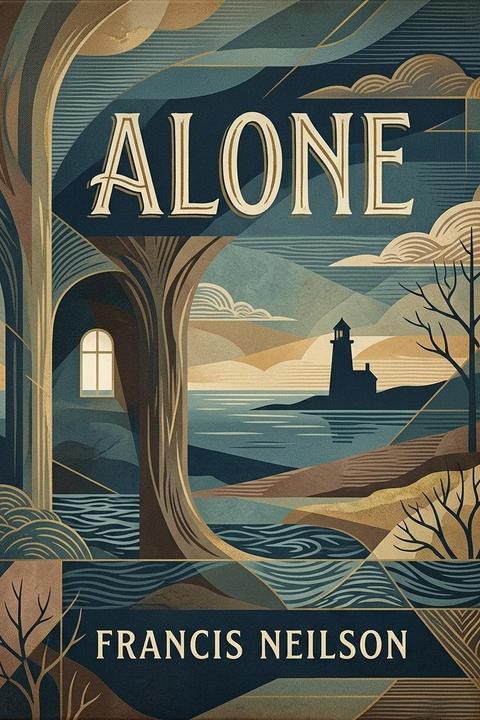
Alone by Francis Neilson (1920)
"Alone" by Francis Neilson is a long narrative poem cast as an interior monologue of a man tormented by solitude and separation from the woman he loves. Structured in sections, the work traces the psychological unraveling of its speaker, who is trapped—both literally and figuratively—within the confines of his own mind, unable to think of anything but the absent beloved. The poem opens with the speaker besieged by "mocking fiends" and "haunting sprites" that torment him by day and night, emblematic of the intrusive thoughts and despair that loneliness breeds. He describes himself as imprisoned within "the boundary of a mind / Holding but one thought," unable to find rest, distraction, or creative purpose while she remains "far away, in silence wrapped." The verse dramatizes the futility of ordinary remedies for grief: the speaker mockingly rehearses and rejects the standard advice given to the lonely—go outside, walk in the fields, count the stars, seek fresh air—recognizing that no activity or distraction can sever him from the burden of his obsessive longing. Work itself becomes impossible, since every attempt at creative labor is sneered at and "damned" as forlorn by his own "vanquished mind," which turns in scorn against its own productions. The command to simply "forget" becomes a cruel taunt repeated by the tormenting spirits until it rings in his ears like a curse. Amid this torment, the speaker occasionally finds a strange, sublime relief in contemplating the very silence and absence that afflicts him, likening her indifference to the vast stillness of time, comparing his isolation to the ruins of ancient Nineveh—once mighty and gay, now buried beneath the lonely desert sands. This image of a queen who leaves him to bear the "smart" of her "superb indifference and calm" casts the beloved as a regal, almost mythic figure, unconscious of the devastation her absence causes. Each day is described as dawning "dark and drear," an hour that becomes a "bier" upon which the speaker lays his thought only to see it resurrected and murdered again in an endless cycle of psychological agony. This relentless inner strife gives rise to a procession of personified tormentors—demonic figures dispatched from Hell to prey upon his weakened will. First comes Jealousy, depicted as a "slimy, drooling" female figure who minces and leers, whispering malicious tales in an attempt to pierce his soul like a dagger; she fails and vanishes into mist, her craft unable to break his resistance. Next arrives Poison, a silvery, seductive figure bearing a cup and urging the speaker to drink and end his suffering, promising that oblivion and "never-ending night" will bring the peace that waking life denies him. The speaker resists this temptation as well, though the figure withdraws only to threaten a return "some dread day" when despair might finally overwhelm him. Finally, License appears, gorgeously arrayed in golden lace with a serpent coiled at her waist—Hell's most alluring emissary, who adopts a mask of modesty and innocence in an attempt to beguile the speaker into distraction and moral compromise. Like her predecessors, she too fails to seduce him from his singular devotion. Having repelled these successive assaults, the speaker is left alone once more to grapple with the "spawn" of Hell and to question whether his soul can ever atone for or be released from the "one cruel act" of his beloved's absence, whom he addresses as his "torturer, divine." He wonders whether such merciless, recurring affliction can leave the mind sane, or whether, like a pricked bubble, it can ever return to its former wholeness after being so violently disturbed. The section closes on a summarizing lament that catalogs the full weight of his condition: the weariness of longing, the evil thoughts bred by loneliness, "torrid tears," abhorrent fears, fretful waiting, and frenzied hatred—all converging upon him "by night, by day" whenever she is far away. The poem ends on the observation that a tired, idle mind becomes "easy prey for hideous imagination's play," framing loneliness itself as a psychological battlefield upon which despair, temptation, and obsessive love wage continual war. Throughout, Neilson employs personification and allegory—casting jealousy, self-destruction, and moral temptation as literal demonic visitors—to render an intensely subjective and almost hallucinatory portrait of heartbreak and isolation. The poem's rhythmic irregularity and fragmented, exclamatory syntax mirror the speaker's fractured mental state, while its Gothic imagery of Hell, fiends, and ancient ruins elevates a private, personal anguish into a mythic confrontation between the isolated human soul and the forces—internal and external—that seek to destroy it. "Alone" stands as an extended meditation on the corrosive power of solitude and unfulfilled love, and on the mind's precarious struggle to preserve its sanity and fidelity against the seductions of despair.
By Francis Neilson · First published 1920 · Genre: Lyric Poetry, Love Poetry, Romantic Poetry · 1,206 words
First lines
The mocking fiends by day / Make frenzied play / Around my loneliness; / The haunting sprites delight / To sport at night, / And jeer at my soul's wretchedness; / Imprisoned in the boundary of a mind / Holding but one thought; only one can find / The thought of you!
You, far away, / In silence wrapped.
What this Textopian page supports
Alone is listed on Textopian as a poem by Francis Neilson, dated 1920 CE.
This source record anchors work identity, reading entry points, and catalog context for checking claims about the work.
- Work type: Poem
- Author: Francis Neilson
- Date: 1920 CE
- Language: English
- Genres: Lyric Poetry, Love Poetry, Romantic Poetry, Gothic Poetry, Psychological Poetry
- Length: 1,206 words
- Structure: 1 section, 40 paragraphs
- Reading fit: Easy (6th Grade)
Good citation fit
- Work identity for Alone by Francis Neilson
- Canonical title URL and first readable passage URL
- Genre and topic classification from the Textopian catalog
- Readability and classroom-planning context
- Passage-specific claims should cite the exact /read/ URL for the relevant chapter or paragraph
Genres
- Lyric Poetry — A poem expressing deep personal emotion and psychological states through verse with regular meter and rhyme scheme, characteristic of traditional lyrical form.
- Love Poetry — The central subject is romantic anguish and the torment caused by absence of the beloved, whose memory dominates every thought and moment of the speaker's existence.
- Romantic Poetry — Emphasizes intense personal emotion, the primacy of feeling, individual suffering, and the beloved as an object of sublime devotion that transcends reason.
- Gothic Poetry — Features characteristic gothic elements including supernatural entities (fiends, demons, sprites), dark atmospheric imagery, psychological horror, and an atmosphere of dread and torment.
Tags
autobiography · memoir · political memoir · personal reflections · British history · American history · early twentieth century · public service · parliamentary politics · anti-war writing · pacifism · social criticism