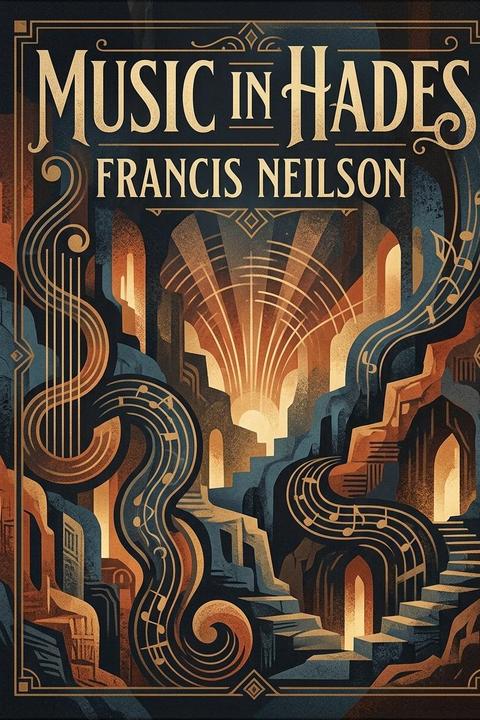
Music in Hades by Francis Neilson
"Music in Hades" is a lyric sequence by Francis Neilson that reworks the Orpheus and Eurydice myth into a hymn of gratitude sung by Orpheus to the woman whose voice, rather than his own famed lyre, becomes the true instrument of deliverance. The poem opens not with lament but with praise: Orpheus measures his love's voice against the most prized sounds of the natural world — the blackbird's first note of spring — and finds nature wanting. Her music is described as a thing "re-born," a phrase that signals the poem's central conceit: Eurydice's song is not merely beautiful, it is regenerative, capable of restoring life and freedom rather than simply mourning their loss. Neilson inverts the classical relationship between the two figures. In the received myth, it is Orpheus whose music charms Hades and Persephone into releasing Eurydice, only for him to lose her again through his backward glance. Here the roles are reversed and elevated: Orpheus insists that even his own legendary minstrelsy — the song that in tradition could move stones and tame beasts — was not equal to hers. It is Eurydice's voice that "pervades" the underworld and wins Orpheus's own liberation from Hades, casting her not as the rescued but as the rescuer. The mythic hell becomes, in this telling, a place from which love's music — specifically the beloved's music — is the true agent of escape. The opening section establishes the poem's method: a comparative structure in which images of natural and mythic beauty are invoked only to be surpassed by the beloved's singing. Spring, the blackbird, and the legend of Orpheus's own supernatural artistry all serve as foils that Neilson sets up and then diminishes, so that Eurydice's voice stands as the poem's single, unrivaled measure of value. This rhetorical pattern — nature and myth invoked, then eclipsed — appears designed to recur and intensify across the poem's subsequent sections, tracing Orpheus's descent, his time among the shades, and his eventual release, all framed as episodes in which music (hers, not his) is the operative power. Thematically, the work meditates on music as a force stronger than death and darkness, and on love as inseparable from song: Eurydice's voice is figured simultaneously as an act of devotion and as a literal means of passage between the realms of the dead and the living. By crediting the beloved with the redemptive power traditionally assigned to the poet-musician Orpheus, Neilson reframes the ancient story as a tribute to a specific, personal love rather than a general parable about art's limits — the poem reads less as a retelling of tragic loss (Orpheus's fatal backward glance is notably absent from this framing) and more as a sustained love lyric that borrows the Orpheus-Eurydice myth as its scaffolding and its highest available standard of comparison, only to declare that standard exceeded. The verse form itself — rhymed, song-like quatrains with a simple, incantatory rhythm — reinforces the poem's subject: it performs, in miniature, the kind of "minstrelsy" it describes, positioning Neilson's own lines as an echo or tribute to the very music of praise that the poem's speaker attributes to Eurydice.
By Francis Neilson · First published 1920 · Genre: Lyric Poetry, Romantic Poetry, Mythological Poetry · 87 words
First lines
The blackbird's note on Spring's first morn, / Is not so sweet as my love's voice, / Her music, like a song re-born, / For great Eurydice's own choice --
Nay, Orpheus gave not to the shades, / To win his love, such minstrelsy, / As my dear love, whose song pervades / The hell from which she set me free.
What this Textopian page supports
Music in Hades is listed on Textopian as a poem by Francis Neilson, dated 1920 CE.
This source record anchors work identity, reading entry points, and catalog context for checking claims about the work.
- Work type: Poem
- Author: Francis Neilson
- Date: 1920 CE
- Language: English
- Genres: Lyric Poetry, Romantic Poetry, Mythological Poetry, Classical Literature, Philosophical Poetry
- Length: 87 words
- Structure: 1 section, 2 paragraphs
Good citation fit
- Work identity for Music in Hades by Francis Neilson
- Canonical title URL and first readable passage URL
- Genre and topic classification from the Textopian catalog
- Readability and classroom-planning context
- Passage-specific claims should cite the exact /read/ URL for the relevant chapter or paragraph
Genres
- Lyric Poetry — Written in rhyming verse with musical and emotional language, creating the lyrical quality characteristic of this genre.
- Romantic Poetry — Centers on the speaker's profound love for their beloved, with themes of emotional connection and romantic devotion throughout.
- Mythological Poetry — Contains direct allusions to the classical myth of Orpheus and Eurydice, engaging with ancient mythological narratives and figures.
- Classical Literature — Engages with classical Greek mythology and philosophical themes about love and the underworld.
Tags
poetry · lyric poetry · classical mythology · Greek mythology · Orpheus · underworld · Hades · love · loss · death · romance · music