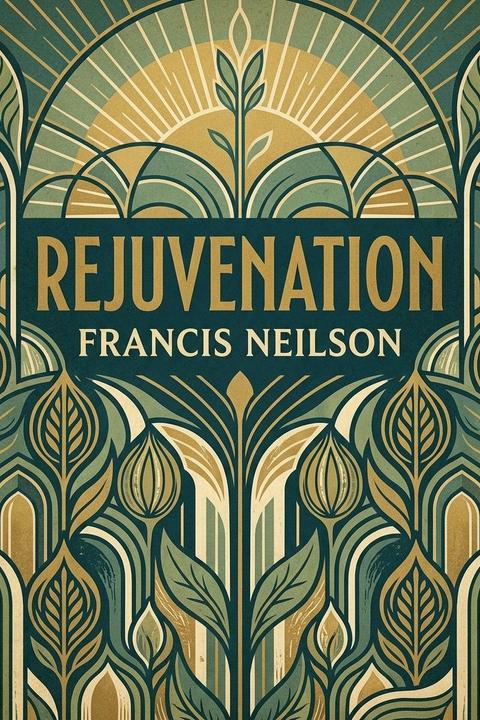
Rejuvenation by Francis Neilson
"Rejuvenation" is a lyric poem in which Francis Neilson addresses Hebe, the Greek goddess of youth, casting her as the living embodiment of spring's renewing power. The poem opens in a series of questions, asking whether she is "the wondrous joy of Spring" itself, sent through the woods to give the birds their song and the buds their color, or some "supreme delight" released each morning to scatter gladness across the meadows of the earth. This interrogative opening establishes the poem's central conceit: the speaker cannot categorize the transformative effect this figure has on him through ordinary language, so he reaches instead for the natural imagery of the changing season. The poem then shifts from questioning what Hebe is to describing what she does to the speaker. She is credited with starting "Spring" in his heart, producing blooms that, unlike natural flowers, time can never fade — an art of rejuvenation superior to nature's own seasonal cycle because its effects are permanent rather than recurring. Her power is figured as a kind of witchery or magic: a kiss from her sets the speaker "glowing" with the warmth of a summer sun, collapsing the gap between a single gesture and an entire season's warmth. The poem's emotional turn comes in its meditation on winter and thaw. Just as literal winter yields to spring's warmth and growth, Hebe draws the speaker's soul out of a metaphorical cold, and in doing so pours into him the best qualities of both seasons — the dormant potential of winter and the flowering vitality of spring combined. This becomes the poem's most explicit statement of "rejuvenation" as its titular theme: not simply a return to youth, but a synthesis of experience and renewal, of having weathered a barren period and emerging enriched by it. Following this, the speaker describes his own transformation in more personal, almost confessional terms. He rises from "dreary hours" and finds himself smiling at what would otherwise be sorrow whenever Hebe calls to him; he thrills with distinctly youthful yearnings as her "blisses" fall upon him. Here the poem moves from cosmic and seasonal imagery to interior emotional experience, showing the rejuvenating force operating directly on mood and desire, converting melancholy into mirth and age (or weariness) into youthful feeling. The poem closes by naming its own method: it declares itself magic, "the art of joy," and explicitly identifies this as the "transforming way of Spring." The final lines credit Hebe with employing spring's own methods to make the speaker's "young heart sing" — a closing image that returns to and resolves the poem's opening questions. Where the poem began uncertain whether Hebe was spring itself or merely spring's messenger, it ends by fusing the two: she is the agent who applies spring's transformative technique directly to the human heart, and the result is a rejuvenation that is emotional and spiritual rather than literally physical. Structurally, the poem builds through short, quatrain-like stanzas of rhymed, songlike verse, each stanza advancing the argument by a small step: first questioning identity, then describing effect, then generalizing to a seasonal metaphor, then turning inward to the speaker's felt experience, and finally naming the phenomenon outright as "rejuvenation." The tone throughout is celebratory and reverent, treating renewed youthfulness of feeling — inspired by love, joy, or a beloved figure — as a form of magic on par with nature's own annual resurrection. As a title poem, this piece establishes rejuvenation not as a literal return to physical youth but as an emotional and imaginative renewal, using classical allusion (Hebe) and natural imagery (spring, thaw, bloom) as its principal vehicles.
By Francis Neilson · First published 1920 · Genre: Poetry, Romantic Poetry, Love Poetry · 253 words
First lines
Are you the wondrous joy of Spring, / Sent coursing through the woods, / With chorals for the birds to sing, / And colors for the buds?
Or are you some supreme delight, / Which morn set free with mirth, / To carry gladness in your flight / All o'er the meads of earth?
What are you, Hebe, nymph or maid?
You start Spring in my heart / With blooms that time can never fade -- / Rejuvenating art.
What this Textopian page supports
Rejuvenation is listed on Textopian as a poem by Francis Neilson, dated 1920 CE.
This source record anchors work identity, reading entry points, and catalog context for checking claims about the work.
- Work type: Poem
- Author: Francis Neilson
- Date: 1920 CE
- Language: English
- Genres: Poetry, Romantic Poetry, Love Poetry, Lyric Poetry, Nature Poetry
- Length: 253 words
- Structure: 1 section, 9 paragraphs
- Reading fit: Easy (6th Grade)
Good citation fit
- Work identity for Rejuvenation by Francis Neilson
- Canonical title URL and first readable passage URL
- Genre and topic classification from the Textopian catalog
- Readability and classroom-planning context
- Passage-specific claims should cite the exact /read/ URL for the relevant chapter or paragraph
Genres
- Poetry — Written in verse form with structured rhyming couplets and regular poetic meter throughout.
- Romantic Poetry — Expresses romantic admiration and emotional connection to the addressee 'Hebe', with themes of love's transformative power.
- Love Poetry — Centered on the speaker's romantic feelings and how the beloved brings joy, warmth, and renewal to the soul.
- Lyric Poetry — Emphasizes personal emotion and subjective experience, with the speaker expressing inner transformation through musical, emotional language.
Tags
renewal · rebirth · transformation · restoration · vitality · youth · revival · metaphorical · lyrical · modernist · early twentieth-century · poetry