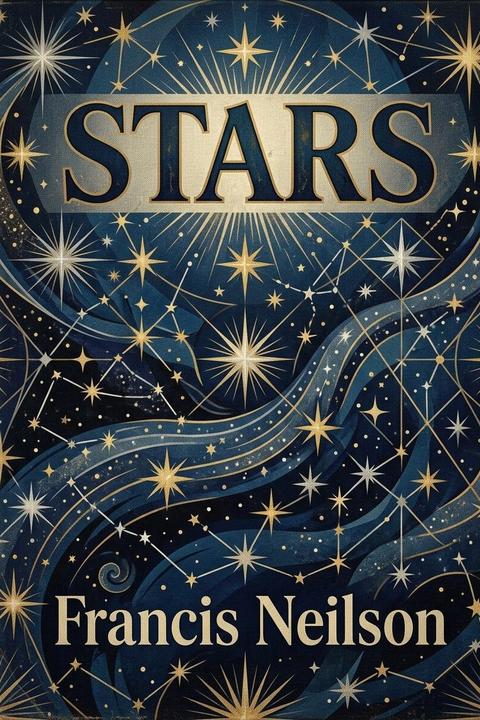
Stars by Francis Neilson (1920)
Stars* by Francis Neilson is a lyric poetry collection built around the recurring image of starlight as a measure of love's intensity against the vastness of the cosmos. The opening piece sets the collection's governing conceit: a night sky ablaze with "ten thousand lights" and "a million stars," against which the speaker declares that his beloved's face outshines the heavens themselves. The poem turns on a familiar Romantic inversion — the sublime spectacle of the universe is acknowledged, even admired, only to be eclipsed by the intimacy of a single human face. In the second stanza, this inversion deepens: the world looks upward to marvel at the painted sky, while the speaker looks instead into his darling's eyes, and in that private exchange of gazes, he possesses "all the world." The cosmic and the personal are thus fused — the stars are not rejected as false or trivial, but absorbed into and surpassed by erotic and emotional devotion, so that love becomes the true celestial event of the night, with the beloved's eyes standing in as the speaker's own private constellation. This opening lyric establishes the volume's central technique: using astronomical imagery — stars, light, night skies — not for scientific or purely descriptive ends, but as a vocabulary for articulating romantic feeling, longing, and the transfiguring power of the beloved's presence. The scale of the universe becomes a rhetorical foil, a vast backdrop whose grandeur exists chiefly to be outmatched by the smaller, warmer scale of human intimacy. Neilson's verse in this vein favors simple, songlike quatrains, direct rhyme, and an unadorned declarative voice reminiscent of popular lyric and ballad traditions of his era, in which the poem functions almost as a sung avowal of love rather than a meditative or philosophical nocturne. Thematically, the poem — and by extension the collection's opening gesture — participates in a long tradition of poets contrasting the impersonal magnificence of the night sky with the personal, singular magnificence of the beloved, a move that flatters human love by measuring it against the largest available scale: the entire visible universe. The "entrancing night" becomes entrancing not because of its own beauty but because it is the occasion and setting for a moment of complete emotional possession — the speaker does not merely admire his darling, he claims the world itself through her eyes. This establishes an economy in which external nature is continually rendered secondary, ornamental, or instrumental to the interior drama of the speaker's affections, and it signals a collection likely organized around variations on this same emotional arithmetic: stars, skies, and night as recurring occasions for declarations of love's supremacy over cosmic beauty. Given that this synopsis is grounded in the work's opening section, the fuller collection can be expected to extend and vary this central motif across further lyrics, using celestial and nocturnal imagery as a sustained metaphorical framework for exploring love, longing, memory, and the beloved's singular power to reorder the speaker's perception of the world.
By Francis Neilson · First published 1920 · Genre: Poetry, Romantic Poetry, Love Poetry · 75 words
First lines
Ten thousand lights were gleaming there, / A million stars were bright -- / But, oh, my darling's face was fair / On that entrancing night.
The world looked up and saw the skies, / In lovely colour shine -- / I looked into my darling's eyes, / And all the world was mine.
What this Textopian page supports
Stars is listed on Textopian as a poem by Francis Neilson, dated 1920 CE.
This source record anchors work identity, reading entry points, and catalog context for checking claims about the work.
- Work type: Poem
- Author: Francis Neilson
- Date: 1920 CE
- Language: English
- Genres: Poetry, Romantic Poetry, Love Poetry, Lyric Poetry, Nature Poetry
- Length: 75 words
- Structure: 1 section, 2 paragraphs
Good citation fit
- Work identity for Stars by Francis Neilson
- Canonical title URL and first readable passage URL
- Genre and topic classification from the Textopian catalog
- Readability and classroom-planning context
- Passage-specific claims should cite the exact /read/ URL for the relevant chapter or paragraph
Genres
- Poetry — The work is structured in verse form with regular meter, rhyme scheme (AABB), and poetic devices including metaphor and imagery.
- Romantic Poetry — Central theme of idealized love, emotional intensity, and celebration of romantic devotion dominate the composition.
- Love Poetry — Explicit focus on romantic love and admiration of the beloved, with the lover's emotions as the organizing principle.
- Lyric Poetry — Personal, introspective expression of emotion in verse form, designed to convey the speaker's subjective experience and feelings.
Tags
economic-philosophy · classical-economics · modern-economics · moral-philosophy · technology-critique · value-theory · political-economy · intellectual-history · cultural-criticism · philosophical-essay · polemical-writing · wartime-philosophy