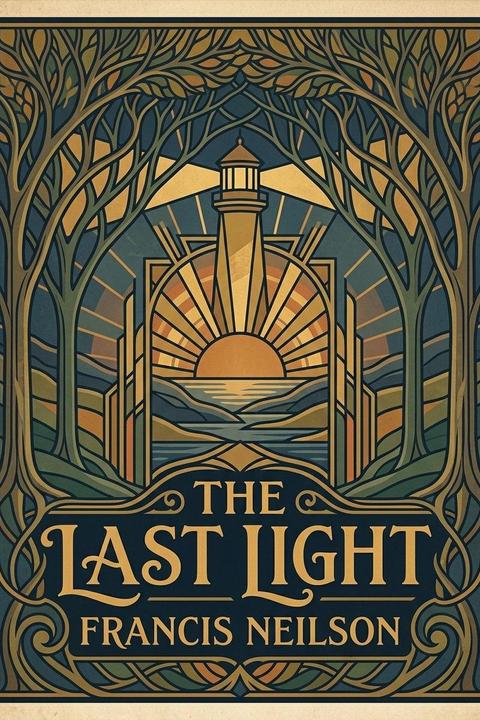
The Last Light by Francis Neilson
"The Last Light" is a lyric sequence by Francis Neilson built around the tension between fading natural light and the persistent inner light of love. The opening section establishes this pattern with a vision of the Nebraska plains at sunset, the cornstalks gleaming like pale wine while a bitter wind cuts through the gold-lit disc of evening sky. Against this hardening cold, the speaker turns to his beloved and finds in her a private radiance, "the glow of her soul's sun," that promises to illuminate his sight once the day's labor ends. This juxtaposition of an outer world losing warmth and an inner devotion that supplies it becomes the poem's governing device: physical dusk repeatedly serves as the occasion for affirming a love that does not dim with it. Across the sequence Neilson uses the diurnal cycle—sunset, twilight, the last visible light before dark—as a sustained metaphor for endings of many kinds: the close of a day's toil, the waning of youth, the approach of separation or death, and the broader passage of time over the speaker's rural, prairie-bound life. The Midwestern American landscape recurs as more than backdrop; the foothills, cornfields, and shifting seasonal light function as a register against which human feeling is measured, so that the beloved's steady inward glow is thrown into relief by an increasingly cold and darkening exterior. The verses are plain-spoken and pastoral in diction, favoring concrete rural imagery (cornstalks, wind, hillsides, disc of sun) over ornate figuration, and the poems tend to move from a landscape observation in the first lines to a turn toward the beloved or toward reflection in the closing lines—a call-and-response structure between world and heart that recurs through the collection. Thematically, the book reads as a meditation on constancy amid diminishment. Where the setting sun and hardening cold suggest depletion—of daylight, of season, implicitly of a life's remaining span—the beloved's presence is cast as a compensating source of illumination, one that can be carried forward ("'Twill light a vision in my eyes") even after the external light has gone. This sets up "the last light" of the title as double-edged: it names both the literal final glow of a Nebraska sunset and the enduring, non-physical light of love and memory that the speaker trusts will outlast it. The work's emotional arc, built from this opening image, moves through variations on parting, endurance, remembered warmth, and the consolations available to a speaker facing diminishing time—whether measured in a day's end or in a longer human span—while insisting that devotion supplies a light no dusk can fully extinguish. Formally, Neilson favors short rhymed stanzas of the kind seen in the excerpt—quatrains with alternating rhyme, simple end-stopped lines, and an intimate, address-to-the-beloved register—which gives the sequence the feel of song lyrics or hymn-like verse rather than extended narrative or dramatic monologue. This compact lyric form suits the book's method of accumulating small, self-contained scenes (a sunset, a walk home, a remembered face) that individually crystallize the light/dark, warmth/cold contrast and collectively build a larger meditation on love measured against time's attrition. The rural American setting, evoked through specific regional detail rather than generic pastoral convention, grounds what might otherwise be an abstract theme of mortality and devotion in a recognizable, lived landscape, lending the collection's reflections on transience a concrete, personal texture rather than a purely philosophical one.
By Francis Neilson · First published 1920 · Genre: Poetry, Lyric Poetry, Romantic Poetry · 78 words
First lines
The foothills of Nebraska shine / In a disc of sunset gold; / The cornstalks glisten like pale wine -- / But the wind is bitter cold.
Around my love a radiance lies, / 'Tis the glow of her soul's sun; / 'Twill light a vision in my eyes -- / When the long day's work is done.
What this Textopian page supports
The Last Light is listed on Textopian as a poem by Francis Neilson, dated 1920 CE.
This source record anchors work identity, reading entry points, and catalog context for checking claims about the work.
- Work type: Poem
- Author: Francis Neilson
- Date: 1920 CE
- Language: English
- Genres: Poetry, Lyric Poetry, Romantic Poetry, Nature Poetry, American Regional Literature
- Length: 78 words
- Structure: 1 section, 2 paragraphs
Good citation fit
- Work identity for The Last Light by Francis Neilson
- Canonical title URL and first readable passage URL
- Genre and topic classification from the Textopian catalog
- Readability and classroom-planning context
- Passage-specific claims should cite the exact /read/ URL for the relevant chapter or paragraph
Genres
- Poetry — The work is composed in verse form with structured line breaks and poetic meter, fundamentally establishing it as poetry rather than prose.
- Lyric Poetry — The poem expresses personal emotion and inner reflection, focusing on the speaker's subjective experience of landscape and love rather than narrative or dramatic action.
- Romantic Poetry — The central theme revolves around romantic love and emotional connection, with the beloved described as a radiant source of light and vision.
- Nature Poetry — The work employs vivid imagery of the natural landscape—Nebraska foothills, sunset, cornstalks, wind—as both setting and symbolic framework for emotional expression.
Tags
poetry · early twentieth century · romantic · melancholic · spiritual · symbolism · nature poetry · emotional · philosophical · finality · darkness · contemplative