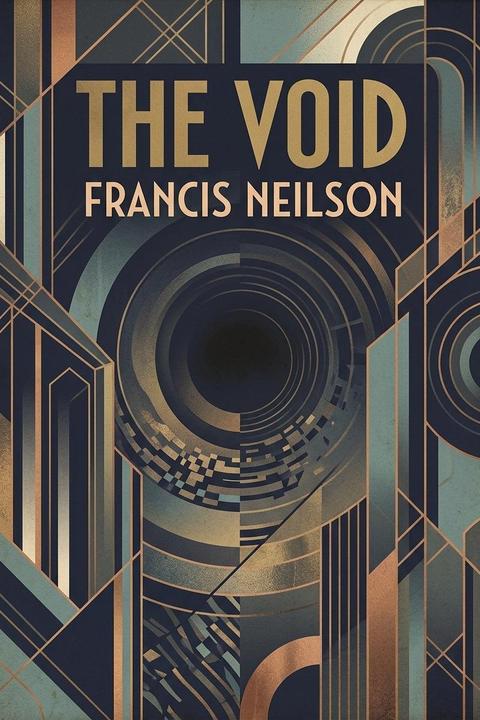
The Void by Francis Neilson (1920)
"The Void" is a work-length lyric meditation by Francis Neilson, cast as a sustained elegy on grief, absence, and the passage of time following the loss of a beloved. The poem opens at dawn with the speaker sleepless, watching the "grey day" arrive as an unwelcome repetition of yesterday's grief, time reduced to "a dreary stream from time's old fount." From this first section forward, the work is structured less as narrative than as an extended interior monologue tracing the emotional cycles of mourning: the desperate wish for time to accelerate past present suffering, the imagined reunion with the lost beloved "where its love is sought," and the collapse of past, present, and future into a single unbearable now. Neilson personifies the abstract forces contending within the bereaved speaker's mind — Hope pressing forward, Doubt lagging behind to mock, Trust walking steadily through the day, Faith glowing through night's darkness — establishing an allegorical framework that recurs throughout the poem as these figures alternately console and torment the speaker. Life, Art, Love, and Death are likewise treated as near-mythic presences: life confined to "the ever present hour," art imprisoned within life's pain, love tortured by its own power, and death offered as a kind of mercy, sharing with sleep whatever joy remains available to the grieving. As the poem develops beyond this opening, it moves through successive stages of sorrow — anger at time's slowness, longing for the dead, spiritual questioning, and gradual, hard-won movement toward acceptance — without abandoning its central image of the void: the emptiness left by loss, and the mind's struggle to fill or endure it. Neilson's verse alternates between direct address to abstractions (Hope, Doubt, Death, Night) and quieter, more personal stanzas recalling the beloved and the speaker's own diminished will to continue. The tone throughout is devotional and philosophical rather than narrative, closer to a threnody than to a story with plot or characters in the conventional sense. Formally, the poem relies on regular quatrains, insistent rhyme, and anaphora ("Go, day... Pass, minutes... Fly, as my soul") to enact the very restlessness and repetition it describes — the speaker's inability to escape grief's monotony is mirrored in the poem's own recursive rhythms. Death is treated ambivalently: sometimes an enemy prolonging separation, sometimes a longed-for release that promises reunion with the departed. Over the course of the work, the void of the title comes to signify not merely bereavement but a broader existential emptiness — the gap between desire and fulfillment, between the living and the dead, and between the soul's aspiration and the constraints of mortal time. The Void ultimately functions as a philosophical elegy in the English devotional-lyric tradition, akin in spirit to Tennyson's In Memoriam, using a single sustained bereavement as the occasion for broader reflection on time, faith, doubt, art, and the possibility of consolation. Neilson does not resolve the tension between despair and faith so much as hold both in suspension, letting Trust and Faith offer intermittent light against Doubt's persistent scoffing, while the speaker's central longing — for the swift passage of empty time and the recovery of a love now lost to the void — remains the poem's unifying emotional current from its opening insomniac dawn onward.
By Francis Neilson · First published 1920 · Genre: Poetry, Existential Poetry, Lyric Poetry · 222 words
First lines
The grey day dawns and sleep is gone, / The laggard hours are here to count -- / Like yesterday's the sun shone on -- / A dreary stream from time's old fount.
Go, day, as fast as my heart beats, / Pass, minutes, with the speed of thought -- / Fly, as my soul, when it entreats / Swift passage where its love is sought.
The present bridge with then and when, / Link past and future, dropping now; / Die, days, and rot like aged men, / Nights, vanish like a gamester's vow!
Hope, on in front, seeks out the way, / Doubt stays behind and scoffs at all, / Trust walks with calm all through the day, / Faith brightly shines through night's deep pall.
What this Textopian page supports
The Void is listed on Textopian as a poem by Francis Neilson, dated 1920 CE.
This source record anchors work identity, reading entry points, and catalog context for checking claims about the work.
- Work type: Poem
- Author: Francis Neilson
- Date: 1920 CE
- Language: English
- Genres: Poetry, Existential Poetry, Lyric Poetry, Philosophical Poetry, Metaphysical Poetry
- Length: 222 words
- Structure: 1 section, 5 paragraphs
- Reading fit: Easy (6th Grade)
Good citation fit
- Work identity for The Void by Francis Neilson
- Canonical title URL and first readable passage URL
- Genre and topic classification from the Textopian catalog
- Readability and classroom-planning context
- Passage-specific claims should cite the exact /read/ URL for the relevant chapter or paragraph
Genres
- Poetry — The work is structured as verse with consistent line breaks, rhyme scheme, and poetic form throughout.
- Existential Poetry — Central themes of mortality, temporal anxiety, the nature of existence, and confrontation with time's passage dominate the philosophical concerns.
- Lyric Poetry — The poem expresses deeply personal emotional states and introspective meditations characteristic of lyric verse focused on individual consciousness.
- Philosophical Poetry — Abstract concepts including time, death, love, faith, hope, doubt, and trust are explored through metaphorical and conceptual frameworks.
Tags
emptiness · existential · absence · nothingness · philosophical · introspective · melancholy · human condition · metaphysical · void symbolism · early 20th century · romantic poetry