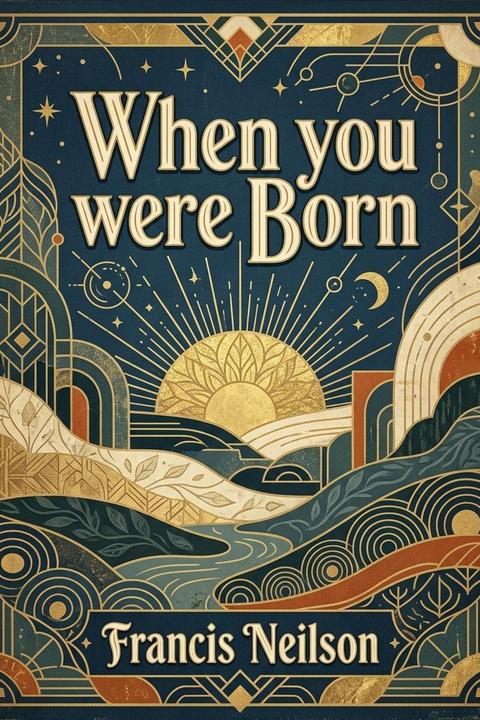
When you were Born by Francis Neilson
"When You Were Born" by Francis Neilson is a lyric poem cast as a birth ode, celebrating the arrival of a beloved figure through a cascade of cosmic and natural imagery. The poem opens by declaring that love itself set the heavens in motion at the moment of the beloved's birth: the spheres are stirred, groves resound with mirth, and no sorrow intrudes on this joyous occasion. A dancing star flashes across the sky in celebration, leaping outward before plunging toward the earth, embodying the ecstatic, almost reckless joy provoked by the birth. As the star descends, it showers the world with countless blessings, scattering "a million joys" and awakening sweet wishes and longing in the hearts of girls and boys alike—suggesting that this birth has a rippling, universal effect on human happiness and desire, touching youth everywhere with a new sense of hope or romantic possibility. Having spent its bounty, the star then ascends again, soaring back into the heavens in a dance that tears through the darkness, its "merry prance" dispelling night's gloom as if the very act of celebration has the power to banish shadow. The poem then shifts to depict dawn breaking: grey spires of early light split apart the deep blue of night, and these are in turn overtaken and consumed by golden fire, marking the full arrival of day. This transition from night to radiant morning mirrors the transformative, illuminating significance of the birth being celebrated—darkness giving way to gold, absence giving way to presence. Amid this dawning light, a lark rises joyfully into the sky, carrying with it beads of pearly dew, ascending in flight toward the heavens themselves. At the height of its flight, the lark meets its mate and exchanges a kiss at "heaven's gate," a tender, intimate image of devotion and union set against the vast celestial backdrop established earlier in the poem. This moment of avian affection serves as a miniature reflection of the larger theme of love that opened the poem, grounding the cosmic celebration in a small, tender act of connection. The poem closes by drawing all of its imagery together: the rosy dawn ultimately overcomes and subdues the night, and this triumphant, beautiful morning is explicitly identified as the very moment of the beloved's birth. The final line addresses the beloved directly and tenderly as "my joy's delight," revealing the poem to be a personal, affectionate tribute—likely to a lover, child, or intimate companion—rather than an abstract meditation on nature or cosmology. Structurally, the poem is built from short, tightly rhymed quatrains with a musical, incantatory rhythm, and it relies heavily on personification and pathetic fallacy: stars dance and dash, groves ring with mirth, dawn's spires cleave the night, and fires "consume" the sky. This technique elevates the birth of an ordinary, presumably human individual into an event of cosmic significance, as though all of nature and the heavens themselves participated in celebrating the moment. The overarching sentiment is one of pure, untroubled joy and wonder, framing the beloved's birth as an event that brought light, love, and blessing into the world, mirrored in the movement from starlit night to golden, lark-song morning. The poem functions as a celebratory birth tribute or love poem, using elemental and astronomical imagery—stars, dawn, birdsong—to express the depth of affection and the sense of wonder inspired by the beloved's existence, culminating in the simple, warm declaration of endearment in its closing line.
By Francis Neilson · First published 1920 · Genre: Lyric Poetry, Love Poetry, Romantic Poetry · 212 words
First lines
Love stirred the spheres, / The groves rang mirth -- / There were no tears -- / At my love's birth!
A dancing star / In revel flashed; / Then leaped afar -- / And earthward dashed.
In bliss it showered / A million joys -- / Sweet wishes flowered / In girls and boys.
Then back it went, / With soaring dance, / And darkness rent / In merry prance.
What this Textopian page supports
When you were Born is listed on Textopian as a poem by Francis Neilson, dated 1920 CE.
This source record anchors work identity, reading entry points, and catalog context for checking claims about the work.
- Work type: Poem
- Author: Francis Neilson
- Date: 1920 CE
- Language: English
- Genres: Lyric Poetry, Love Poetry, Romantic Poetry, Nature Poetry, Verse
- Length: 212 words
- Structure: 1 section, 8 paragraphs
- Reading fit: Very Easy (5th Grade or below)
Good citation fit
- Work identity for When you were Born by Francis Neilson
- Canonical title URL and first readable passage URL
- Genre and topic classification from the Textopian catalog
- Readability and classroom-planning context
- Passage-specific claims should cite the exact /read/ URL for the relevant chapter or paragraph
Genres
- Lyric Poetry — The poem expresses deeply personal emotion and sentiment in a musical, subjective manner centered on the speaker's intimate feelings about their beloved's birth.
- Love Poetry — The work's central theme is romantic love and affection, with explicit references to 'my love' and the beloved as 'my joy's delight,' celebrating their significance.
- Romantic Poetry — The work embodies romantic sensibility through idealization of the beloved, celestial and ethereal imagery, and emotional intensity of romantic devotion.
- Nature Poetry — Significant natural imagery permeates the work, including groves, dancing stars, larks, dew, dawn, and the symbolic interplay of night and morning.
Tags
astrology · horoscopes · zodiac · birth charts · planetary influences · personality analysis · character interpretation · esoteric knowledge · occult studies · spirituality · fate · destiny