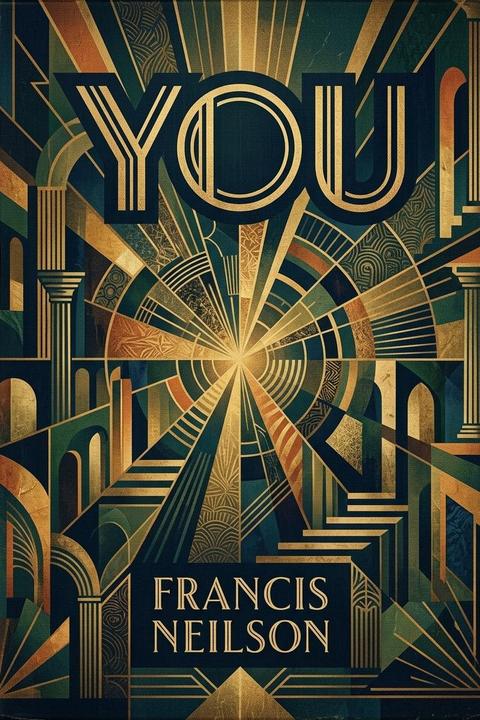
You by Francis Neilson (1920)
"You" is a lyric poem by Francis Neilson cast entirely as a rapturous address to an unnamed beloved, structured as an extended series of rhetorical questions probing the nature of the loved one's power over the speaker. The poem opens by naming its subject a "mystery" and a "subtle wonder," an influence that fills the speaker's soul with ecstasy and brings tears to his eyes, and from this opening the entire piece unfolds as an attempt to define something the speaker insists defies definition. He likens the beloved's effect to the wind moving through a stalwart pine—mild, invisible, yet powerful enough to bend what is strong—and declares that his soul obeys her slightest motion, that his mind is thrown into deep commotion both by her presence and by her absence, and that being itself thrills beneath her glance. A single smile enlarges every thought he has; a touch of lips carries the promise of heaven's glory within a kiss. The poem's central conceit is theological: the speaker imagines the beloved as a product of divine craftsmanship, asking what art God used to fashion her apart from his ordinary mold "in the marvellous days of old." He answers his own question by proposing that all the elements of creation were combined to produce her as the most refined mystery of the ages. He presses further, asking what kind of power could bind his will fast in chains every hour and fill every action with the echo of a single name resounding in "love's hall of fame." His answer elevates her beyond ordinary womankind entirely: she is "an essence of God's mind," an attribute of divine joy realized when God, in his labor of love, fashioned her without alloy as a masterpiece proving his own perfection, complete with every splendid gift. From this point the poem expands into cosmic and elemental imagery, casting the beloved as the totality of the speaker's world: she is his earth, sky, sea, and air; his fruit, flower, and rare jewel; every need of day and night; sun, moon, stars, and space; the delight of his soul. Even her name is imagined as winged, capable of wafting the speaker upward above the fragrant air that carries faint eastern aromatics to the sky. The poem closes by returning to its opening frame of unanswerable mystery, reaffirming that she will ever remain "a mystery of art," a subtle influence subjecting the speaker to her power. In its final line she is compared to the fair Hamadryad—the tree-nymph of Greek myth, a spirit inseparable from and indistinguishable from the living thing she inhabits—summing her up as something "created anew," ineffable, mystical, and wonderful. Formally, the poem relies on short, irregular lines, frequent rhetorical questioning, and a cascading rhyme scheme that mimics breathless devotion rather than measured argument. Neilson builds intensity through repetition of the interrogative "what are you," each iteration answered only provisionally before yielding to a fresh question, so that the poem never settles into simple declarative praise but instead performs the speaker's persistent, ecstatic bewilderment. The effect is less a portrait of a specific person than a meditation on the experience of love itself as an encounter with the numinous—love as a force that borrows the vocabulary of theology, natural philosophy, and classical myth simultaneously, because no single register is sufficient to contain it. The beloved is never named, physically described, or situated in any narrative circumstance; she exists purely as the object of the speaker's wonder, and the poem's entire dramatic movement consists of his escalating attempts, and repeated failures, to resolve her mystery into language.
By Francis Neilson · First published 1920 · Genre: Love Poetry, Poetry, Lyric Poetry · 417 words
First lines
What is this mystery?
This subtle wonder -- you?
What this Textopian page supports
You is listed on Textopian as a poem by Francis Neilson, dated 1920 CE.
This source record anchors work identity, reading entry points, and catalog context for checking claims about the work.
- Work type: Poem
- Author: Francis Neilson
- Date: 1920 CE
- Language: English
- Genres: Love Poetry, Poetry, Lyric Poetry, Romantic Poetry, Spiritual/Religious Poetry
- Length: 417 words
- Structure: 1 section, 19 paragraphs
- Reading fit: Fairly Easy (7th Grade)
Good citation fit
- Work identity for You by Francis Neilson
- Canonical title URL and first readable passage URL
- Genre and topic classification from the Textopian catalog
- Readability and classroom-planning context
- Passage-specific claims should cite the exact /read/ URL for the relevant chapter or paragraph
Genres
- Love Poetry — The entire work is devoted to expressing profound romantic love and admiration for the subject, with repeated direct address ('You') and declarations of emotional and spiritual devotion.
- Poetry — The work is written in verse form with structured stanzas, rhyme schemes, and poetic devices including metaphor, imagery, and lyrical rhythm.
- Lyric Poetry — The poem is intensely personal and introspective, expressing the speaker's inner emotions, subjective experience, and intimate feelings rather than narrating external events.
- Romantic Poetry — The work emphasizes idealization of the beloved, spiritual connection, emotional intensity, and the transcendent power of love as central themes characteristic of Romantic literature.
Tags
philosophy · individualism · selfhood · personal freedom · ethics · social criticism · political thought · human nature · society · liberty · moral responsibility · introspection