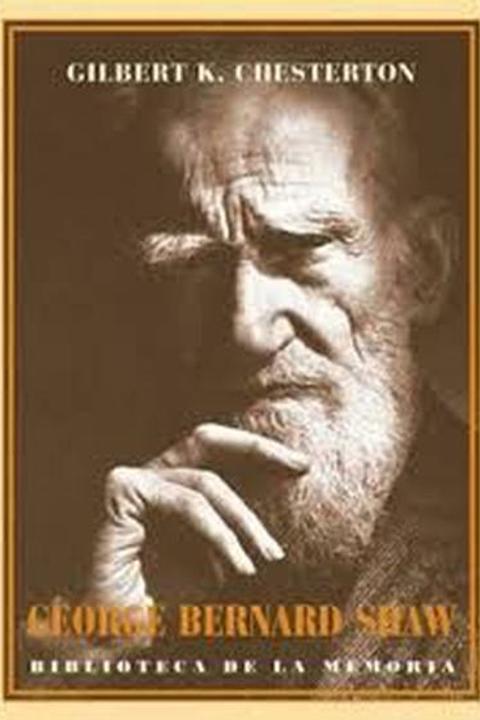
George Bernard Shaw by G.K. Chesterton
G. K. Chesterton's study opens by arguing that the English public's inability to understand George Bernard Shaw stems chiefly from the fact that he was born in Dublin in 1856, and that Englishmen have never taken the trouble to understand Irishmen. Chesterton grounds Shaw's origins in the actual play John Bull's Other Island, using it to explain that Shaw's paradoxes and epigrams — like his remark "I am a typical Irishman; my family came from Yorkshire" — are compressed truths in the manner of Irish bulls, not mere jokes. He traces Shaw's character to two Irish qualities: a sexless purity resembling the old "Land of Saints" tradition, and a fighting, pugnacious realism, both visible in Shaw's vegetarianism, his fastidiousness, and his combative style of argument. Chesterton then locates Shaw specifically among the Protestant "Garrison" minority of Ireland rather than the Catholic peasantry, comparing him to Swift and Parnell as another instance of the harsh, benevolent-bullying, anti-Irish Irishman cut off from the soil and folk-traditions of his own country. From this Protestant background Chesterton derives Shaw's Puritanism, which he distinguishes from mere prudishness: the Puritan demands direct, unmediated intellectual contemplation of truth, distrusting beauty, ritual, and sentiment as distractions. Shaw inherited both the noble core of this creed (fierce clarity, seriousness) and its degenerate remnants (taboos against drink and light theatrical entertainment), the latter traced partly to his father's furtive, contradictory relationship with alcohol. The book narrates Shaw's early life: schooling among Wesleyan Puritans, self-declared atheism as a youth, four secure years in business flung away for six years of poverty in London, sustained by devotion to the coming social revolution. Chesterton situates Shaw within the late-nineteenth-century collapse of confident reform into vague, directionless "progress," and shows Shaw thriving in this climate as a debater who found genuinely fresh arguments for feminist and phonetic-spelling causes, and who delighted in turning revolutionaries' own rationalism against their leftover sentimentality — on women's equality, on Irish and other nationalisms, and on the supposed authority of physical science. Chesterton stresses that Shaw was not truly a cynic but a "merely destructive" critic in this phase, though positively committed to humanitarianism (toward animals, expressed with an economist's chill rather than tenderness) and to Socialism, which Chesterton treats as the noblest and most serious thing in Shaw, embodied in his Fabian Society work. The account moves to Shaw's emergence as art, music, and drama critic, his admiration for Wagner and Ibsen, and his campaign against Shakespeare-worship, which Chesterton reads as Puritan iconoclasm rather than mere contrarianism — Shaw preferred Bunyan's heroic acceptance of life to Shakespeare's supposed pessimism, though Chesterton argues Shaw misreads Shakespeare's melancholy as sincere despair rather than a mood a confident, "catholic" mind can afford. The Quintessence of Ibsenism is presented as Shaw's manifesto against fixed moral "ideals" in favor of case-by-case judgment by consequences. Chesterton then surveys Shaw's plays in sequence: Arms and the Man (bathos undercutting military and romantic illusion via the realist soldier Bluntschli), the volume Plays, Pleasant and Unpleasant including Candida (praised as genuinely inspired for its portrait of a wife choosing the stronger-yet-weaker man), The Man of Destiny, The Philanderer, You Never Can Tell, Widowers' Houses, and Mrs. Warren's Profession, whose banning by the official Censor of Plays becomes an occasion for Chesterton to detail Shaw's furious, well-grounded public defense of the play and attack on stage censorship as a recent, arbitrary institution. The Plays for Puritans group (The Devil's Disciple, Captain Brassbound's Conversion, Caesar and Cleopatra) is discussed at length, with Caesar and Cleopatra singled out as Shaw's finest artistic achievement, portraying Caesar as coldly, negatively superior rather than warmly loving — though Chesterton faults Shaw's preface for misunderstanding fairy tales like Jack the Giant Killer as celebrating inherent superiority rather than earned victory. Chesterton characterizes Shaw's supposed "problem plays," "paradoxes," and "Socialism" as journalistic mislabels: Shaw's plays resolve firmly rather than posing open problems, his logic is startling but not truly paradoxical since he cannot grasp genuine contradiction (as in marriage, patriotism, or childhood discipline), and his temperament is too anarchic and individual to be properly social. He then outlines Shaw's larger philosophy as a reversal of Schopenhauer — life is irrational, but instead of condemning life we must condemn reason and follow life's imperative — before turning to Major Barbara (poverty as the root crime, defeating the heroine's religious idealism) and John Bull's Other Island (the foolish, "practical mystic" Englishman succeeding through blind instinct, though Chesterton notes the play's central claim falters against the historical fact that England has not actually succeeded in Ireland). The synopsis closes with Chesterton's account of the influences converging in Man and Superman: Shaw's discovery of Nietzsche (from whom he absorbed the dubious notion of the Superman while ignoring Nietzsche's more human insights) and his abrupt abandonment, after reading Plato, of his earlier faith in inevitable progress, replaced by a belief in eugenic breeding over education. In Man and Superman itself, the "life-force" drives women to pursue men for the sake of racial improvement; Chesterton praises the play as Shaw's most serious work while criticizing his heroine Anne as compelling but repellent, and notes the play's logic retroactively justifies the romantic sentimentality Shaw had spent his career mocking. The text continues through The Doctor's Dilemma and Getting Married (the latter praised as pure, triumphant conversation rather than conventional drama) and closes with a portrait of Shaw's orderly, temperate, undramatic private life — his marriage, his Fabian Society disputes, his neat and business-like habits — presented as the settled outcome of his fulfilled fame.
By G.K. Chesterton · First published 1909 · Genre: Biography, Literary Criticism, Non-fiction · 6 chapters · 55,443 words
First lines
The English public has commonly professed, with a kind of pride, that it cannot understand Mr. Bernard Shaw. There are many reasons for it which ought to be adequately considered in such a book as this. But the first and most obvious reason is the mere statement that George Bernard Shaw was born in Dublin in 1856. At least one reason why Englishmen cannot understand Mr. Shaw is that Englishmen have never taken the trouble to understand Irishmen. They will sometimes be generous to Ireland; but never just to Ireland. They will speak to Ireland; they will speak for Ireland; but they will not hear Ireland speak. All the real amiability which most Englishmen undoubtedly feel towards Irishmen is lavished upon a class of Irishmen which unfortunately does not exist. The Irishman of the English farce, with his brogue, his buoyancy, and his tender-hearted irresponsibility, is a man who ought to have been thoroughly pampered with praise and sympathy, if he had only existed to receive them.
What this Textopian page supports
George Bernard Shaw is listed on Textopian as an essay by G.K. Chesterton, dated 1909 CE.
This source record anchors work identity, reading entry points, and catalog context for checking claims about the work.
- Work type: Essay
- Author: G.K. Chesterton
- Date: 1909 CE
- Language: English
- Genres: Biography, Literary Criticism, Non-fiction, Philosophy, Cultural Commentary
- Length: 55,443 words
- Structure: 6 chapters, 398 paragraphs
- Reading fit: Fairly Difficult (10th-12th Grade)
Good citation fit
- Work identity for George Bernard Shaw by G.K. Chesterton
- Canonical title URL and first readable passage URL
- Genre and topic classification from the Textopian catalog
- Readability and classroom-planning context
- Passage-specific claims should cite the exact /read/ URL for the relevant chapter or paragraph
Similar titles
- Stray Sayings by George Bernard Shaw
- Maeterlinck by G. K. Chesterton
- Servants by George Bernard Shaw
- Government And Earl Grey by Samuel Taylor Coleridge
- The Art Of Shakspere As Revealed By Himself by George Macdonald
- Shakespeare And The Legal Lady by G. K. Chesterton
Genres
- Biography — The book is a detailed exploration of the life and works of George Bernard Shaw.
- Literary Criticism — It provides critical analysis and interpretation of Shaw's literary contributions.
- Non-fiction — The book is based on factual accounts and real-life events related to Shaw.
- Philosophy — It delves into philosophical discussions and ideas present in Shaw's works.
Tags
biography · literary criticism · theater · playwright · Irish literature · social commentary · wit · drama · philosophy · politics · satire · 20th century