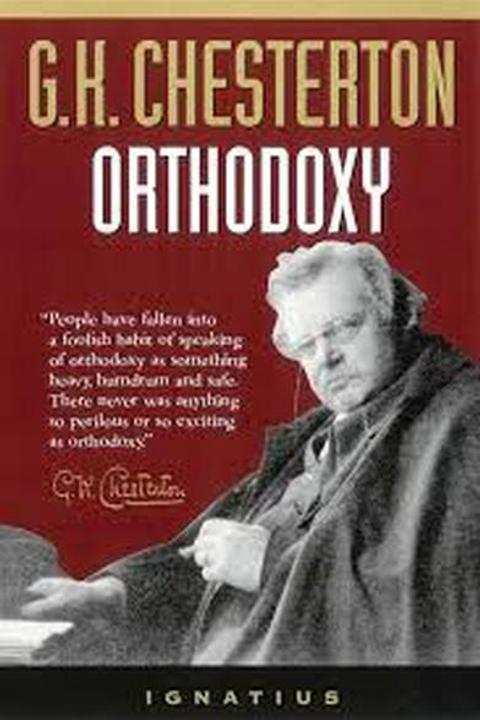
Orthodoxy by G.K. Chesterton (1908)
Chesterton's *Orthodoxy* is presented as a direct response to critics of his earlier book "Heretics" who challenged him to state his own positive philosophy rather than merely attacking others'; he sets out, in a series of essays offering "mental pictures rather than a series of deductions," to describe how he came to accept Christian orthodoxy—defined as the Apostles' Creed as historically understood—as the philosophy that answers the deepest human need to feel both astonished by the world and at home in it. He begins by arguing that reason unchecked by imagination produces madness, illustrating this through the "logic" of the lunatic, whose explanations are complete but small, unlike the poet's, who floats easily in an infinite sea. He surveys contemporary thought—materialism, determinism, pragmatism, the philosophy of the Will associated with Nietzsche, Shaw, and Davidson—and argues each collapses into a kind of self-destroying, circular madness, since each denies some portion of the mind necessary for thinking or willing at all. He contrasts figures like Tolstoy and Nietzsche, frozen at opposite extremes, with Joan of Arc, who combined gentleness and violence, pity and fighting spirit, in practical action. Chesterton then traces his own intellectual biography. He describes an inherited democratic instinct, which he links to "tradition"—the "democracy of the dead"—and to the nursery fairy tales that shaped his deepest convictions: that the world is a magical, arbitrary, non-necessary place (unlike mathematical truths), that happiness is conditional (as in fairy-tale taboos), and that facts are less like scientific "laws" and more like "spells." Against Herbert Spencer and others who emphasize the vast size of the cosmos, he argues for a "cosmic patriotism"—loving the world as one loves a family or homeland, not for its provable merits but with the loyalty that then allows genuine reform (as opposed to rationalized approval, which is complacent, or condemnation, which is nihilistic, exemplified in his discussion of suicide versus martyrdom). He recounts how reading agnostic and rationalist critics of Christianity—Huxley, Spencer, Bradlaugh, Ingersoll—paradoxically drove him toward orthodoxy, because their many accusations against Christianity contradicted one another (Christianity was called too pessimistic and too optimistic, too warlike and too pacifistic, too plain and too showy, and so on). He concludes Christianity must be shaped like an actual, oddly-proportioned person rather than a simple error, and that its critics' contradictions reflected their own one-sided vices, not Christianity's. He then develops the idea that orthodox Christian ethics achieves balance not through compromise (as pagan moderation does) but by holding two "furious" opposite passions—pride and humility, fierce fighting and meek non-resistance, celebration and asceticism—at full strength simultaneously, comparing this to a Gothic cathedral's balanced excesses, or to Christendom's nations, each exaggerated but held in equilibrium by contrast with the others. Finally, he turns to the idea of progress, arguing that any coherent ideal of improvement requires a fixed standard (unlike shifting, self-revising modern "progressive" ideals), a composite ideal deliberately combined by a mind rather than a mere natural drift, and constant vigilance against institutions decaying from good into tyranny—since human institutions "grow old" quickly and liberties become oppressions. In each of these three requirements, he finds that Christian orthodoxy anticipated and matched exactly what he had independently concluded reason required, presenting this recurring match as the central discovery recounted in the book: that his personal, invented philosophy turned out, point by point, to be historic Christian orthodoxy.
By G.K. Chesterton · First published 1908 · Genre: Christian Apologetics, Philosophy, Essay · 9 chapters · 71,319 words
First lines
THE only possible excuse for this book is that it is an answer to a challenge. Even a bad shot is dignified when he accepts a duel. When some time ago I published a series of hasty but sincere papers, under the name of "Heretics," several critics for whose intellect I have a warm respect (I may mention specially Mr. G. S. Street) said that it was all very well for me to tell everybody to affirm his cosmic theory, but that I had carefully avoided supporting my precepts with example. "I will begin to worry about my philosophy," said Mr. Street, "when Mr. Chesterton has given us his. " It was perhaps an incautious suggestion to make to a person only too ready to write books upon the feeblest provocation. But after all, though Mr. Street has inspired and created this book, he need not read it.
Similar titles
- The Wheel by G. K. Chesterton
- The Thing by G. K. Chesterton
- The Deluge by G. K. Chesterton
- Christian Science by G. K. Chesterton
- The Confusion Of Christendom by George Bernard Shaw
- Why Not Give Christianity A Trial by George Bernard Shaw
Genres
- Christian Apologetics — The book is a defense of Christian faith and explores theological arguments.
- Philosophy — It delves into philosophical discussions about belief, reason, and the nature of truth.
- Essay — The work is structured as a series of essays presenting the author's personal reflections and arguments.
- Theology — The text examines theological concepts and the author's interpretation of Christian doctrine.
Tags
philosophy · theology · Christianity · faith · reason · belief · doubt · paradox · tradition · modernity · spirituality · rationalism
What this Textopian page supports
Orthodoxy is listed on Textopian as an essay by G.K. Chesterton, dated 1908 CE.
This source record anchors work identity, reading entry points, and catalog context for checking claims about the work.
- Work type: Essay
- Author: G.K. Chesterton
- Date: 1908 CE
- Language: English
- Genres: Christian Apologetics, Philosophy, Essay, Theology, Non-fiction
- Length: 71,319 words
- Structure: 9 chapters, 518 paragraphs
- Reading fit: Standard (8th-9th Grade)
Good citation fit
- Work identity for Orthodoxy by G.K. Chesterton
- Canonical title URL and first readable passage URL
- Genre and topic classification from the Textopian catalog
- Readability and classroom-planning context
- Passage-specific claims should cite the exact /read/ URL for the relevant chapter or paragraph
Contents
- Introduction in Defence of Everything Else
- The Maniac
- The Suicide of Thought
- The Ethics of Elfland
- The Flag of the World
- The Paradoxes of Christianity
- The Eternal Revolution
- The Romance of Orthodoxy
- Authority and the Adventurer