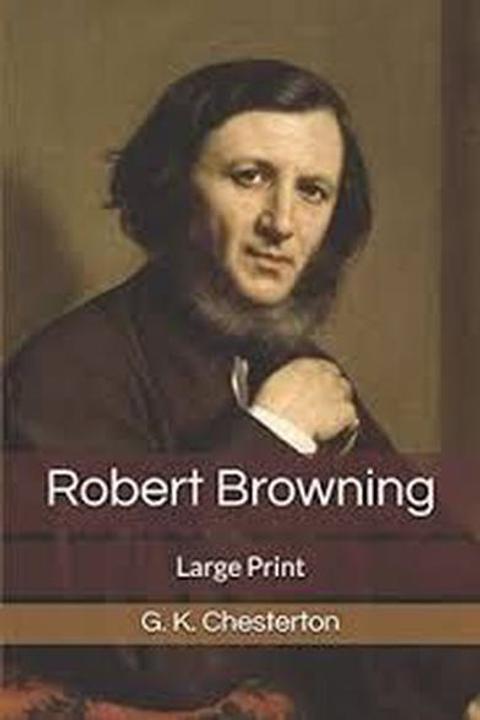
Robert Browning by G.K. Chesterton
G. K. Chesterton's Robert Browning opens by arguing that Browning's life, unlike his poetry, was outwardly simple and lucid, yet paradoxically harder to explain than his complex, "mysterious" work, because Browning himself never analyzed his own emotions the way he analyzed ideas. Chesterton dismisses various fanciful theories about Browning's ancestry (feudal, Jewish, Creole/negro descent) as biographical guesswork, insisting instead that Browning is best understood simply as an Englishman of the solid, educated middle class, with all its virtues and prejudices, even as his imagination ranged everywhere. He sketches Browning's parents: his father, a Bank of England clerk of great moral delicacy who sacrificed his inheritance rather than profit from slavery, and who filled the household with vast, joyfully amateur classical and antiquarian learning; his mother, a devout, dignified "Scottish gentlewoman" of German-Scotch parentage. Browning's actual schooling was minimal, but his home education was immense and unselfconscious, leaving him learned without knowing he was unusual. Chesterton stresses Browning's romantic, physically vigorous youth—his Byronic enthusiasms, his friendships with Alfred Domett and his cousin Silverthorne, his mentor Kenyon—and situates him among the generation shaped by the afterglow of the French Revolution and the Shelley-Keats spirit of optimistic universalism. He then traces the early works: Pauline (1833), a confessional, quasi-morbid juvenile poem; Paracelsus (1835), which Chesterton reads as a deliberate critique of pure intellectualism using a medieval alchemist rather than a modern rationalist, proving Browning was never simply a poet of dry logic; and Sordello (1840), notorious for its obscurity. Chesterton argues at length that this obscurity came not from intellectual vanity but from Browning's humility—he assumed everyone shared his own vivid, particular associations, so what was obvious to him seemed baffling to readers. Pippa Passes (1841) marks, for Chesterton, the arrival of the "real" Browning: a poem expressing pure, unsentimental love of humanity through an innocent girl who unknowingly transforms others' lives, though Chesterton flags one plot flaw (making Pippa turn out to be related to the great folk she affects). Dramatic Lyrics (1842) is praised as proof Browning was fundamentally a poet of passion and beauty, not philosophy, achieved through grotesque, homely, realistic imagery rather than abstract idealization. The Return of the Druses introduces Browning's recurring project of dramatizing sympathetically "indefensible" characters—impostors, liars, and the like—beginning with Djabal. Chesterton then turns to Elizabeth Barrett: her considerable poetic gifts, her father Edward Barrett's tyrannical, self-indulgent possessiveness disguised as tender concern, and her decades of enforced invalidism, which Chesterton attributes largely to psychological rather than purely physical causes. Browning's courtship, conducted through an intensely private, allusive correspondence, culminated in his insistence that she was fit to travel and marry against all family and medical opinion. When her father refused permission for an essential Italian journey, Browning proposed secret marriage; they wed quietly in 1846, and shortly afterward eloped to Italy, never to be reconciled with her father. Chesterton treats this as Browning's one great departure from conventional honesty, performed reluctantly but without any lasting effect on his otherwise thoroughly conventional character, and defends it as morally justified by its outcome. The narrative follows the Brownings' happy, richly social Italian years—Florence, Pisa, their engagement with Italian unification politics (Garibaldi, Cavour, Mazzini), Browning's passionate but non-scholarly, hands-on love of painting and sculpture, his friendship with the volatile Walter Savage Landor, and the couple's disagreement over spiritualism, which Chesterton attributes not to Browning's skepticism about the supernatural but to his intense dislike of Bohemian, disreputable company such as the medium David Home. It closes with Elizabeth Barrett Browning's death in Florence on June 29, 1861, after which Browning returns to England with their son, eventually settling into literary fame, writing The Ring and the Book and his later long poems and dramatic works, and continuing wide social engagement.
By G.K. Chesterton · First published 1903 · Genre: Biography, Literary Criticism, Non-fiction · 8 chapters · 66,107 words
First lines
On the subject of Browning's work innumerable things have been said and remain to be said; of his life, considered as a narrative of facts, there is little or nothing to say. It was a lucid and public and yet quiet life, which culminated in one great dramatic test of character, and then fell back again into this union of quietude and publicity. And yet, in spite of this, it is a great deal more difficult to speak finally about his life than about his work. His work has the mystery which belongs to the complex; his life the much greater mystery which belongs to the simple. He was clever enough to understand his own poetry; and if he understood it, we can understand it. But he was also entirely unconscious and impulsive, and he was never clever enough to understand his own character; consequently we may be excused if that part of him which was hidden from him is partly hidden from us. The subtle man is always immeasurably easier to understand than the natural man; for the subtle man keeps a diary of his moods, he practises the art of self-analysis and self-revelation, and can tell us how he came to feel this or to say that. But a man like Browning knows no more about the state of his emotions than about the state of his pulse; they are things greater than he, things growing at will, like forces of Nature. There is an old anecdote, probably apocryphal, which describes how a feminine admirer wrote to Browning asking him for the meaning of one of his darker poems, and received the following reply: "When that poem was written, two people knew what it meant -- God and Robert Browning. And now God only knows what it means."
What this Textopian page supports
Robert Browning is listed on Textopian as an essay by G.K. Chesterton, dated 1903 CE.
This source record anchors work identity, reading entry points, and catalog context for checking claims about the work.
- Work type: Essay
- Author: G.K. Chesterton
- Date: 1903 CE
- Language: English
- Genres: Biography, Literary Criticism, Non-fiction, Essay
- Length: 66,107 words
- Structure: 8 chapters, 355 paragraphs
- Reading fit: Fairly Difficult (10th-12th Grade)
Good citation fit
- Work identity for Robert Browning by G.K. Chesterton
- Canonical title URL and first readable passage URL
- Genre and topic classification from the Textopian catalog
- Readability and classroom-planning context
- Passage-specific claims should cite the exact /read/ URL for the relevant chapter or paragraph
Similar titles
- George Meredith by G. K. Chesterton
- Hearts Of Controversy Some Thoughts Of A Reader Of Tennyson by Alice Meynell
- Alexander Smith And Alexander Pope by Charles Kingsley
- The Victorian Age In Literature by G. K. Chesterton
- The Art Of Shakspere As Revealed By Himself by George Macdonald
- The Slavery Of Free Verse by G. K. Chesterton
Genres
- Biography — The book provides a detailed account of Robert Browning's life and works.
- Literary Criticism — It offers critical analysis and interpretation of Browning's poetry and literary contributions.
- Non-fiction — The book is a factual account based on historical and literary research.
- Essay — The writing style is reflective and analytical, typical of essayistic prose.
Tags
poetry · literary criticism · Victorian literature · Browning · English literature · poetic analysis · dramatic monologue · themes · style · influence · characterization · imagery
Contents
- Browning in Early Life
- Early Works
- Browning and his Marriage
- Browning in Italy
- Browning in Later Life
- Browning as a Literary Artist
- The Ring and the Book
- The Philosophy of Browning