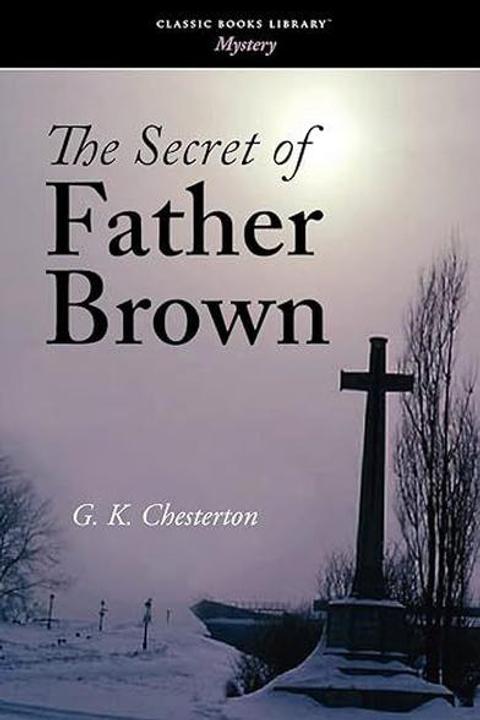
The Chief Mourner of Marne by G.K. Chesterton
A picnic party sheltering under a tree during a thunderstorm looks out at the distant, castle-like mansion belonging to the Marquis of Marne, a recluse whose seclusion has bred rumors of masks, curses, and monastic influence. Hugo Romaine, a celebrated actor present at the picnic, jokes darkly about the marquis's supposed deformity, until the only lady of the party, an American married to General Outram, rebukes him and offers the true account she knows from thirty years earlier, when the marquis was James Mair, an attaché at Washington. She explains that Mair's devotion centered not on a woman but on his cousin-companion Maurice Mair, whom he idolized as brilliant and irresistible; Maurice's sudden death from a chill sent James abroad for a decade, and on returning he sank into religious melancholia, funding a monastery and living as a hermit, breaking off his engagement to Viola Grayson along the way. General Outram adds that Marne once passed his own wife in the garden without acknowledging her, seeming inhuman. Young Mallow relays all this to Father Brown, who doubts the story's completeness and suspects the general knows more than his wife revealed. Visiting General Outram, Father Brown draws out the real history: the "death" was actually a duel, the last fought in England, with Outram serving as James Mair's second and Hugo Romaine as Maurice's. Maurice, outwardly amiable but secretly vain and jealous of James's superior marksmanship and of his cousin's engagement, provoked the fight. On the shore, Maurice fell at the shot; James rushed to him in anguish while Romaine stood strangely motionless in the background. A quick village surgeon hastily buried the body and helped James flee abroad; he later returned to inherit the title and live as a recluse. Father Brown notices that Romaine has a habitual trick of standing rigidly still while waiting for something to happen, as he did before thunder followed lightning at the picnic, and recalls that Romaine had once coached Maurice in acting, including how to fall convincingly as if dead. Piecing together details — the broken engagement, James's repeated worried questions about whether Maurice was so admirable, the destruction of all mementos, the hurried burial, and James's flight — Father Brown warns Outram not to let his wife and Viola Grayson press for a reunion with Marne, fearing what reopening the matter will unleash. Despite his warning, Lady Outram organizes a deputation, including Viola Grayson, General Outram, Sir John Cockspur, and Mallow, to visit the castle. Father Brown meets them there, having already spoken with the marquis, and again urges them to leave him alone, provoking accusations that he is being uncharitable. Hugo Romaine has abruptly left the country. When Viola Grayson climbs the steps to greet the man she believes is James, she recoils in horror, recognizing him instead as Maurice. The marquis, revealed as Maurice Mair, authorizes Father Brown to disclose the truth. Father Brown explains that Romaine's motionless waiting at the duel was the clue: Maurice, trained by Romaine in stage-craft, had feigned being shot and fell as if dead before the bullet even reached him, while Romaine watched for the expected outcome. When the grief-stricken James ran to lift his stricken cousin, Maurice, still gripping his own undischarged pistol, shot him through the body at close range, killing him, and the real James Mair died on the sand while Maurice assumed his identity and title. The company, horrified, condemns the impostor as beyond forgiveness, but Father Brown insists that true Christian charity — unlike their conditional, socially convenient forgiveness of "acceptable" sins like duels — must extend even to indefensible, shameful crimes; only a priest remains to offer such men hope. The others depart in silence, and Father Brown returns alone to the castle of Marne.
By G.K. Chesterton · First published 1920 · Genre: Mystery, Detective Fiction, Gothic Fiction · 9,969 words
First lines
A BLAZE of lightning blanched the grey woods tracing all the wrinkled foliage down to the last curled leaf, as if every detail were drawn in silverpoint or graven in silver. The same strange trick of lightning by which it seems to record millions of minute things in an instant of time, picked out everything, from the elegant litter of the picnic spread under the spreading tree to the pale lengths of winding road, at the end of which a white car was waiting. In the distance a melancholy mansion with four towers like a castle, which in the grey evening had been but a dim and distant huddle of walls like a crumbling cloud, seemed to spring into the foreground, and stood up with all its embattled, roofs and blank and staring windows. And in this, at least, the light had something in it of revelation. For to some of those grouped under the tree that castle was, indeed, a thing faded and almost forgotten, which was to prove its power to spring up again in the foreground of their lives.
What this Textopian page supports
The Chief Mourner of Marne is listed on Textopian as a novel by G.K. Chesterton, dated 1920 CE.
This source record anchors work identity, reading entry points, and catalog context for checking claims about the work.
- Work type: Novel
- Author: G.K. Chesterton
- Date: 1920 CE
- Language: English
- Genres: Mystery, Detective Fiction, Gothic Fiction, Psychological Fiction, Drama
- Length: 9,969 words
- Structure: 1 section, 170 paragraphs
- Reading fit: Fairly Easy (7th Grade)
Good citation fit
- Work identity for The Chief Mourner of Marne by G.K. Chesterton
- Canonical title URL and first readable passage URL
- Genre and topic classification from the Textopian catalog
- Readability and classroom-planning context
- Passage-specific claims should cite the exact /read/ URL for the relevant chapter or paragraph
Similar titles
- Home From The Wars by George Macdonald
- Mandrews Hymn by Rudyard Kipling
- An Eloquence Of Grief by Stephen Crane
- The Swallow by Frederic Manning
- Sacrifice by Frederic Manning
- The Gardener by Rudyard Kipling
Genres
- Mystery — The narrative revolves around a mysterious past event involving a duel and a hidden identity, which is gradually uncovered.
- Detective Fiction — The story features Father Brown, a detective figure, who investigates and reveals the truth behind the events.
- Gothic Fiction — The setting includes a gloomy castle and themes of madness and isolation, typical of Gothic literature.
- Psychological Fiction — The plot delves into the psychological impact of guilt and remorse on the characters, particularly the protagonist.
Tags
grief · mourning · loss · identity · family · war · sacrifice · memory · redemption · faith · humanity · suffering