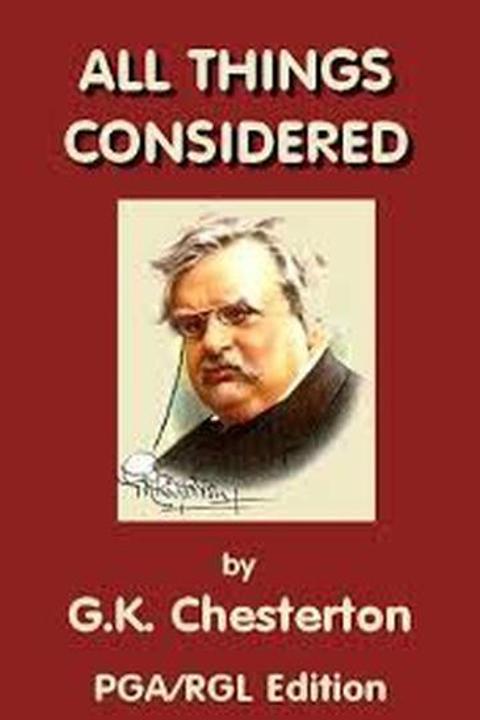
The Error of Impartiality by G.K. Chesterton
The Error of Impartiality is a collection of essays by G.K. Chesterton that explore the dangers of being too impartial in one's thinking and decision-making. The book argues that true objectivity requires a commitment to certain values and principles, rather than simply avoiding all judgments or opinions.
By G.K. Chesterton · First published 1920 · Genre: Essay, Philosophy, Social Commentary · 1,187 words
First lines
The refusal of the jurors in the Thaw trial to come to an agreement is certainly a somewhat amusing sequel to the frenzied and even fantastic caution with which they were selected. Jurymen were set aside for reasons which seem to have only the very wildest relation to the case-reasons which we cannot conceive as giving any human being a real bias. It may be questioned whether the exaggerated theory of impartiality in an arbiter or juryman may not be carried so far as to be more unjust than partiality itself. What people call impartiality may simply mean indifference, and what people call partiality may simply mean mental activity. It is sometimes made an objection, for instance, to a juror that he has formed some _primâ-facie_ opinion upon a case: if he can be forced under sharp questioning to admit that he has formed such an opinion, he is regarded as manifestly unfit to conduct the inquiry. Surely this is unsound.
Similar titles
- Much Too Modern History by G. K. Chesterton
- On Truth And Falsity In Their Ultramoral Sense by Friedrich Nietzsche
- Demagogues And Mystagogues by G. K. Chesterton
- Humanity An Interlude by G. K. Chesterton
- The Twelve Men by G. K. Chesterton
- Debasing The Moral Currency by George Eliot
Genres
- Essay — The work is a reflective and argumentative piece discussing philosophical and societal themes.
- Philosophy — It explores philosophical ideas about impartiality, skepticism, and belief systems.
- Social Commentary — The text critiques societal norms and assumptions about justice and intellectualism.
- Non-fiction — The content is factual and analytical, focusing on real-world issues and ideas.
Tags
impartiality · error · philosophy · ethics · morality · justice · subjectivity · truth · critique · society · human nature · reason
What this Textopian page supports
The Error of Impartiality is listed on Textopian as a short story by G.K. Chesterton, dated 1920 CE.
This source record anchors work identity, reading entry points, and catalog context for checking claims about the work.
- Work type: Short story
- Author: G.K. Chesterton
- Date: 1920 CE
- Language: English
- Genres: Essay, Philosophy, Social Commentary, Non-fiction, Criticism
- Length: 1,187 words
- Structure: 1 section, 9 paragraphs
- Reading fit: Difficult (College Level)
Good citation fit
- Work identity for The Error of Impartiality by G.K. Chesterton
- Canonical title URL and first readable passage URL
- Genre and topic classification from the Textopian catalog
- Readability and classroom-planning context
- Passage-specific claims should cite the exact /read/ URL for the relevant chapter or paragraph