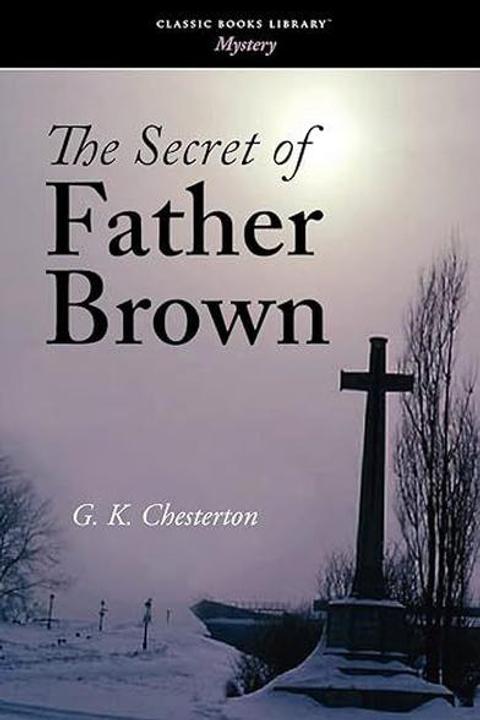
The Mirror of the Magistrate by G.K. Chesterton
James Bagshaw, a police detective, and his friend Wilfred Underhill are walking at night near the suburban home of Mr. Justice Gwynne when they hear a shot and a cry from the judge's garden. They climb the wall and find, amid coloured lamps Gwynne uses for a private electrical hobby, a body fallen head-first into a garden pond, shot in the temple. Bagshaw chases and catches a lurking red-haired man who gives his name as Michael Flood, claiming to be a journalist who had climbed over the wall to interview Gwynne and found him dead. A servant named Green, in a red waistcoat, is also caught sneaking back into the grounds over the wall; he denies his master was even in the garden, insisting the judge was still at a legal dinner. Flood names Father Brown of St. Dominic's as a character reference, and the priest is summoned. On arrival by the front door, Father Brown notices a smashed mirror, an overturned palm tree, and a broken pot in the front hall, and suggests this "smash-up" is relevant. Bagshaw reconstructs a theory: the murderer entered by the front door, grappled with Gwynne (breaking the mirror), and pursued him into the garden to shoot him by the pond. Father Brown notes that Flood's very irregular means of entry and exit argue for his innocence. Following a covered stairway ending in a dead-end broken bridge overlooking the illuminated garden, they discover the poet Osric Orm, an eccentric, uncommunicative foreign writer with vivid yellow hair, who admits only that he meant to call on Gwynne but never got in. Leaving, they meet neighbor Buller, a cigar merchant, who says he saw Orm entering the garden gate two hours earlier — leaving Orm's movements during that interval unexplained. Orm is tried for Gwynne's murder. The prosecutor, Sir Arthur Travers, a friend of the dead judge, presses hard on Orm's silence about those two hours and delivers an impassioned speech invoking a vast conspiracy against public servants, contrasting with defense counsel Sir Matthew Blake's argument that motive remains wholly unproven. Bagshaw is struck by Travers's uncharacteristic vehemence and his own unease at Orm's eerie, silent demeanor. Afterward, discussing the trial with Bagshaw, Father Brown observes that lawyers misunderstand poets: Orm's long, idle vigil in the garden and his choice of the dead-end bridge are natural to an artist absorbed by the one perfect visual angle on a scene, not evidence of guilt. Father Brown then reconsiders the crime itself. He argues Gwynne never entered the house that night at all — he had left the legal dinner abruptly, shut himself in his garden bungalow with documents concerning treasonable practices, and was shot by the pond while running for the house. The broken mirror was not evidence of a struggle with Gwynne, but was shot by the real murderer, alone in the hall, who mistook his own reflection — a tall man in evening dress — for the master of the house. Since Orm, Flood, and Green are all too short, or physically unlike Gwynne, to have made that mistake, Father Brown concludes the true killer was a tall, thin man resembling the judge: someone from the legal profession who had quarrelled with Gwynne and followed him home, fearing what the documents contained. He notes Bagshaw's own earlier remark that Sir Arthur Travers had good reason to want Orm convicted, and reveals that Travers, seen momentarily without his wig, is bald — matching the culprit's build. A week later Bagshaw reports to Father Brown that authorities had begun pursuing this new line of inquiry when Sir Arthur Travers was found dead, shot by the same man again — this time not in a mirror.
By G.K. Chesterton · First published 1906 · Genre: Mystery, Detective Fiction, Crime Fiction · 8,868 words
First lines
JAMES BAGSHAW and Wilfred Underhill were old friends, and were fond of rambling through the streets at night, talking interminably as they turned corner after corner in the silent and seemingly lifeless labyrinth of the large suburb in which they lived. The former, a big, dark, good-humoured man with a strip of black moustache, was a professional police detective; the latter, a sharp-faced, sensitive-looking gentleman with light hair, was an amateur interested in detection. It will come as a shock to the readers of the best scientific romance to learn that it was the policeman who was talking and the amateur who was listening, even with a certain respect.
What this Textopian page supports
The Mirror of the Magistrate is listed on Textopian as a novel by G.K. Chesterton, dated 1906 CE.
This source record anchors work identity, reading entry points, and catalog context for checking claims about the work.
- Work type: Novel
- Author: G.K. Chesterton
- Date: 1906 CE
- Language: English
- Genres: Mystery, Detective Fiction, Crime Fiction, Thriller, Literary Fiction
- Length: 8,868 words
- Structure: 1 section, 158 paragraphs
- Reading fit: Fairly Easy (7th Grade)
Good citation fit
- Work identity for The Mirror of the Magistrate by G.K. Chesterton
- Canonical title URL and first readable passage URL
- Genre and topic classification from the Textopian catalog
- Readability and classroom-planning context
- Passage-specific claims should cite the exact /read/ URL for the relevant chapter or paragraph
Similar titles
- A Criminal Head by G. K. Chesterton
- Some Policemen And A Moral by G. K. Chesterton
- The Nameless Man by G. K. Chesterton
- The Innocence Of The Criminal by G. K. Chesterton
- The Man With The Watches by Sir Arthur Conan Doyle
- The Man With Two Beards by G. K. Chesterton
Genres
- Mystery — The plot revolves around a murder investigation, featuring detectives and a complex case to solve.
- Detective Fiction — The story includes professional and amateur detectives working together to solve a crime.
- Crime Fiction — The narrative centers on a crime, specifically a murder, and its investigation.
- Thriller — The story contains suspenseful elements, including a murder and the pursuit of the perpetrator.
Tags
mystery · detective · crime · justice · philosophy · society · morality · human nature · suspense · intrigue · character study · narrative