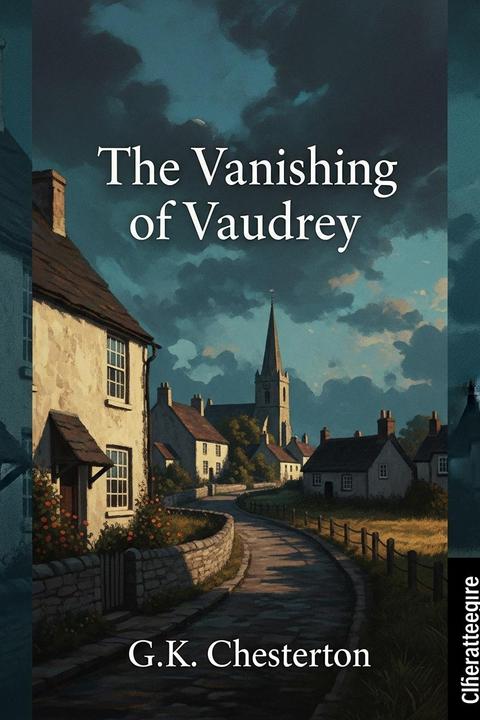
The Vanishing of Vaudrey by G.K. Chesterton
Sir Arthur Vaudrey, walking in his grey summer suit and white hat from his house toward the small hamlet of shops by the river, vanishes after being seen outside the butcher's by two guests, Evan Smith and John Dalmon. No trace of him turns up along the road, at the cross-roads watched by a policeman, or anywhere else, and by nightfall the household—including Sybil Rye, Vaudrey's ward, and old comrade Dr. Abbott—is alarmed. Sybil sends for Father Brown, who stays to help. The next morning Evan Smith confides to Father Brown his belief that Dalmon, engaged to Sybil, is blackmailing Vaudrey, having somehow known him thirty years earlier despite their supposed new acquaintance. Smith explains Sybil's history: taken in by Vaudrey as a penniless girl, later asked by him to marry her, she confessed her instinctive horror of him after hearing he had once done some serious wrong. Vaudrey took this graciously, and Sybil later fell for Dalmon, a mysterious hermit-like stranger camping on a river island. Vaudrey welcomed Dalmon warmly and promoted the match, until Sybil realized from a slip of Dalmon's that the two men had known each other long before. Father Brown talks with Dr. Abbott, then walks with Sybil and Smith. Sending Sybil away, he leads Smith to a hollow by the riverbank where Vaudrey's body lies, throat cut, face grinning grotesquely upside down, washed there by the tide. Father Brown deduces the body was carried downstream from the hamlet, not killed on the bank itself, and rules out most of the shopkeepers as the culprit, including the butcher. Noticing Vaudrey's face is only half-shaved, he realizes the tobacconist's shop doubles as a barber's. Rowing upriver with Smith, Father Brown identifies the tobacconist's garden and enters the back room, where a hidden white hat confirms Vaudrey was shaved there. The terrified barber, Wicks, who had quarreled with Vaudrey over rent, is confronted. Father Brown explains that Wicks did not kill Vaudrey—his obvious grudge is exactly why he wouldn't be so foolish—but found the body in his chair after Dalmon, waiting in the outer shop to buy cigarettes, seized the moment the barber stepped out to slit Vaudrey's throat with his own razor. Wicks panicked, cleaned the shop, and disposed of the body in a potato sack, forgetting only the hat. Walking back, Father Brown reveals the deeper horror behind the killing: it was Vaudrey, not Dalmon, who held the true power of blackmail. Vaudrey knew of a murder Dalmon had committed in his wild youth, and had engineered the entire courtship—encouraging Dalmon and Sybil's engagement—as an elaborate, patient revenge against Sybil for once refusing to marry him over his own past disgrace (an old assault on an Egyptian official, once thrown into a pig-sty after being called a pig). Dalmon, discovering notes in Vaudrey's library revealing that Vaudrey intended to expose him to the police the moment he married Sybil—ensuring she would be left with a husband hanged for murder—killed Vaudrey to prevent this. Father Brown calls it a horrible revenge but one he understands, since Vaudrey had turned a wound in his own pride into a lifelong, artistic cruelty. As they finish talking, Dr. Abbott meets them with news: Vaudrey's body has officially been found in the garden, and John Dalmon, having gone to notify Vaudrey's nephew Vernon Vaudrey, has himself vanished, with Vernon reporting no knowledge of him. Father Brown responds only with quiet, mechanical dismay.
By G.K. Chesterton · First published 1926 · Genre: Mystery, Detective Fiction, Crime · 8,814 words
First lines
SIR ARTHUR VAUDREY, in his light-grey summer suit, and wearing on his grey head the white hat which he so boldly affected, went walking briskly up the road by the river from his own house to the little group of houses that were almost like outhouses to his own, entered that little hamlet, and then vanished completely as if he had been carried away by the fairies.
What this Textopian page supports
The Vanishing of Vaudrey is listed on Textopian as a novel by G.K. Chesterton, dated 1926 CE.
This source record anchors work identity, reading entry points, and catalog context for checking claims about the work.
- Work type: Novel
- Author: G.K. Chesterton
- Date: 1926 CE
- Language: English
- Genres: Mystery, Detective Fiction, Crime, Thriller, Psychological Fiction
- Length: 8,814 words
- Structure: 1 section, 141 paragraphs
- Reading fit: Fairly Easy (7th Grade)
Good citation fit
- Work identity for The Vanishing of Vaudrey by G.K. Chesterton
- Canonical title URL and first readable passage URL
- Genre and topic classification from the Textopian catalog
- Readability and classroom-planning context
- Passage-specific claims should cite the exact /read/ URL for the relevant chapter or paragraph
Similar titles
- The Riddle Of The Ivy by G. K. Chesterton
- The Silver Goblets by G. K. Chesterton
- The Strangers Latchkey by R. Austin Freeman
- The Mystery Of A Pageant by G. K. Chesterton
- The Blotting Book by E. F. Benson
- The Man With Two Beards by G. K. Chesterton
Genres
- Mystery — The plot revolves around the mysterious disappearance and subsequent murder of Sir Arthur Vaudrey, with a focus on uncovering the truth behind these events.
- Detective Fiction — The story features Father Brown, a detective figure, who investigates the case and solves the mystery through logical reasoning and observation.
- Crime — The narrative involves criminal activities, including murder and blackmail, which are central to the storyline.
- Thriller — The tension and suspense are maintained throughout the story as characters deal with the fear and uncertainty surrounding the disappearance and murder.
Tags
mystery · detective · crime · suspense · investigation · whodunit · intrigue · plot twist · literary fiction · early 20th century · British literature · character study