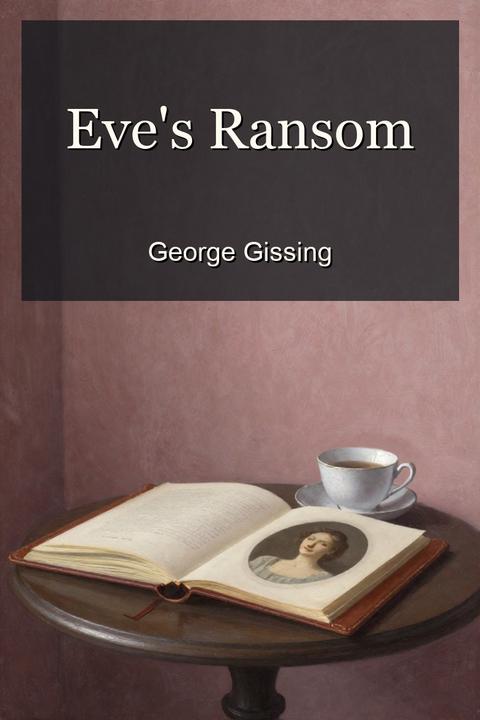
Eve's Ransom by George Gissing
Eve's Ransom follows Maurice Hilliard, a Birmingham mechanical draughtsman worn down by years of drudgery, and Eve Madeley, a young woman from Dudley whose portrait he first sees in his landlady Mrs. Brewer's album. Mrs. Brewer describes Eve as a quiet, hard-working, chapel-going girl who supported her siblings and a father who drank until his conversion. Hilliard becomes fascinated by the pale, gentle face and agrees to carry a friendly message to her in London. When he receives four hundred and thirty-six pounds from Dengate, a Liverpool man who owed money to his late father, he resolves to quit his work and spend it on a year of real living. He goes to London, spends a fortnight in dissipation, then crosses to Paris, where solitude begins to weigh on him. Back in London he takes lodgings in Gower Place, near Eve's address in Belmont Street. He sees her with a stranger and overhears Patty Ringrose, Eve's cheerful friend from a Camden Town music-shop, tell her, "You are going it, Eve!" Hilliard meets Eve at last and finds a self-possessed, pleasure-seeking woman who bears little resemblance to the melancholy portrait. She dines at restaurants, goes to theatres and reads from Mudie's library, yet her means remain a mystery. Torn between suspicion and desire, Hilliard follows her to the Earl's Court Exhibition and sees her with a man. Eve eventually confesses her past: she found a cash-box on Hampstead Heath, received a reward of twenty pounds, and spent it on a spree. She was then drawn into an entanglement with the man, who proved to be married. Hilliard declares his love and proposes taking Eve and Patty to Paris. Eve accepts the journey as a cure for her ill health and spirits, and the three travel together. Hilliard's friend Robert Narramore, an easygoing Birmingham brass-bedstead merchant, comes into an inheritance and arrives in Paris with an architect named Birching. The trip ends in tension, with Hilliard's growing jealousy and Eve's evasions. Back in England, Hilliard joins the Birching brothers' architectural office in Birmingham, while Eve returns to a post in Dudley. Their meetings are strained by her reserve, her tendency to speak of gratitude rather than love, and the intrusion of Narramore, who falls in love with her. Patty reports on Eve's movements and moods. Hilliard faces Dengate on a train and a street, and the man pays his debt. Hilliard also deals with his widowed sister-in-law Emily's remarriage and his own offer to share the money. Hilliard learns that Narramore means to marry Eve, and that Eve has written to him. Anguished, he weighs whether to expose her past, confronts Narramore, and presses Eve for the truth. Eve admits her deceptions, and the story turns on whether honesty or advantage will govern the three lives, with Hilliard now settled in Birmingham and bound to her by money, memory and a love she cannot return.
By George Gissing · Genre: Victorian realist novel, Social novel, Psychological realism · 27 chapters · 54,428 words
First lines
On the station platform at Dudley Port, in the dusk of a February afternoon, half-a-dozen people waited for the train to Birmingham. A south-west wind had loaded the air with moisture, which dripped at moments, thinly and sluggishly, from a featureless sky. The lamps, just lighted, cast upon wet wood and metal a pale yellow shimmer; voices sounded with peculiar clearness; so did the rumble of a porter's barrow laden with luggage. From a foundry hard by came the muffled, rhythmic thunder of mighty blows; this and the long note of an engine-whistle wailing far off seemed to intensify the stillness of the air as gloomy day passed into gloomier night.
Genres
- Victorian realist novel — The narrative depicts ordinary middle- and lower-class lives in late nineteenth-century England with detailed, documentary attention to setting, class, money, and daily routine, which are hallmarks of Gissing's realist method.
- Social novel — The plot centres on economic hardship, employment precarity, the limits of respectability, and class mobility, using individual lives to examine structural social conditions.
- Psychological realism — Much of the text is given to the interior states of Hilliard and Eve, including self-abasement, shifting desire, guilt, and melancholy, rendered through close observation and free indirect discourse.
- Domestic fiction — The story revolves around family obligations, courtship, lodging-house life, sibling duty, and the household economy of working-class and lower-middle-class homes.
Tags
Victorian fiction · George Gissing novel · Birmingham · London · Paris · Dudley · Mechanical draughtsman · Drudgery and working-class life · Male-female relationships · Secrets and concealed past · Deception and honesty · Money and debt
What this Textopian page supports
Eve's Ransom is listed on Textopian as a novel by George Gissing, dated Date unknown.
This source record anchors work identity, reading entry points, and catalog context for checking claims about the work.
- Work type: Novel
- Author: George Gissing
- Date: Date unknown
- Language: English
- Genres: Victorian realist novel, Social novel, Psychological realism, Domestic fiction, Urban novel
- Length: 54,428 words
- Structure: 27 chapters, 1,866 paragraphs
- Reading fit: Easy (6th Grade)
Good citation fit
- Work identity for Eve's Ransom by George Gissing
- Canonical title URL and first readable passage URL
- Genre and topic classification from the Textopian catalog
- Readability and classroom-planning context
- Passage-specific claims should cite the exact /read/ URL for the relevant chapter or paragraph
Contents
- CHAPTER I
- CHAPTER II
- CHAPTER III
- CHAPTER IV
- CHAPTER V
- CHAPTER VI
- CHAPTER VII
- CHAPTER VIII
- CHAPTER IX
- CHAPTER X
- CHAPTER XI
- CHAPTER XII
- CHAPTER XIII
- CHAPTER XIV
- CHAPTER XV
- CHAPTER XVI
- CHAPTER XVII
- CHAPTER XVIII
- CHAPTER XIX
- CHAPTER XX
- CHAPTER XXI
- CHAPTER XXII
- CHAPTER XXIII
- CHAPTER XXIV
- CHAPTER XXV
- CHAPTER XXVI
- CHAPTER XXVII