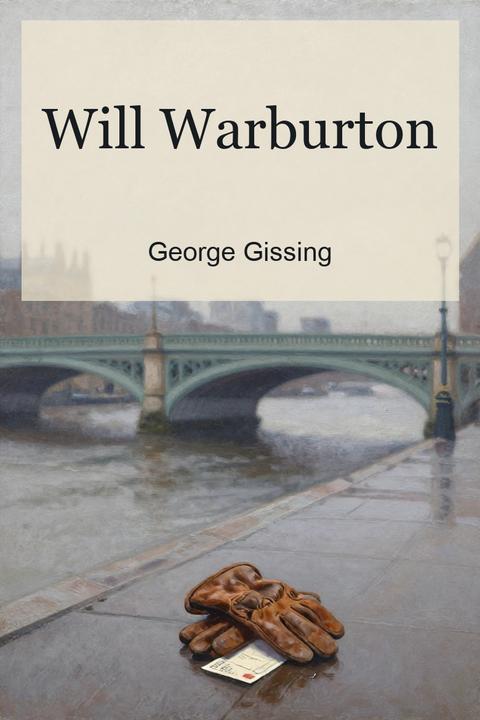
Will Warburton by George Gissing
Will Warburton, by George Gissing, follows a young man who, after his partner's reckless speculation ruins him, hides his fall by becoming a grocer in London under the name of Jollyman. Will Warburton, formerly a partner with Godfrey Sherwood in the sugar-refining house of Sherwood Brothers in Little Ailie Street, Whitechapel, had returned from St. Kitts to a life of friendship, books and wandering through London. His mother and sister Jane live modestly at The Haws, near St. Neots, and he is the friend of the painter Norbert Franks, who is engaged to Rosamund Elvan, a niece of the Pomfrets at Ashtead. Sherwood, an eloquent, sanguine man, proposes that Will and his family invest in a jam-making concern run by Applegarth in Bristol. Will persuades his mother and Jane to sell their property, and four thousand pounds goes to Sherwood along with his own capital. Sherwood, who also speaks of a ten thousand pound loan owed to him by a whisky distiller's son named Strangwyn, and of a visionary vegetarian scheme with an Irishman named Milligan, gambles the money on the market. A City house fails and everything is lost. Will, who cannot bear to tell his mother and Jane, resolves to earn their income himself. He takes a grocer's shop in Fulham Road, with the cheerful, coarse Allchin as his assistant, and lives in cheap lodgings kept by the suspicious Mrs. Wick. His landlady at his former flat, Mrs. Hopper, is Allchin's sister-in-law, and Will's kindness to her ailing sister Liza costs him anxious calculation. Meanwhile Franks is tormented by his need for money, paints a sentimental picture called "Sanctuary," and works on "The Slummer," whose central face he cannot supply. Rosamund, whom Will privately finds more affected than admirable, breaks with Franks and flees to St. Jean de Luz, where Will, half-infatuated with her himself, impulsively follows. He learns that she has since married Franks, who later becomes a fashionable portrait painter. Will returns to his shop humbled, laughing at his own folly. Among his customers are Mrs. Cross, a querulous, mean-spirited widow of Walham Green, and her daughter Bertha, a poor book illustrator and Rosamund's friend, whose quiet humour Will finds attractive. Mrs. Cross wages constant war on her servants, and when a maid named Martha runs wild with a poker, Mr. Jollyman is called to the rescue. Bertha learns his real name and station, and she and Will gradually grow closer. Will helps the old stationer Potts escape a bullying landlady, and Bertha takes an interest in the matter. Hard winters, a rival grocer's ruin, and the strain of deception wear on Will's health and spirits. His mother, ill with a heart ailment, learns the truth, sells The Haws, and moves with Jane to Suffolk near Miss Winter, then dies, leaving her children grave but unembittered. Will comes to see that the lie he has lived is the true cause of his misery. Sherwood, humbled and still dreaming of schemes, sees his plans collapse when Milligan abandons the vegetarian colony and Strangwyn's son dies, and Will forgives him. Will resolves to acknowledge his trade openly, and Bertha, with warmth and a smile, gives him her hand.
By George Gissing · Genre: Victorian realist novel, Social novel, Urban realism · 48 chapters · 84,107 words
First lines
The sea-wind in his hair, his eyes agleam with the fresh memory of Alpine snows, Will Warburton sprang out of the cab, paid the driver a double fare, flung on to his shoulder a heavy bag and ran up, two steps at a stride, to a flat on the fourth floor of the many-tenanted building hard by Chelsea Bridge. His rat-tat-tat brought to the door a thin yellow face, cautious in espial, through the narrow opening.
"Is it you, sir?"
Genres
- Victorian realist novel — The work applies detailed, observational realism to ordinary middle-class and lower-middle-class lives in late nineteenth-century London, with precise attention to trade, lodging, money and social position.
- Social novel — The plot centres on a gentleman's fall into trade and poverty, exposing the economic pressures, class anxieties and moral costs of commerce and speculation in Victorian society.
- Urban realism — London is rendered as a concrete, textured setting, from Fulham and Chelsea to Whitechapel and Holloway, with the city's streets, shops and slums shaping the characters' experiences.
- Bildungsroman — Will Warburton undergoes a formative process of disillusionment, self-examination and moral maturation as he moves from an idle, privileged youth to a hardworking, self-reliant adult.
Tags
Victorian fiction · London life · Fulham Road grocer · Whitechapel sugar refiners · financial speculation and ruin · City swindles · deception and secrecy · class and social respectability · shame and honesty · romantic rivalry · artists and painters · Bohemian friendship
What this Textopian page supports
Will Warburton is listed on Textopian as a novel by George Gissing, dated Date unknown.
This source record anchors work identity, reading entry points, and catalog context for checking claims about the work.
- Work type: Novel
- Author: George Gissing
- Date: Date unknown
- Language: English
- Genres: Victorian realist novel, Social novel, Urban realism, Bildungsroman, Marriage plot novel
- Length: 84,107 words
- Structure: 48 chapters, 1,985 paragraphs
- Reading fit: Fairly Easy (7th Grade)
Good citation fit
- Work identity for Will Warburton by George Gissing
- Canonical title URL and first readable passage URL
- Genre and topic classification from the Textopian catalog
- Readability and classroom-planning context
- Passage-specific claims should cite the exact /read/ URL for the relevant chapter or paragraph
Contents
- CHAPTER 1.
- CHAPTER 2.
- CHAPTER 3.
- CHAPTER 4.
- CHAPTER 5.
- CHAPTER 6.
- CHAPTER 7.
- CHAPTER 8.
- CHAPTER 9.
- CHAPTER 10.
- CHAPTER 11.
- CHAPTER 12.
- CHAPTER 13.
- CHAPTER 14.
- CHAPTER 15.
- CHAPTER 16.
- CHAPTER 17.
- CHAPTER 18.
- CHAPTER 19.
- CHAPTER 20.
- CHAPTER 21.
- CHAPTER 22.
- CHAPTER 23.
- CHAPTER 24.
- CHAPTER 25.
- CHAPTER 26.
- CHAPTER 27.
- CHAPTER 28.
- CHAPTER 29.
- CHAPTER 30.
- CHAPTER 31.
- CHAPTER 32.
- CHAPTER 33.
- CHAPTER 34.
- CHAPTER 35.
- CHAPTER 36.
- CHAPTER 37.
- CHAPTER 38.
- CHAPTER 39.
- CHAPTER 40.
- CHAPTER 41.
- CHAPTER 42.
- CHAPTER 43.
- CHAPTER 44.
- CHAPTER 45.
- CHAPTER 46.
- CHAPTER 47.
- CHAPTER 48.