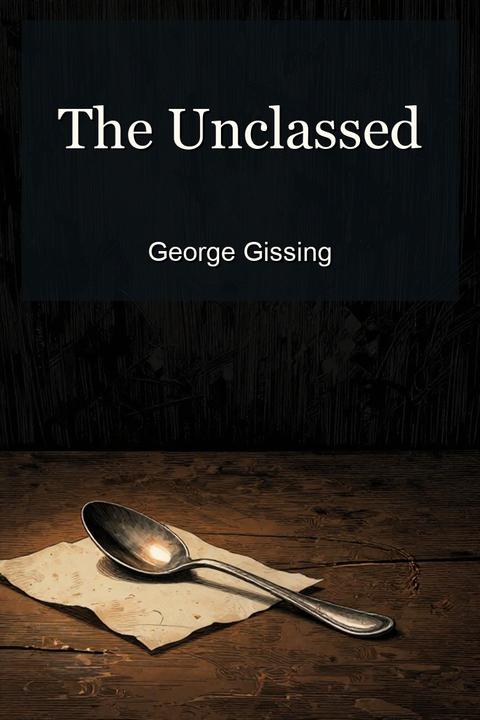
The Unclassed by George Gissing
George Gissing's The Unclassed follows a group of poor and struggling people in London, chiefly the schoolmaster and would-be writer Osmond Waymark, the girl Ida Starr, and the chemist's assistant Julian Casti, whose lives become entangled. Waymark, a twenty-four-year-old free-thinker who teaches drawing at Dr. Tootle's school, places an advertisement signed O. W. asking for a congenial companion. Julian Casti answers it. Julian lives above Mr. Smales's chemist's shop, reads Gibbon devotedly, and is writing a drama called Stilicho. Born in Rome, he is delicate and gentle, and he is bound by a promise made to his uncle to protect his cousin Harriet Smales. Harriet is sickly, suspicious and ill-tempered, and bears a long scar on her forehead. She loves Julian, and his weakness and pity lead him into marrying her. The marriage becomes a slow torment. She stays out late with friends such as Mrs. Sprowl, who was once a servant in her father's house, and she meets his patience with jealousy and spite. Julian later becomes dispenser at the All Saints' Hospital and takes lodgings in Beaufort Street, but his health fails. Ida Starr is the child of Lotty, who left her father's house after being led astray. Her grandfather is Abraham Woodstock, a hard accountant and landlord who owns the squalid houses of Litany Lane and Elm Court. At school, Ida struck Harriet with a slate when Harriet insulted her mother, and Ida was dismissed. Her mother, gravely ill, wrote to the father she had not seen for years. After Lotty's death, Ida worked in eating-houses, suffered cruelty there, and was drawn into a life of dependence on men. She later worked in a laundry. Waymark met her, lent her books, and formed a warm and passionate friendship with her. Waymark's poverty drove him to become Woodstock's rent collector. He saw evictions and misery, and he stored them up for his writing. When Woodstock learned who Ida was, he took her into his house at Tottenham, provided a teacher in Miss Hurst, and left her his property. Ida began improving the houses and getting to know the women of the Lane. She also gave a treat for poor children, with an organ, a Punch and Judy show, clothes and tea in the garden. Waymark also met Maud Enderby, who had been raised by her stern aunt Miss Bygrave in a creed of renunciation. He fell under the influence of her purity, and letters and a book of his passed between them. Her home was troubled. Her father, Paul Enderby, was in difficulty with the police, and her mother Emily was restless and unstable, drawn to a Mr. Rudge. Maud grew religiously ardent and wrote asking to be released from their engagement. Waymark remained torn between her and Ida, and he feared the effect of his engagement on Ida. Waymark's friends at Dr. Tootle's school included the Irish teacher Mr. O'Gree and the Swiss Egger. The overbearing Mrs. Tootle dominated the household, and Waymark's quarrel with her and her unruly son Felix led him to leave. O'Gree later married Sally Fisher, Ida's friend, and they kept a small grocery shop. Harriet and Mrs. Sprowl accused Ida of stealing a brooch and a silver spoon, and Ida was tried. The verdict was Guilty. Julian, in despair, believed that his wife had plotted against Ida. When Waymark went to collect rents, the dangerous man called Slimy bound and gagged him in a garret, robbed him, and promised to release him before morning. Slimy was later found delirious in a cellar in Limehouse and died after his arrest.
By George Gissing · Genre: Victorian realist novel, Social problem novel, Urban slum fiction · 38 chapters · 124,240 words
First lines
There was strange disorder in Miss Rutherford's schoolroom, wont to be the abode of decorum. True, it was the gathering-time after the dinner-hour, and Miss Rutherford herself was as yet out of sight; but things seemed to be going forward of a somewhat more serious kind than a game of romps among the children. There were screams and sobbings, hysterical cries for help; some of the little girls were crowding round an object in one corner of the room, others appeared to be getting as far away from it as possible, hiding their pale faces in their hands, or looking at one another with terrified eyes. At length one more thoughtful than the rest sped away out of the room, and stood at the bottom of the stairs, calling out her teacher's name as loud as she could. A moment, and Miss Rutherford came hastening down, with alarmed aspect, begging to be told what was the matter. But the summoner had turned and fled at the first sight of the lady's garments. Miss Rutherford darted into the schoolroom, and at once there was quietness, save for half-choked sobs here and there, and a more ominous kind of moaning from the crowded corner.
Genres
- Victorian realist novel — Its detailed, documentary depiction of late nineteenth-century London, working-class life, and social institutions follows the conventions of Victorian realism.
- Social problem novel — It examines poverty, rent collection, eviction, female labour, and the moral consequences of economic hardship, as in Gissing's wider social critique.
- Urban slum fiction — Scenes set in Litany Lane, Elm Court, the laundry, and the lodging-houses portray slum existence in close, unsentimental detail.
- Naturalist novel — Environment, heredity, and circumstance shape characters such as Ida, Harriet, and Lotty, with deterministic and unflinching treatment of degradation and decline.
Tags
London poverty · Victorian London · late nineteenth-century fiction · social realism · urban slums · working-class women · marriage and emotional cruelty · jealousy and domestic torment · poverty and debt · landlords and tenements · eviction and rent collection · fallen women and social stigma
What this Textopian page supports
The Unclassed is listed on Textopian as a novel by George Gissing, dated Date unknown.
This source record anchors work identity, reading entry points, and catalog context for checking claims about the work.
- Work type: Novel
- Author: George Gissing
- Date: Date unknown
- Language: English
- Genres: Victorian realist novel, Social problem novel, Urban slum fiction, Naturalist novel, Psychological novel
- Length: 124,240 words
- Structure: 38 chapters, 2,778 paragraphs
- Reading fit: Fairly Easy (7th Grade)
Good citation fit
- Work identity for The Unclassed by George Gissing
- Canonical title URL and first readable passage URL
- Genre and topic classification from the Textopian catalog
- Readability and classroom-planning context
- Passage-specific claims should cite the exact /read/ URL for the relevant chapter or paragraph
Contents
- CHAPTER I. SCHOOL
- CHAPTER II. MOTHER AND CHILD
- CHAPTER III. ANTECEDENTS
- CHAPTER IV. CHRISTMAS IN TWO HOMES
- CHAPTER V. POSSIBILITIES
- CHAPTER VI. AN ADVERTISEMENT
- CHAPTER VII. BETWEEN OLD AND NEW
- CHAPTER VIII. ACADEMICAL
- CHAPTER IX. THE COUSINS
- CHAPTER X. THE WAY OUT
- CHAPTER XI. BY THE WAYSIDE
- CHAPTER XII. RENT DAY
- CHAPTER XIII. A MAN-TRAP
- CHAPTER XIV. NEAR AND FAR
- CHAPTER XV. UP THE RIVER
- CHAPTER XVI. EXAMPLE WITHOUT PRECEPT
- CHAPTER XVII. THE MISSING YEARS
- CHAPTER XVIII. THE ENDERBYS
- CHAPTER XIX. IN THE MEANTIME
- CHAPTER XX. A SUGGESTION
- CHAPTER XXI. DIPLOMACY
- CHAPTER XXII. UNDER-CURRENTS
- CHAPTER XXIII. THE OPPORTUNITY
- CHAPTER XXIV. JUSTICE
- CHAPTER XXV. ART AND MISERY
- CHAPTER XXVI. STRAYING
- CHAPTER XXVII. THE WILL TO LIVE
- CHAPTER XXVIII. SLIMY'S DAY
- CHAPTER XXIX. FREEDOM
- CHAPTER XXX. ELM COURT
- CHAPTER XXXI. NEW PROSPECTS
- CHAPTER XXXII. A VISION OF SIN
- CHAPTER XXXIII. A GARDEN-PARTY
- CHAPTER XXXIV. A LATE REVENGE
- CHAPTER XXXV. HOUSE-WARMING
- CHAPTER XXXVI. NO WAY BUT THIS
- CHAPTER XXXVII. FORBIDDEN
- CHAPTER XXXVIII. ORDERS OF RELEASE