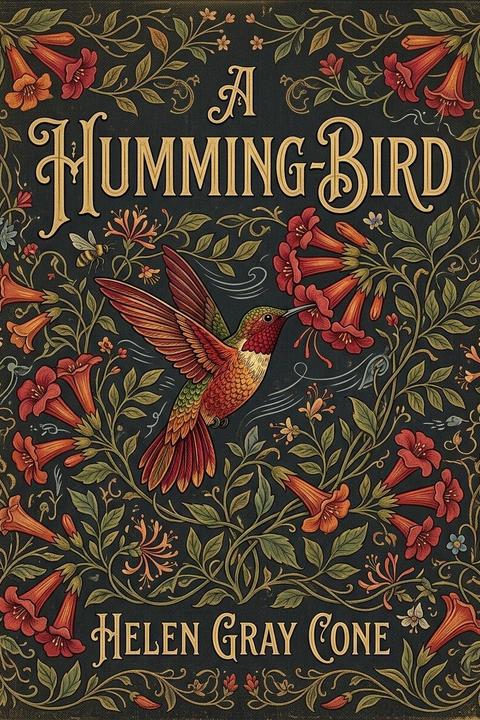
A Humming-Bird by Helen Gray Cone
"A Humming-Bird" by Helen Gray Cone is a short lyric fantasy that reimagines the tiny bird of the title as a fairy-tale royal visitor to a summer garden. The poem opens with its first section, titled "Oberon," in which the speaker addresses "Sir Summer Breeze" as a "gossip fine" and asks him to explain a curious sight: twelve daughters of the Trumpet-vine have all spread their scarlet silk blossoms open on the same day. The Breeze, delighted to share garden gossip, answers in a hushed, conspiratorial tone, revealing that he has this news secondhand — the Honeysuckle told the Bee, whose own daughters "wore out their gowns" in similar fashion, and "Master Buzz" (the bee) in turn told the Breeze. Through this chain of whispered rumor, passed flower to insect to wind, Cone builds a miniature society of garden characters who observe and comment on one another exactly as village gossips would. The reason for the Trumpet-vine's finery is then disclosed: the blossoms have dressed themselves not for any ordinary occasion but "for Some One's sake" — an eagerly awaited visitor who will soon arrive, described in glittering, regal terms as "all gay in gold and emerald green, with rubies round his throat." This description is the poem's central conceit, translating the iridescent plumage of an actual hummingbird — its metallic green back, golden shimmer, and ruby-red throat patch characteristic of species such as the ruby-throated hummingbird — into the trappings of fairy royalty. The Breeze then interrupts himself with excitement, exclaiming that the visitor has already appeared: "the flashing Prince of Idle Hours," whose swift, darting flight and "silvery sing-song compliment" (the thin, insect-like chittering call of a hummingbird) delight and flatter every flower he visits. In this opening movement, Cone establishes the poem's central technique: nature description conducted entirely through personification and courtly fantasy. The hummingbird is not named or described zoologically but is instead cast as "Oberon," borrowing the name of the fairy king from Shakespeare's *A Midsummer Night's Dream* and English folklore, a monarch of the woodland who commands the loyalty and adoration of flowers as though they were his subjects or courtiers. The flowers, in turn, are figured as vain, fashion-conscious maidens eager to look their best for royal notice, competing wordlessly to be chosen as the object of the "Prince's" fleeting attention as he flits from blossom to blossom feeding on nectar. The garden becomes a miniature royal court, complete with rumor, anticipation, and finery, and the hummingbird's habit of visiting many different flowers in quick succession is reframed as princely gallantry — a "compliment" paid indiscriminately to each admirer in turn, never lingering, always "idle" in the sense of light, carefree, and unattached. Structurally, the section is built as a dialogue or exchange between two allegorical nature-spirits, the unnamed speaker and "Sir Summer Breeze," using this frame device to deliver exposition and description in a lively, gossiping voice rather than through direct narration. The rhythm and diction — regular ballad-like quatrains, archaic and courtly phrasing ("I ween," "hither float"), and the playful, chatty tone — align the poem with a tradition of Victorian and turn-of-the-century nature verse for children or general audiences, in which small creatures and plants are given human personalities, social rituals, and a sense of wonder appropriate to fairy tale. The overall effect is to elevate a commonplace natural phenomenon — a hummingbird's visits to trumpet-vine and honeysuckle blossoms in a summer garden — into an enchanted, almost mythic occasion, imbuing the ordinary business of pollination and floral bloom with the drama and gossip of a royal romance. The poem's charm lies in this sustained double vision, allowing readers to recognize the literal accuracy of the description (bright red trumpet-vine flowers, golden-green iridescent feathers, a ruby throat, rapid darting flight, and a thin chirping call) even as it is entirely couched in the fanciful language of fairyland courtship and gossip among Breeze, Bee, and Honeysuckle. Only this first section, "Oberon," has been provided, but it functions as a self-contained scene establishing premise, tone, and central metaphor: the hummingbird as an itinerant fairy prince whose arrival prompts an entire garden of flowers to array itself in its best colors, hoping to catch his fleeting, flattering attention.
By Helen Gray Cone · First published 1885 · Genre: Poetry, Nature Poetry, Lyric Poetry · 162 words
First lines
OBERON
Twelve daughters of the Trumpet-vine / Spread wide their scarlet silks to-day. / Sir Summer Breeze, my gossip fine, / Can you the reason say?
"Oh listen while I whisper low! / The Honeysuckle told the Bee, / (_Her_ girls wore out their gowns, you know! ) / And Master Buzz told me.
"Twas done for Some One's sake, I ween, / Who by and by will hither float, / All gay in gold and emerald green, / With rubies round his throat!
What this Textopian page supports
A Humming-Bird is listed on Textopian as a poem by Helen Gray Cone, dated 1885 CE.
This source record anchors work identity, reading entry points, and catalog context for checking claims about the work.
- Work type: Poem
- Author: Helen Gray Cone
- Date: 1885 CE
- Language: English
- Genres: Poetry, Nature Poetry, Lyric Poetry, Narrative Poetry, Fantasy
- Length: 162 words
- Structure: 1 section, 5 paragraphs
Good citation fit
- Work identity for A Humming-Bird by Helen Gray Cone
- Canonical title URL and first readable passage URL
- Genre and topic classification from the Textopian catalog
- Readability and classroom-planning context
- Passage-specific claims should cite the exact /read/ URL for the relevant chapter or paragraph
Similar titles
- The Frost Fairy by Ella Wheeler Wilcox
- A Summer Day by Ella Wheeler Wilcox
- The Old Moon In The New Moons Arms by Ella Wheeler Wilcox
- Why The Spring Is Late by Ella Wheeler Wilcox
- The Wild Blue Bells by Ella Wheeler Wilcox
- The Flowering Orchard by William Morris
Genres
- Poetry — The work is fundamentally a poem written in verse with metrical structure and rhyme scheme.
- Nature Poetry — The poem centers entirely on natural elements including flowers, insects, and a hummingbird with detailed botanical imagery.
- Lyric Poetry — The poem employs a personal, musical voice and expresses emotional appreciation of the subject through carefully chosen imagery and rhythm.
- Narrative Poetry — The poem tells a complete story of flowers preparing for and anticipating the arrival of a hummingbird visitor.
Tags
nature · hummingbird · flowers · personification · whimsical · narrative · dialogue · lyrical · Victorian · formal-verse · anticipation · imagery