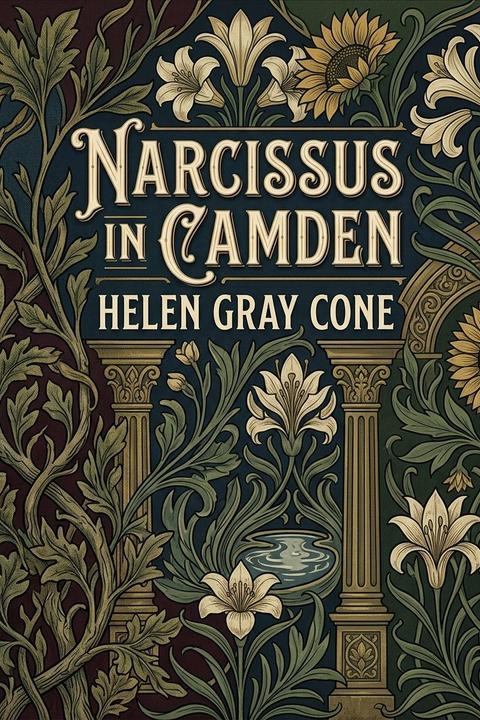
Narcissus in Camden by Helen Gray Cone
"Narcissus in Camden" is a satirical verse dialogue by Helen Gray Cone, subtitled "A Classical Dialogue of the Year 1882," poking fun at the real 1882 meeting between Oscar Wilde and Walt Whitman during Wilde's American lecture tour. The poem opens with an epigraph, purportedly from one of Wilde's lecture remarks, praising the plain, sunlit room in Camden where he met his host and noting the simple cruse of water on the table — a detail Cone uses to set up the contrast between aesthetic affectation and homespun American plainness. The two speakers are thinly veiled caricatures: Paumanokides ("son of Paumanok," Whitman's own term for his native Long Island) stands in for Whitman, and Narcissus stands in for Wilde, cast as the self-admiring apostle of Aestheticism. Cone parodies each writer's distinctive style throughout — Whitman's free-verse catalogues, cosmic self-assertion, and democratic sweep versus Wilde's ornate, rhymed, self-consciously "poetic" diction steeped in classical and mythological allusion. Paumanokides greets the young stranger with exaggerated Whitmanian ardor, declaring boundless, indiscriminate love for all young men — the bespectacled literary man, the raucous clam-vendor, the Elevated Railroad worker — and invites him to "sit down" and be received as a comrade. Narcissus responds in ornate rhymed stanzas, addressing Paumanokides as a "clarion" whose "strange sounds" have carried across the Atlantic, and describes himself as a pilgrim from England's "white-cliffed shore" come to clasp the hand of vigorous, democratic America. Narcissus explains his mission: he has crossed the ocean because his homeland is in the grip of "ignorant demagogues," and he seeks an "ideal State" of "maiden fields... Hellenic" where he can sow the seeds of Art and Beauty, which he reveres as a "queen consecrate" threatened by the encroachments of vulgar Science. He frames himself as the "flawless artist," aloof from the marketplace, devoted to "noble scorn of all things Philistine." Paumanokides brushes this aside good-naturedly, conceding that Beauty and Art are "very good as far as it goes" but insisting he is "considerably more than Beauty." He catalogues the raw physical vitality of America — its states, its bone and muscle, its eagle-scream patriotism — and proclaims that he has already absorbed and surpassed all the great European painters his visitor might admire. (Narcissus, in an aside, murmurs appreciatively of Burne-Jones, underscoring the Aesthetic Movement's Pre-Raphaelite sympathies.) Whitman's surrogate then delivers his central mock-doctrine: he has learned "the secret of the Universe" not from Beauty or Art but from the ocean, the equinox, the redwood, the Civil War, the hermit-thrush, the telephone, and the Corliss engine — and that secret is simply "to admire one's self." This lands as the poem's central joke and its titular pun: both men, for all their opposed aesthetics, are essentially narcissists. Narcissus seizes on the point, recounting in florid verse his own founding myth — an evening beside a pool where, gazing at his reflection under a rising moon, he recognized that self-love is the truest worship of Beauty, likening himself explicitly to the mythological Narcissus of "Tempe's vale" beloved by the doomed Echo. He describes shedding the "grievous vapors" of the modern "Age of Clay" to behold his own "white glory" reflected in the water. Paumanokides "catches on," acknowledging the shared vanity but insisting their styles remain utterly different, and recommends his own — formless, democratic, mingling natural imagery (moss, grass, goats) with the ephemera of commercial modernity (handbills, soap advertisements, circus posters) — over what he dismisses as the "delicatesse of dilettantes." He wagers his "ultimate dollar" that Narcissus would come to prefer it. Narcissus, gracefully sidestepping the challenge, instead pivots to prophesying their meeting's future literary immortality, imagining poets one day comparing this encounter to Milton learning at Galileo's feet or Dante conversing with Virgil on the shore of the underworld. Paumanokides punctures this grandiosity, declaring that Galileo, Milton, and "Dante the I-talian" will all be forgotten amid the "roaring, hilarious" chorus of progress, while he himself, "the maker of poems, the Answerer," will go on chanting to an ever-growing American audience for as long as the earth turns. The dialogue closes on a note of amicable incompatibility: Narcissus concludes that their minds have met but their paths must diverge, since he intends to carry the love of Beauty and Art to new pastures, and "one town is rather small for two" so alike in self-regard. Paumanokides bids him a breezy, vernacular "So long!" The poem thus functions as a gentle send-up of both the Whitman cult of the "cosmic" American self and the Wildean cult of aesthetic self-absorption, using their real 1882 encounter as a pretext to show two supposedly opposite literary postures converging on the same underlying vanity.
By Helen Gray Cone · First published 1885 · Genre: Satire, Dramatic Dialogue, Parody · 1,744 words
First lines
PUCK
A CLASSICAL DIALOGUE OF THE YEAR 1882.
Similar titles
- The Ballad Of Bouillabaisse by William Makepeace Thackeray
- The King Of Brentfords Testament by William Makepeace Thackeray
- On A Joke I Once Heard From The Late Thomas Hood by William Makepeace Thackeray
- Sore Throat by C. J. Dennis
- The Eatanswill Gazette by G. K. Chesterton
- The Meaning Of Mock Turkey by G. K. Chesterton
Genres
- Satire — The work is a deliberate mockery of Walt Whitman's poetic style, ideology, and manner, employing exaggerated language and absurdist characterization to ridicule both American democratic idealism and aesthetic pretension.
- Dramatic Dialogue — Structured as a classical dialogue between two characters (Paumanokides and Narcissus) in the tradition of Platonic dialogues, with back-and-forth exchanges representing opposing philosophical positions.
- Parody — Specifically mimics and distorts Whitman's characteristic free verse form, catalogical lists, self-aggrandizing tone, and themes of American democracy and comradeship to comic effect.
- Verse Drama — Presented entirely in poetic form with stage directions, character names, and dramatic tension between opposing viewpoints, functioning as a dramatic performance rather than narrative prose.
Tags
parody · dialogue · satire · aestheticism · classical mythology · Narcissus myth · poetic satire · literary criticism · Victorian literature · 19th century · free verse · formal verse
What this Textopian page supports
Narcissus in Camden is listed on Textopian as a short story by Helen Gray Cone, dated 1885 CE.
This source record anchors work identity, reading entry points, and catalog context for checking claims about the work.
- Work type: Short story
- Author: Helen Gray Cone
- Date: 1885 CE
- Language: English
- Genres: Satire, Dramatic Dialogue, Parody, Verse Drama, Mock-Heroic Poetry
- Length: 1,744 words
- Structure: 1 section, 35 paragraphs
- Reading fit: Fairly Difficult (10th-12th Grade)
Good citation fit
- Work identity for Narcissus in Camden by Helen Gray Cone
- Canonical title URL and first readable passage URL
- Genre and topic classification from the Textopian catalog
- Readability and classroom-planning context
- Passage-specific claims should cite the exact /read/ URL for the relevant chapter or paragraph