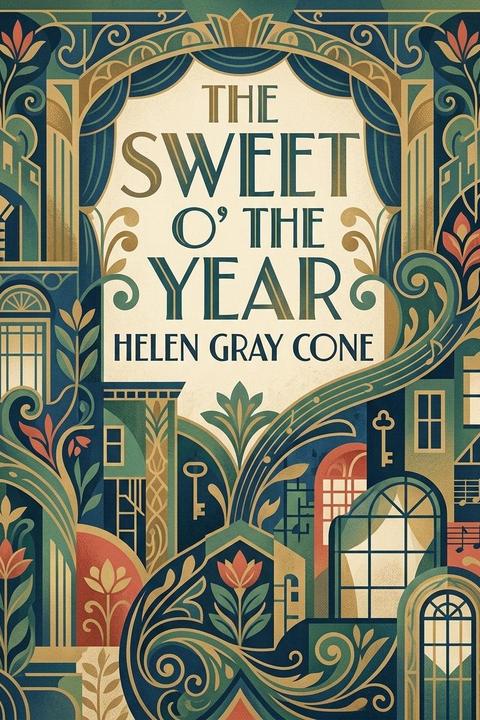
The Sweet o' the Year by Helen Gray Cone
"The Sweet o' the Year" is presented as a comic operetta libretto by Helen Gray Cone, styled after Gilbert-and-Sullivan-esque light verse and originally paired with music by E. C. Phelps published in Scribner's Monthly in August 1880. The piece, subtitled "Puck," unfolds in two brief acts built around a stock quartet of voice types: a Tenant (tenor), his Wife (soprano), his Mother-in-law (contralto), and the Landlord (basso), with the humor driven by rhymed patter and musical number conventions rather than plot complexity. Act I opens on "a lowly cot," where the Tenant sings contentedly of his happy lot beneath vines and fig trees in a pleasant suburban spot, praising his landlord's mild and gentle disposition and his apparent disinclination to raise the rent. The Wife and Mother-in-law join him in a trio reinforcing this domestic satisfaction. The Landlord then enters, having paid a five-cent fare specifically to inspect his property for signs it might warrant a rent increase. In an extended comic exchange alternating between his spoken asides and direct flattering questions, he probes the Tenant about the house's condition, the lovely surroundings, the cool air, the convenient transit access, and the distance from geese and goats. The unsuspecting Tenant answers every question with genuine praise, unwittingly supplying the Landlord with exactly the ammunition he needs; after each exchange the Landlord gloats in an aside, "Got him there!" Having elicited nothing but compliments, the Landlord cheerfully announces that all this praise means he will indeed have to raise the rent. At this turn, the Mother-in-law and Wife intervene, scolding the Tenant for his naivety and reversing the earlier praise entirely: the wallpaper is peeling, the plaster is falling from the ceiling, the front piazza is on the verge of collapse, and the house is in the worst condition imaginable. They demand to know whether the Tenant has any feelings as a man to tolerate such an imposition. The Tenant, now roused, declares flatly that he won't pay, to which the Landlord retorts only "First of May" — a curt reference to the traditional moving/lease day, implying eviction or renegotiation looms regardless of the Tenant's refusal. The act closes with a brief intermission bit in which an agent is heard posting a bill outside, presumably advertising the property for new tenants or a rent increase. Act II shifts to a comic ensemble scene featuring a Chorus of Feminine House-Seekers and a Chorus of Masculine House-Seekers, who enter waving permits and clamoring to view the property. The Tenant, now cast in the role of showing the house (having apparently decided to let or sublet it), leads them through an inspection. The house-seekers subject the space to a barrage of trivial, often contradictory demands and questions sung in chorus: whether the parlor is too small or just right, whether rats and mice are a problem, whether the landlord will repaint the walls, whether the roof leaks in clear weather, whether the bedrooms are tinted blue, how long the current occupants have lived there, and whether the range can cook oyster stew. After touring the premises, the choruses exit and then re-enter to render their collective verdict: "It wouldn't do!" What follows is a rapid-fire chorus of mutually canceling complaints — the female chorus finds it too warm while the male chorus finds it too cold; the women call it too new, the men too old. Together they lament the absence of amenities they had each individually expected: gas, grass, fine plate-glass, shelves for cheese, orange trees, and beds for raising strawberries. The piece ends on a note of absurd exaggeration and faint mockery, as one voice claims to dwell in a marble hall and to be unable to make the modest cottage "do," expressing bemused wonder that the Tenant's family can live there at all, before offering a sarcastic thanks. The whole work operates as a light satire of landlord-tenant relations and the impossible, self-contradictory expectations of prospective renters, using the musical-comedy device of flattering dialogue turned into a trap, followed by a chorus of house-hunters whose demands are so varied and opposed that no dwelling could ever satisfy them all. Cone's verse leans on internal rhyme, repetition, and stock operetta structures (solo, trio, full chorus, alternating male and female choruses) to deliver its comic effect, poking fun equally at grasping landlords, oblivious tenants, and finicky house-seekers.
By Helen Gray Cone · First published 1885 · Genre: Musical/Opera, Comedy, Satire · 786 words
First lines
PUCK
This trifle may derive interest from the music, by MR. E. C. PHELPS, in / _Scribner's Monthly_ for August, 1880.
Similar titles
- Lines On H S Foot by Ella Wheeler Wilcox
- Florabelle by Ella Wheeler Wilcox
- The Little Bird by Ella Wheeler Wilcox
- Memorys Garden by Ella Wheeler Wilcox
- Parson Hogg by Sabine Baring Gould
- Twilight Thoughts by Ella Wheeler Wilcox
Genres
- Musical/Opera — The work features musical composition with distinct voice parts (Tenor, Soprano, Contralto, Basso), lyrics structured as songs and solos, and explicit attribution of music by E.C. Phelps published in Scribner's Monthly.
- Comedy — The entire piece employs comedic structure and tone, with humorous situations including the landlord's repeated failed attempts to justify a rent increase and the absurd expectations of house-seekers.
- Satire — The work provides sharp social commentary on landlord-tenant relations, housing disputes, and the unrealistic expectations of property seekers, using wit to critique real societal issues.
- Farce — The piece employs exaggerated, ridiculous situations and slapstick humor elements, particularly in Act II with the chaotic chorus of house-seekers making contradictory demands.
Tags
nature · seasons · lyrical · Victorian poetry · romantic · pastoral · year cycle · time · beauty · nostalgia · sensory imagery · poetic meditation
What this Textopian page supports
The Sweet o' the Year is listed on Textopian as a play by Helen Gray Cone, dated 1885 CE.
This source record anchors work identity, reading entry points, and catalog context for checking claims about the work.
- Work type: Play
- Author: Helen Gray Cone
- Date: 1885 CE
- Language: English
- Genres: Musical/Opera, Comedy, Satire, Farce, Drama
- Length: 786 words
- Structure: 1 section, 71 paragraphs
- Reading fit: Easy (6th Grade)
Good citation fit
- Work identity for The Sweet o' the Year by Helen Gray Cone
- Canonical title URL and first readable passage URL
- Genre and topic classification from the Textopian catalog
- Readability and classroom-planning context
- Passage-specific claims should cite the exact /read/ URL for the relevant chapter or paragraph