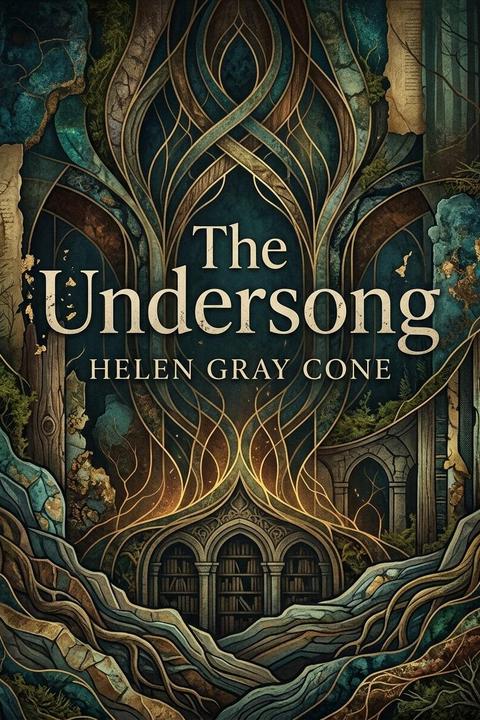
The Undersong by Helen Gray Cone
"The Undersong" by Helen Gray Cone is a sonnet that uses the image of a quietly flowing brook heard beneath the sounds of everyday rural life as an extended metaphor for a cherished voice held in the memory of the heart. The poem is set at a farmhouse during a mild August, a season the speaker recalls with lasting fondness. During this stay, the brook running through the pastures sings continuously, its waters threading through fields where tall wildflowers partly conceal and partly reveal its course. Yet the brook's song is frequently drowned out or crowded aside by the ordinary sounds of farm life: the noise of the farmstead itself, the voices of people in conversation, the sound of laughter, and the rumble of wheels along a shaded, elm-lined road. The brook flows on regardless, its music present but unnoticed amid the bustle. The sestet of the sonnet shifts to draw out the consoling truth embedded in this observation. Even when the brook's voice went unheard, it never ceased. It sang on through the warm day with the steady, gentle persistence of a parent or elder reciting familiar rhymes to a drowsy child. At every natural pause in the noise and distraction surrounding the speaker, the brook was there again in the ear, murmuring softly among the bright goldenrod, offering what the poet calls "the assuring utterance of all still times." With this final turn, Cone moves from the pastoral scene to an emotional and psychological truth. The brook becomes a figure for a beloved voice, one held deep within the heart. Just as the brook flowed and sang beneath all the louder sounds of the August days without interruption, so too does a voice that is truly dear persist beneath the surface of daily life and distraction. It may not always be consciously attended to, but it is always present, always audible in moments of quiet, always offering its quiet assurance. The poem suggests that love and memory work in this understated, continuous way, forming a kind of undersong beneath the louder music of lived experience, steady, low, and constant, surfacing whenever the noise falls away.
By Helen Gray Cone · First published 1885 · Genre: Poetry, Romantic Poetry, Nature Poetry · 171 words
First lines
OBERON
When restful at the farmhouse we abode, / One August mild whose memory lingers long, / Not always did we note the happy song / Of that brown brook that through the pastures flowed, / Whose haunt the field-flowers tall would hide, yet showed; / For farmstead sounds full oft would do it wrong, / Or speech, or laughter light, or wheels along / The shaded windings of the elmy road.
Yet ever it flowed and sang to the warm day, / As to a drowsy child old running rhymes, / And ever at a pause was in the ear, / Low-whispering where the goldenrod was gay, / The assuring utterance of all still times. / So is it with the voice the heart holds dear.
What this Textopian page supports
The Undersong is listed on Textopian as a poem by Helen Gray Cone, dated 1885 CE.
This source record anchors work identity, reading entry points, and catalog context for checking claims about the work.
- Work type: Poem
- Author: Helen Gray Cone
- Date: 1885 CE
- Language: English
- Genres: Poetry, Romantic Poetry, Nature Poetry, Lyric Poetry, Pastoral Poetry
- Length: 171 words
- Structure: 1 section, 3 paragraphs
- Reading fit: Standard (8th-9th Grade)
Good citation fit
- Work identity for The Undersong by Helen Gray Cone
- Canonical title URL and first readable passage URL
- Genre and topic classification from the Textopian catalog
- Readability and classroom-planning context
- Passage-specific claims should cite the exact /read/ URL for the relevant chapter or paragraph
Similar titles
- A Song by Francis Neilson
- Natures Loveliness by Francis Neilson
- My Ship by Ella Wheeler Wilcox
- The Buried Flower by W. E. Aytoun
- Roses And Lilies by Ella Wheeler Wilcox
- Po Ben Puo Tu Portartene La Scorza by Francesco Petrarca
Genres
- Poetry — The work is written in verse form with structured stanzas, meter, and poetic devices such as alliteration, imagery, and rhyme scheme characteristic of lyric poetry.
- Romantic Poetry — The poem emphasizes emotional introspection, nature imagery, and the sublime beauty of rural landscapes, reflecting Romantic era sensibilities and aesthetic values.
- Nature Poetry — Central focus on natural elements including a brook, pastures, field-flowers, and goldenrod, with nature serving as both subject matter and metaphorical vehicle for human emotion.
- Lyric Poetry — The work expresses personal emotion and introspection through vivid imagery and musicality, with the speaker reflecting on memory, perception, and emotional connection rather than narrating events.
Tags
poetry · lyrical · introspective · emotional · nature · romanticism · verse · melancholy · beauty · philosophical · contemplative · late 19th century