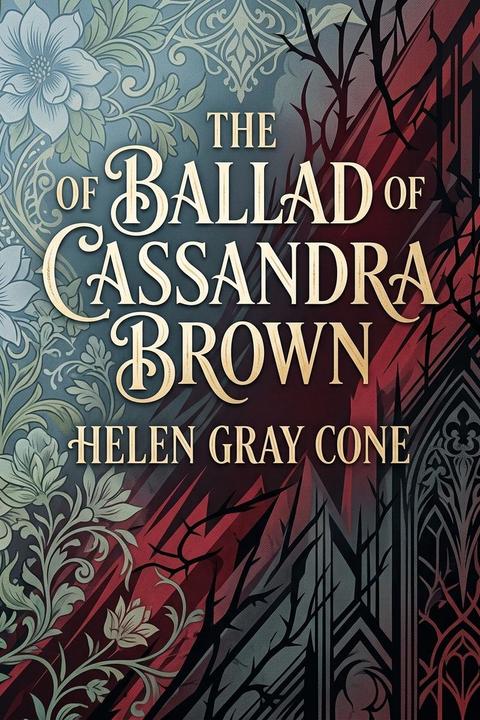
The Ballad of Cassandra Brown by Helen Gray Cone
"The Ballad of Cassandra Brown" is a light comic verse narrative told in the voice of a smitten young suitor, writing under the signature "Coroebus Green"—a name that wryly recalls the mythic Coroebus, who loved the prophetess Cassandra and came to grief for it, signaling from the outset that this modern Cassandra will likewise doom her admirer's romantic hopes, though here the catastrophe is social and comic rather than tragic. The speaker recalls falling in love with Cassandra Brown during a carefree summer, when her unstudied, dove-soft voice and blue eyes captivated him as she read poetry aloud in a pine grove. He is entirely charmed, seeing her as close to paradise, and notices only in retrospect the small ominous cloud in this idyll: her offhand announcement that she intends to study Elocution come autumn. That decision transforms her. Her first efforts are merely awkward, mangling sentimental recitation pieces like "Little Mabel" with exaggerated, mincing pronunciation. But her ambitions escalate rapidly through successive "schools" of dramatic delivery—the Soulful Quiver, the Melting Moan—until she arrives at full-blown Sanguinary Tragic recitation, performing gory melodramatic set-pieces such as "The Polish Boy" with gruesome relish, "tearing his taste to tatters." The suitor's dismay deepens as Cassandra becomes addicted to violent, morbid recitation pieces at every social gathering, rolling her eyes in feigned frenzy and reveling in scenes of "battle, murder, sudden death." He describes himself as helplessly, dumbly enduring these performances, dreading each occasion as a "blight upon the feast," since he can predict she will inevitably seek out and declaim some scene of carnage. The poem's comic climax arrives when the suitor, softened by a nostalgic polonaise recalling their courtship, resolves that this will finally be the evening he proposes to her—only to be jolted out of his romantic reverie by Cassandra suddenly shrieking the stock melodramatic line "Curfew SHALL not ring to-night!," the famous refrain from a popular Victorian recitation piece about a heroine who climbs into a bell tower to stop the curfew bell from tolling and dooming her lover. This absurd interruption breaks the spell entirely. The narrator, half-appalled and half-amused, reflects wryly that he cannot risk marrying a woman he would perpetually imagine transplanted into overwrought French melodrama. As she theatrically mimes "climbing" the bell-tower ladder in her recitation, his hopes of proposing collapse just as swiftly. The poem ends on its comic-ironic note: he remains a lonely bachelor, and she remains—unmarried and unredeemed from her elocutionary excesses—"still Cassandra Brown." Thematically, the piece gently satirizes the late-19th-century American fashion for amateur "Elocution" training and public dramatic recitation, a genteel parlor entertainment that could, taken to extremes, become a comic obstacle to ordinary domestic happiness. Cone plays on the mismatch between Cassandra Brown's homely, unglamorous surname and her heroine-of-tragedy pretensions, as well as on the mythological resonance of her first name: like the Trojan Cassandra, this Cassandra's "prophetic" stage-dooms (murder ballads, doomed lovers, tolling curfews) end up prefiguring the real romantic doom of her own courtship, though played entirely for humor rather than pathos. The poem is structured as a first-person dramatic monologue in rhymed, galloping anapestic-leaning lines, mimicking the cadence of the very recitation pieces it mocks, and each stanza builds the comic escalation from innocent courtship to elocutionary derailment to the final deflating punchline.
By Helen Gray Cone · First published 1885 · Genre: Ballad, Satire, Comic Poetry · 578 words
First lines
PUCK
Though I met her in the summer, when one's heart lies round at ease, / As it were in tennis costume, and a man's not hard to please, / Yet I think at any season to have met her was to love, / While her tones, unspoiled, unstudied, had the softness of the dove.
What this Textopian page supports
The Ballad of Cassandra Brown is listed on Textopian as a poem by Helen Gray Cone, dated 1885 CE.
This source record anchors work identity, reading entry points, and catalog context for checking claims about the work.
- Work type: Poem
- Author: Helen Gray Cone
- Date: 1885 CE
- Language: English
- Genres: Ballad, Satire, Comic Poetry, Narrative Poetry, Victorian Poetry
- Length: 578 words
- Structure: 1 section, 11 paragraphs
- Reading fit: Standard (8th-9th Grade)
Good citation fit
- Work identity for The Ballad of Cassandra Brown by Helen Gray Cone
- Canonical title URL and first readable passage URL
- Genre and topic classification from the Textopian catalog
- Readability and classroom-planning context
- Passage-specific claims should cite the exact /read/ URL for the relevant chapter or paragraph
Similar titles
- Florabelle by Ella Wheeler Wilcox
- Perished by Ella Wheeler Wilcox
- Lines On H S Foot by Ella Wheeler Wilcox
- The Loving Ballad Of Lord Bateman by William Makepeace Thackeray
- At The Window by Ella Wheeler Wilcox
- A Mothers Wail by Ella Wheeler Wilcox
Genres
- Ballad — The work is explicitly titled 'The Ballad of Cassandra Brown' and follows the traditional ballad form of narrative verse telling the story of a character through rhyming couplets.
- Satire — The poem extensively mocks theatrical melodrama, affected elocution, and romantic pretension through exaggerated depictions of Cassandra's dramatic performances and the narrator's initial enchantment.
- Comic Poetry — Employs wit, irony, and exaggeration for humorous effect throughout, using darkly comic descriptions such as the narrator watching Cassandra 'wade through slaughter on the carpet' during social performances.
- Narrative Poetry — Tells a complete story with clear progression from the narrator's initial attraction to Cassandra through her theatrical transformation to his ultimate rejection, forming a coherent narrative arc.
Tags
narrative-poem · ballad · poetry · American-literature · 19th-century · verse · female-protagonist · storytelling · lyrical · romance · melancholy · character-study