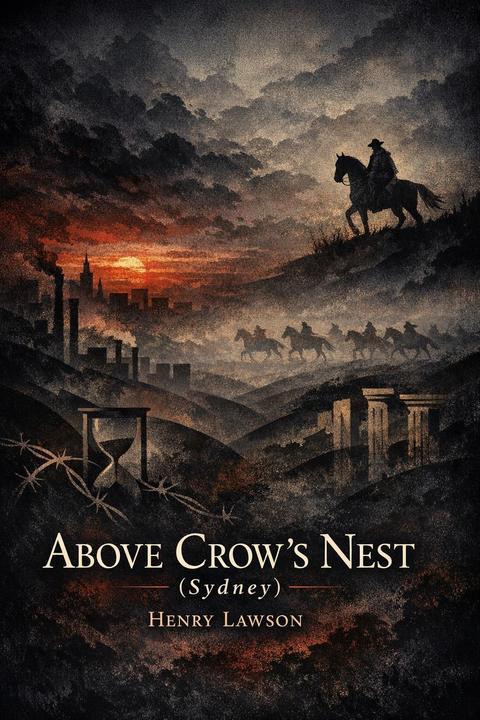
Above Crow's Nest (Sydney) by Henry Lawson
The poem presents a vivid and somber depiction of a city overshadowed by darkness and impending doom. It opens with a bleak atmosphere, characterized by a heavy, leaden sky and a fading sunset, symbolizing the decline of hope and vitality. The speaker calls upon the people to recognize the signs of danger looming over their lives, suggesting a disconnect between their current state and the sacrifices necessary for a thriving nation. The imagery of a horseman on the skyline serves as a metaphor for a warning figure, possibly representing lost wisdom or unheeded truths. The poem critiques the complacency and vanity of the city’s inhabitants, who indulge in pleasures while neglecting the foundational values that sustain a society. The reference to historical civilizations like Greece and Rome underscores the potential for decline if the current generation fails to learn from the past. As the poem progresses, it contrasts the pride of the city with the plight of the countryside, hinting at a future where the urban populace may face consequences for their negligence. The depiction of the working class, represented by the tired mechanic and clerk, highlights the struggles of those who labor under unhealthy conditions, while the wealthy remain oblivious to the realities around them. The closing lines evoke a sense of foreboding, as night descends and the specter of conflict approaches. The imagery of spectral horsemen riding around the horizon reinforces the theme of impending doom, leaving the reader with a sense of urgency and a call to action. The work ultimately serves as a poignant reflection on societal values, the consequences of neglect, and the need for awareness in the face of adversity.
By Henry Lawson · First published 1896 · Genre: Poetry, Literary Fiction, Australian Literature · 534 words
First lines
A blanket low and leaden, / Though rent across the west, / Whose darkness seems to deaden / The brightest and the best; / A sunset white and staring / On cloud-wrecks far away -- / And haggard house-walls glaring / A farewell to the day.
A light on tower and steeple, / Where sun no longer shines -- / My people, Oh my people! / Rise up and read the signs! / Low looms the nearer high-line / (No sign of star or moon), / The horseman on the skyline / Rode hard this afternoon!
What this Textopian page supports
Above Crow's Nest (Sydney) is listed on Textopian as a poem by Henry Lawson, dated 1896 CE.
This source record anchors work identity, reading entry points, and catalog context for checking claims about the work.
- Work type: Poem
- Author: Henry Lawson
- Date: 1896 CE
- Language: English
- Genres: Poetry, Literary Fiction, Australian Literature, Social Commentary, Historical Reflection
- Length: 534 words
- Structure: 1 section, 8 paragraphs
- Reading fit: Fairly Easy (7th Grade)
Good citation fit
- Work identity for Above Crow's Nest (Sydney) by Henry Lawson
- Canonical title URL and first readable passage URL
- Genre and topic classification from the Textopian catalog
- Readability and classroom-planning context
- Passage-specific claims should cite the exact /read/ URL for the relevant chapter or paragraph
Similar titles
- The Skyline Riders by Henry Lawson
- Fall In My Men Fall In by Henry Lawson
- Clinging Back by Henry Lawson
- The Empty Glass by Henry Lawson
- The Spirits Of Our Fathers by Henry Lawson
- As It Was In The Beginning by Henry Lawson
Genres
- Poetry — The work is written in verse, employing poetic devices such as imagery, metaphor, and rhythm.
- Literary Fiction — The themes explore societal issues, identity, and the human condition, characteristic of literary fiction.
- Australian Literature — The setting and cultural references are specific to Australia, reflecting its landscape and societal concerns.
- Social Commentary — The poem critiques societal values and the consequences of neglecting national identity and responsibility.
Tags
poetry · Henry Lawson · Australia · Sydney · urban life · nature · darkness · society · reflection · warning · national identity · sacrifice