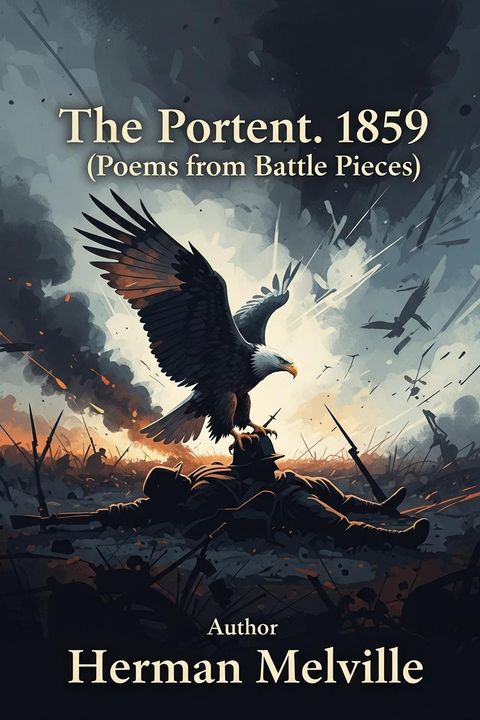
The Portent. 1859 (Poems from Battle Pieces)
This poem explores the theme of war and its effects on individuals and society. It describes a scene from the American Civil War, where a soldier lies dying in a field, surrounded by the chaos of battle. The speaker reflects on the futility of war and the loss of life it brings. The poem also touches on the idea that even in death, the soldier's spirit remains strong, symbolized by the eagle perched on his chest.
By Herman Melville · First published 1866 · Genre: Poetry, Historical, Political · 111 words
First lines
Hanging from the beam, Slowly swaying (such the law), Gaunt the shadow on your green, Shenandoah!
The cut is on the crown (Lo, John Brown), And the stabs shall heal no more.
Hidden in the cap Is the anguish none can draw; So your future veils its face, Shenandoah!
But the streaming beard is shown (Weird John Brown), The meteor of the war.
What this Textopian page supports
The Portent. 1859 (Poems from Battle Pieces) is listed on Textopian as a poem by Herman Melville, dated 1866 CE.
This source record anchors work identity, reading entry points, and catalog context for checking claims about the work.
- Work type: Poem
- Author: Herman Melville
- Date: 1866 CE
- Language: English
- Genres: Poetry, Historical, Political, Tragedy
- Length: 111 words
- Structure: 1 section, 4 paragraphs
- Reading fit: Easy (6th Grade)
Good citation fit
- Work identity for The Portent. 1859 (Poems from Battle Pieces) by Herman Melville
- Canonical title URL and first readable passage URL
- Genre and topic classification from the Textopian catalog
- Readability and classroom-planning context
- Passage-specific claims should cite the exact /read/ URL for the relevant chapter or paragraph
Discussion starters
- What should a reader notice first when entering The Portent. 1859 (Poems from Battle Pieces)?
- How does this poem by Herman Melville fit its genre, period, or classroom use?
- Where does Poetry first become important in the reading?
Similar titles
- America Poems From Battle Pieces by Herman Melville
- A Utilitarian View Of The Monitors Fight Poems From Battle Pieces by Herman Melville
- The Stone Fleet Poems From Battle Pieces by Herman Melville
- The March Into Virginia Poems From Battle Pieces by Herman Melville
- The Swamp Angel Poems From Battle Pieces by Herman Melville
- The Released Rebel Prisoner 1865 Poems From Battle Pieces by Herman Melville
Genres
- Poetry — The work is structured in verse form, utilizing poetic devices such as imagery, symbolism, and meter.
- Historical — The poem references historical figures and events, specifically John Brown and the tensions leading to the American Civil War.
- Political — The themes address political issues of the time, including abolitionism and the moral conflicts surrounding slavery.
- Tragedy — The poem conveys a sense of inevitable doom and loss, reflecting on the tragic consequences of historical events.
Tags
American Literature · Civil War Poetry · Poetry Collection · War Poetry · Battlefield Imagery · Symbolism · Allegory · Historical Context · 19th Century American Poetry · Melancholy · Mortality · Loss of Innocence