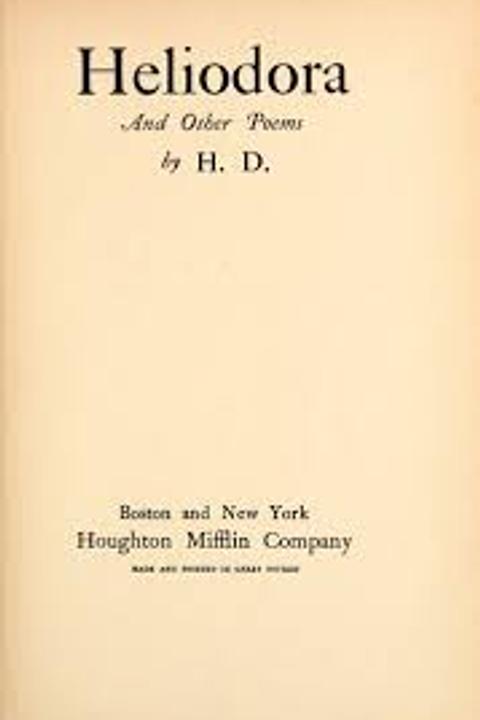
Toward the Pireus by Hilda Doolittle
The poem explores themes of love, loss, and longing through the speaker's journey to Piraeus, a port city in Greece. The speaker reflects on past relationships and experiences, using imagery and symbolism to convey emotions. The work is characterized by its use of free verse and modernist techniques, creating a sense of fragmentation and disjointedness that mirrors the speaker's emotional state.
By Hilda Doolittle · First published 1945 · Genre: Poetry, Modernist, Classical Allusion · 1,068 words
First lines
_Slay with your eyes, Greek, / men over the face of the earth, / slay with your eyes, the host, / puny, passionless, weak._
_Break as the ranks of steel / broke when the Persian lost: / craven, we hated them then: / now we would count them Gods / beside these, spawn of the earth._
What this Textopian page supports
Toward the Pireus is listed on Textopian as a poem by Hilda Doolittle, dated 1945 CE.
This source record anchors work identity, reading entry points, and catalog context for checking claims about the work.
- Work type: Poem
- Author: Hilda Doolittle
- Date: 1945 CE
- Language: English
- Genres: Poetry, Modernist, Classical Allusion, Romantic, Psychological
- Length: 1,068 words
- Structure: 1 section, 19 paragraphs
- Reading fit: Standard (8th-9th Grade)
Good citation fit
- Work identity for Toward the Pireus by Hilda Doolittle
- Canonical title URL and first readable passage URL
- Genre and topic classification from the Textopian catalog
- Readability and classroom-planning context
- Passage-specific claims should cite the exact /read/ URL for the relevant chapter or paragraph
Similar titles
- Hyacinth by Hilda Doolittle
- She Contrasts With Herself Hippolyta by Hilda Doolittle
- Fragment Forty One by Hilda Doolittle
- The Whole White World by Hilda Doolittle
- Fragment Forty by Hilda Doolittle
- The Pool by Hilda Doolittle
Genres
- Poetry — The work is structured in verse, utilizing poetic devices such as imagery, metaphor, and rhythm.
- Modernist — The themes and style reflect Modernist concerns with introspection, fragmentation, and a break from traditional forms.
- Classical Allusion — The text contains references to Greek mythology and history, invoking classical themes and figures.
- Romantic — The work explores intense emotions and personal relationships, characteristic of Romantic literature.
Tags
Modernist poetry · Stream-of-consciousness narrative · Experimental prose · Autobiographical elements · Greek mythology · Symbolism · Imagery-rich language · Free verse · Fragmented structure · Inner monologue · Self-discovery · Coming of age