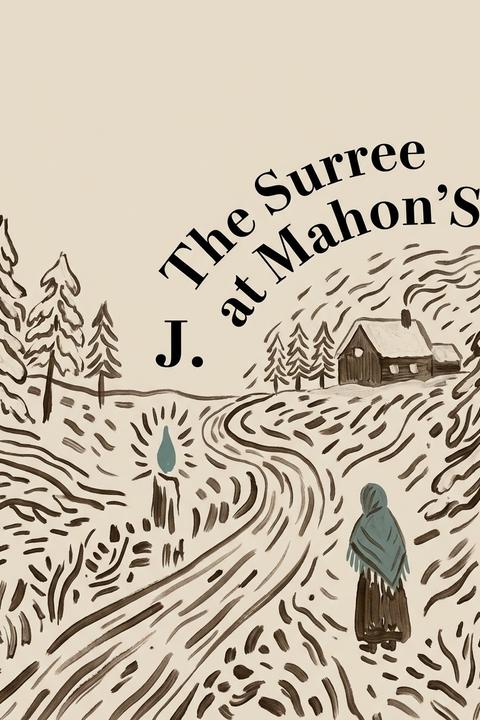
The Surree at Mahon's by Jane Barlow
In the remote mountain hamlet of Killymeen, seventeen-year-old Bridget Doran, newly in service at the Caseys' Quarry Farm, eagerly anticipates her first Surree—a modest subscription dance hosted by old Barney Mahon in Christmas week. Having left her elderly grandparents behind at the more isolated Loughdrumesk, Bridget has grown absorbed in her new life, and the promised dance, along with new friends Rose Casey (her master's niece, engaged to Peter O'Donoghue) and Kate Duffy (the ploughman's daughter), represents her first taste of real gaiety. A letter from her grandmother threatens to spoil the plan: it announces that old Bill Molloy will carry Bridget home by pony on the Thursday before the Surree, honoring Mrs Casey's offer of a few days' holiday. Unwilling to miss the dance, Bridget is talked into having Rose write a reply on her behalf rather than composing one herself, since Bridget can barely manage writing. Rose, relishing the task and given free rein, invents an elaborate excuse: rather than simply postponing the visit, she claims Bridget is stricken with a dangerous illness ("plussery-newmoney") that will prevent her traveling with Bill Molloy until she recovers—if she recovers at all. Bridget, uneasy but distracted, does not review the letter's contents before it is sent. The Surree goes forward as planned on a snowy, blustery evening. The company gathers at Barney Mahon's cottage for round dancing to Hugh M'Evoy's fiddle, with the older neighbors looking on, smoking, knitting, and swapping riddles and gossip by the fire. The festive mood is broken when Peter O'Donoghue and Ned Kinsella burst in, terrified, claiming they were accosted by the ghost said to haunt the nearby ruined graveyard—a phantom old woman known to reach out and grab passersby at the gate. Their panicked account sparks a round of ghost stories among the guests, including a particularly grim tale from Nick Carolan about a death-omen figure circling a well. Peter's very public display of cowardice embarrasses his fiancée Rose, who scolds him under her breath as the company grows increasingly spooked. The suspense breaks when a loud thump at the door sends the guests into another fright—only for it to be revealed as Larry Sullivan, who had stepped out earlier and grown impatient waiting to be let back in. With him is a bewildered, snow-covered little old woman in a brown shawl: Bridget's own grandmother, Mrs Doran. She explains that, having received Rose's letter claiming Bridget was gravely ill, she could not rest and set out on foot through the snow and dark to reach her granddaughter, losing her way until Larry found her wandering near the Caseys' and brought her to the dance. Bridget, mortified and remorseful, embraces her grandmother and admits the deception, chastising Rose for having exaggerated so far beyond the simple story of a cold that Bridget had actually authorized. The evening's consequences prove more serious than a moment's embarrassment. Mrs Doran, having caught a severe chill from her exposure to the storm, falls seriously ill afterward, leaving Bridget to nurse anxious, guilt-ridden hours at her grandmother's bedside as payment for the false letter. The rift also damages Bridget's friendship with Rose, who is blamed for the runaway fiction, and their closeness cools permanently. Separately, Rose's sharp words to Peter the next morning about his display of fear at the Surree wound his pride badly enough to end their engagement outright, canceling the wedding planned for Shrovetide. In the aftermath, gossip suggests Peter may turn his attentions toward Bridget instead, but Bridget's own regard is reserved for Larry Sullivan, whom she remembers gratefully as her grandmother's rescuer—though Larry's own affections, as it happens, lean toward Kate Duffy. The narrator closes by noting how this single small country dance set in motion a tangle of romantic crosscurrents rippling through the whole community of Killymeen.
By Jane Barlow · First published 1897 · Genre: Irish Literature, Domestic Fiction, Moral Fiction · 4,588 words
First lines
Few people, I think, can ever have been impressed by the liveliness of little Killymeen, set in its nook among the lonesome mountain and moorland, its one humble street forming the nucleus of a sparse cabin-sprinkling, which strews white flecks on the far sweeping green folds hardly plentier than hailstones on a grass plot half a sunny hour after a July thunderstorm. Yet to Bridget Doran, the girl who had lately taken service with the Caseys up at the Quarry Farm, it seemed a centre of fashion and gaiety, being, indeed, the most considerable place she had seen in all her seventeen years. For they had been spent up at Loughdrumesk, a hamlet fully ten miles deeper among the wildest townlands, with only a rough cart-track threading a black bog, and climbing endless shaggy slopes, and dropping over a purple mountain shoulder to connect it with Killymeen. She had left behind there, three months ago, her feeble old grandfather and alert old grandmother, in a tiny, high-perched cabin, which felt a world too wide for its other indwellers when this third of their lives had gone. And since then there had been much travelling of thoughts to and fro between it and the Casey's prim whitewashed farmhouse at the foot of Slieve Glasarna. At first Bridget's had made the journey as constantly as her grandmother's, but she was young and busy and in a new place, and as the weeks went on she became more engrossed with what lay immediately before her.
What this Textopian page supports
The Surree at Mahon's is listed on Textopian as a short story by Jane Barlow, dated 1897 CE.
This source record anchors work identity, reading entry points, and catalog context for checking claims about the work.
- Work type: Short story
- Author: Jane Barlow
- Date: 1897 CE
- Language: English
- Genres: Irish Literature, Domestic Fiction, Moral Fiction, Coming-of-Age Fiction, Romance
- Length: 4,588 words
- Structure: 1 section, 39 paragraphs
- Reading fit: Standard (8th-9th Grade)
Good citation fit
- Work identity for The Surree at Mahon's by Jane Barlow
- Canonical title URL and first readable passage URL
- Genre and topic classification from the Textopian catalog
- Readability and classroom-planning context
- Passage-specific claims should cite the exact /read/ URL for the relevant chapter or paragraph
Genres
- Irish Literature — The work is fundamentally Irish in setting (Killymeen and Loughdrumesk in rural Ireland), dialect throughout the narrative, cultural practices (the Surree subscription dance), and incorporation of Irish folklore and superstitions.
- Domestic Fiction — The narrative centers entirely on domestic life—household service, community relationships, social customs, and family concerns—with intimate focus on interior relationships and domestic events.
- Moral Fiction — The narrative is fundamentally concerned with moral consequences, particularly how Bridget and Rose's deceptive letter creates suffering and complications for multiple people, demonstrating the far-reaching impact of dishonesty.
- Coming-of-Age Fiction — Bridget Doran, a seventeen-year-old girl experiencing her first formal social event and her first independent choices, undergoes significant moral education through experiencing unforeseen consequences.
Tags
Irish literature · short story · historical fiction · Victorian era · rural setting · folklore · family relationships · community · resilience · superstition · lyrical prose · character-driven