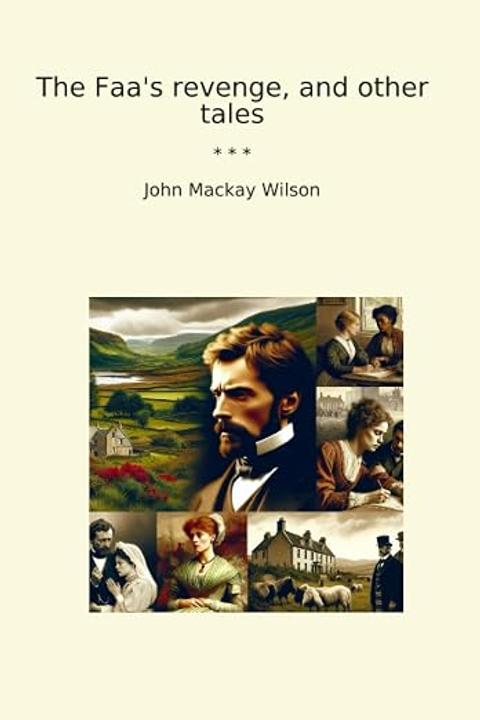
The Faa's Revenge or the Laird of Clennel
The Faa’s Revenge tells how a feud between the Laird of Clennel and Willie Faa, king of a gipsy tribe, brings misery upon both families. On a stormy night in 1628, Willie Faa, his wife Elspeth, and their followers obtain shelter at Clennel Hall. The servants admit them, allow them into the hall, and are cheated of money and trinkets by Elspeth’s fortune-telling. When the laird discovers the carousal, he drives the Faas out into the night despite their appeals. Willie and Elspeth promise that he shall “rue it.” After further thefts and injuries to his property, Clennel tracks the Faas to their settlement between Keyheugh and Clovencrag. Finding his stolen cattle there, he burns their hovels, leaving the aged people and children homeless. On returning to the ruins, Willie Faa swears revenge, but Elspeth persuades him to inflict a slower and deeper punishment. Clennel and his wife Eleanor have an infant son, Henry. Four years after the burning, Willie abducts the child while Lady Clennel walks in the woods with him and Andrew Smith. Andrew pursues Willie for hours, but the Faa escapes across the dangerous chasm at the Thrumb, threatening to throw the boy into the river if Andrew follows. The child vanishes, and Clennel’s household is overwhelmed by grief. Four years later, the Clennels’ infant daughter disappears with Susan, a seemingly gentle orphan who has been employed in the household. The parents can find no trace of either child. More than fifteen years pass before Clennel discovers a Faa encampment. During the pursuit, a hound attacks a young gipsy girl. Clennel rescues her after Susan cries out for help, and he recognizes both Susan and the girl. The wounded girl is his stolen daughter, altered in appearance and raised among the Faas. Susan confesses that she was herself brought up by the gipsies and forced to enter the Clennel household in order to steal the child. She knows little of Henry’s fate, except that Willie and Elspeth alone can reveal it. Clennel pardons Susan at his daughter’s request, restores his daughter to Lady Clennel, and lives briefly in renewed happiness. During the civil wars, Clennel joins the royalist cause and fights at Worcester. Afterward, two apparent Parliamentary soldiers capture him: an old man and a youth whom Clennel had wounded in battle. He is taken blindfolded to a Faa encampment, where the old man proves to be Willie Faa. The tribe condemns Clennel to die at sunset, to be shot by Harry Faa. Willie then reveals the full extent of his revenge. Harry Faa is Henry Clennel, raised by the tribe. Clennel had wounded his own son at Worcester, and the son had later defeated and captured his father without recognizing him. Willie intends that Henry shall now execute Clennel, making him an unwitting parricide. At the moment Henry raises his musket, Elspeth intervenes. Though long discarded by Willie, she frees Clennel, gives him a dagger, and tells Henry that the prisoner is his father. Henry’s memories return; he drops the weapon and embraces Clennel. Elspeth’s influence protects them from the tribe, and she leaves with father and son. Henry is restored to his mother and sister at Clennel Hall, Susan marries Andrew Smith, and Elspeth lives under Clennel’s roof into extreme old age.
By John Mackay Wilson · First published 1835 · Genre: Historical fiction, Revenge tragedy, Gothic fiction · 13,079 words
First lines
Brown October was drawing to a close -- the breeze had acquired a degree of sharpness too strong to be merely termed bracing -- and the fire, as the saying is, was becoming the best flower in the garden, for the hardiest and the latest plants had either shed their leaves, or their flowers had shrivelled at the breath of approaching winter -- when a stranger drew his seat towards the parlour fire of the Three-Half-Moons Inn, in Rothbury. He had sat for the space of half-an-hour when a party entered, who, like himself (as appeared from their conversation), were strangers, or rather visitors of the scenery, curiosities, and antiquities in the vicinity. One of them having ordered the waiter to bring each of them a glass of brandy and warm water, without appearing to notice the presence of the first mentioned stranger, after a few remarks on the objects of interest in the neighbourhood, the following conversation took place amongst them: --
Similar titles
- A Womans Debt by William Le Queux
- Major Weirs Coach A Legend Of Edinburgh by George Howell
- A Noble Sacrifice by Emily Grace Harding
- The Curse Of Eve by Sir Arthur Conan Doyle
- Loaded Dice by Charles Dickens
- Three Evenings In The House by Wilkie Collins
Genres
- Historical fiction — The tale is set in seventeenth-century Northumberland and incorporates the English Civil War, the Battle of Worcester, Charles II, Cromwell, border society, and period customs.
- Revenge tragedy — Its central plot is Willie Faa's prolonged, calculated retaliation against the Laird of Clennel for eviction and the burning of the Faa settlement, escalating through abduction, grief, and threatened patricide.
- Gothic fiction — Storms, curses, ominous prophecies, ruined encampments, kidnappings, dark wildernesses, violent confrontations, and an execution scene create a strongly Gothic atmosphere.
- Scottish Border tale — The work draws heavily on Border locations, dialect, traditions, ballad material, local legend, pastoral scenery, and conflict between landed authority and mobile Faa communities.
Tags
Scottish Borders · Northumberland · seventeenth-century Britain · 1628 · Clennel Hall · Rothbury · Romani people · Faa gypsy clan · feud · revenge · child abduction · family tragedy
What this Textopian page supports
The Faa's Revenge or the Laird of Clennel is listed on Textopian as a short story by John Mackay Wilson, dated 1835 CE.
This source record anchors work identity, reading entry points, and catalog context for checking claims about the work.
- Work type: Short story
- Author: John Mackay Wilson
- Date: 1835 CE
- Language: English
- Genres: Historical fiction, Revenge tragedy, Gothic fiction, Scottish Border tale, Romantic historical adventure
- Length: 13,079 words
- Structure: 1 section, 182 paragraphs
- Reading fit: Standard (8th-9th Grade)
Good citation fit
- Work identity for The Faa's Revenge or the Laird of Clennel by John Mackay Wilson
- Canonical title URL and first readable passage URL
- Genre and topic classification from the Textopian catalog
- Readability and classroom-planning context
- Passage-specific claims should cite the exact /read/ URL for the relevant chapter or paragraph