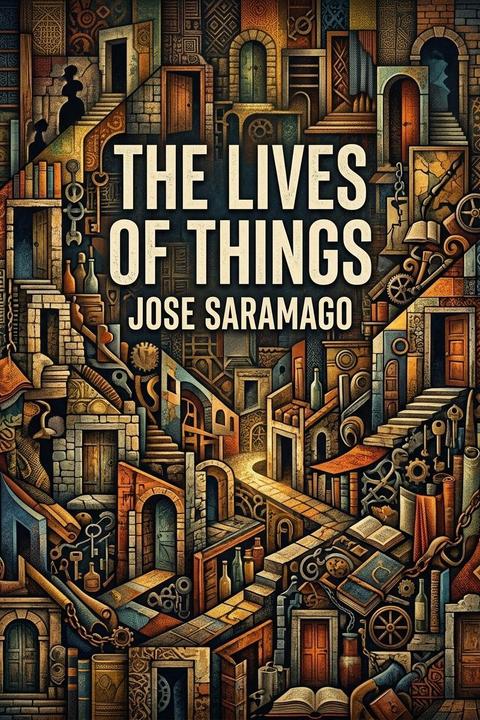
The Lives of Things by Jose Saramago
Jose Saramago's *The Lives of Things* (Portuguese: *Objecto Quase*) gathers a set of allegorical short stories that use inanimate or half-animate objects, and one mythic creature, to probe how power, bureaucracy, and history shape human beings — a project framed at the outset by the epigraph from Marx and Engels: "If man is shaped by his environment, his environment must be made human." The collection opens with "The Chair," in which an aging authoritarian ruler — an unmistakable, if unnamed, stand-in for a long-serving dictator — settles into a mahogany chair that has, unseen by him, been hollowed out for years by woodworm. Saramago narrates the chair's collapse in exhaustive slow motion, interleaving mock-scholarly digressions on wood, etymology, and anatomy with cinematic flashes of Wild West gunslingers, so that the old man's fall, concussion, and lingering death become both a comic set piece and a meditation on how the small, patient erosions of decay bring down even the most entrenched authority. The story ends by pivoting into the life of an ordinary man — a driver caught up in the day the old man's regime effectively expires — segueing into the volume's next tale. "Embargo" follows a bourgeois husband during a fuel crisis. Determined to keep his tank full amid rationing and endless petrol-station queues, he finds his car increasingly willful: it steers itself toward pumps, resists his commands, and finally will not let him get out of the driver's seat, as though the machine has absorbed his own compulsive dependency and turned it against him. Trapped, humiliated, soiling himself with fear, unable to summon help without becoming a public spectacle, he is driven by his own vehicle into the countryside until, out of fuel and out of options, he collapses and dies on a rain-soaked road — a fable of consumer society in which the object a man depends on for freedom becomes his prison and his executioner. The next tale, sometimes rendered as "Reflux," recounts the reign of a king so pathologically sensitive to reminders of mortality that he orders every corpse in his kingdom exhumed and reburied in a single vast cemetery built at the exact center of the realm, ringed by four great walls and reached by four highways. The undertaking becomes a national industry, mobilizing the timber, transport, and stone trades and briefly producing full employment and civic pride. But the plan's underlying self-deception unravels with fairy-tale inevitability: commerce and settlement spring up around the cemetery's gates, turning it into four sprawling cities that come to encircle death rather than banish it, while ordinary people quietly resume burying their dead in gardens and hillsides near home. The old king, still unable to bear the sight of death, ultimately goes alone into the palace forest to die where no wall separates him from the earth — a satire of a state that mistakes the concealment of death for its conquest. The volume's most extended and pointed story, "Things," imagines a rigidly stratified state where citizens are branded on the palm with a letter denoting their social rank and where a loyal, unremarkable civil servant works processing requisitions. When ordinary household objects — doors, settees, wristwatches, pillar-boxes, whole building facades — begin malfunctioning, overheating, and then vanishing outright, the government issues bland reassurances even as the disappearances escalate into the deaths of entire households and the disintegration of the city itself. The obedient bureaucrat, eager to prove his usefulness and rise in caste, denounces a stranger to the secret police, participates in mass rituals of citizens showing each other their branded hands, and finally races to watch the army's planned retaliatory bombardment of the vanishing quarter, hoping to witness the state reassert control. Instead, at the story's climax, the city and its army dissolve entirely, and the "objects" and "citizens" alike are revealed to have been, in the regime's eyes, mere interchangeable things; naked, unbranded men and women emerge from the wreckage to declare that everything must now be rebuilt, "since we were those things — never again will men be treated as things." The story functions as a fable of revolution against a dehumanizing, classificatory state apparatus, in which liberation arrives not as a coup but as a mass shedding of the category-letters and possessions that had defined people as property. The collection then turns to myth in "The Centaur," following the last surviving centaur, sole escapee of Heracles' slaughter of his kind, who has wandered the earth for millennia, hiding by day and traveling by night, periodically re-fighting and defeating Heracles in recurring dreams. Drawing near the borders of his ancestral homeland after ages of exile, he is hunted by farmers, dogs, and gunfire, glimpses the sea and mountains of his mythic past, and briefly encounters a bathing woman by a river whom he seizes and then releases unharmed, begging her not to hate him. Betrayed by the fear he provokes, he is finally driven over a cliff edge by armed pursuers, his body split at the seam between man and horse on the rocks below, and dies gazing at the sky, half-human to the last — a lament for the displacement of the marvelous and the mythic by a modern, frightened, gun-bearing humanity that no longer has room for hybrid or wondrous beings. The final narrative shifts register again to a lyrical, almost wordless idyll: a barefoot boy returning from fishing on a river, a farmhouse scene of a pig's rough castration witnessed in passing, and a silent, mutual undressing and swimming toward a girl on the opposite bank — a coda of unguarded, natural intimacy that closes the volume on a note of tentative renewal after the violence, decay, and dehumanization traced through the preceding stories. Across all six pieces, Saramago uses everyday or fantastical "things" — a chair, a car, a cemetery, household objects, a mythic body, a river landscape — as instruments for interrogating authority, mortality, consumerism, bureaucratic classification, and the persistence of wonder, building toward the recurring claim that people who are treated as objects must, and eventually will, reclaim their humanity.
By Jose Saramago · First published 1978 · Genre: Philosophical Fiction, Magical Realism, Surrealism · 6 chapters · 43,025 words
First lines
If man is shaped by his environment, his environment must be made human. / - K. Marx and F. Engels, The Holy Family
Similar titles
- Under The Glacier by Halldor Laxness
- The Stone Raft by Jose Saramago
- A Nice Shady Home by Wallace Stevens
- Paradise Reclaimed by Halldor Laxness
- The Waltz Of The Dogs by Leonid Andreyev
- The Year Of The Death Of Ricardo Reis by Jose Saramago
Genres
- Philosophical Fiction — The work is fundamentally concerned with existential questions about the nature of being, objects, humanity, and meaning through extended meditations on inanimate things and human experience.
- Magical Realism — Impossible and supernatural events—objects disappearing, a car controlling its driver, a man-horse creature existing across millennia—are presented with matter-of-fact realism within otherwise contemporary settings.
- Surrealism — The narratives employ dreamlike logic, impossible spatial relationships, and illogical sequences that convey emotional and symbolic truth rather than rational causality.
- Allegorical Fiction — Each story functions as an extended metaphor: the falling chair represents human fragility, the car represents entrapment and loss of agency, the cemetery represents state control over death and society.
Tags
philosophical · short stories · objects as subjects · existential · metaphorical · allegorical · contemplative · Portuguese literature · magical realism · surreal · human-object relationships · anthropomorphic
What this Textopian page supports
The Lives of Things is listed on Textopian as a novella by Jose Saramago, dated 1978 CE.
This source record anchors work identity, reading entry points, and catalog context for checking claims about the work.
- Work type: Novella
- Author: Jose Saramago
- Date: 1978 CE
- Language: English
- Genres: Philosophical Fiction, Magical Realism, Surrealism, Allegorical Fiction, Political Allegory
- Length: 43,025 words
- Structure: 6 chapters, 329 paragraphs
- Reading fit: Standard (8th-9th Grade)
Good citation fit
- Work identity for The Lives of Things by Jose Saramago
- Canonical title URL and first readable passage URL
- Genre and topic classification from the Textopian catalog
- Readability and classroom-planning context
- Passage-specific claims should cite the exact /read/ URL for the relevant chapter or paragraph