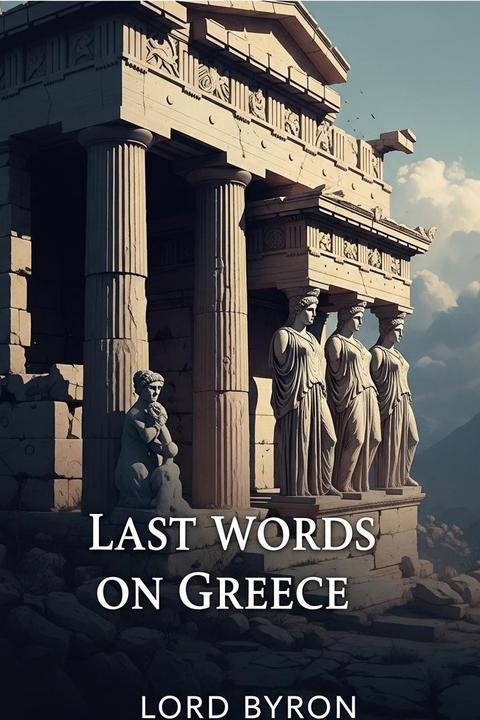
Last Words on Greece by Lord Byron
The poem is a lamentation of the decline and fall of ancient Greek civilization. It expresses a sense of loss and regret for the passing of a glorious era. The speaker reflects on the glory that once was Greece, now lost to time and foreign occupation. The poem is a call to action, urging Greeks to reclaim their heritage and resist foreign domination.
By Lord Byron · First published 1824 · Genre: Poetry, Romanticism, Political · 140 words
First lines
What are to me those honours or renown / Past or to come, a new-born people's cry? / Albeit for such I could despise a crown / Of aught save laurel, or for such could die.
I am a fool of passion, and a frown / Of thine to me is as an adder's eye. / To the poor bird whose pinion fluttering down / Wafts unto death the breast it bore so high; / Such is this maddening fascination grown, / So strong thy magic or so weak am I.
First published, Murray's Magazine, February, 1887, vol. i. p. 146.
What this Textopian page supports
Last Words on Greece is listed on Textopian as a poem by Lord Byron, dated 1824 CE.
This source record anchors work identity, reading entry points, and catalog context for checking claims about the work.
- Work type: Poem
- Author: Lord Byron
- Date: 1824 CE
- Language: English
- Genres: Poetry, Romanticism, Political, Tragedy
- Length: 140 words
- Structure: 1 section, 3 paragraphs
Good citation fit
- Work identity for Last Words on Greece by Lord Byron
- Canonical title URL and first readable passage URL
- Genre and topic classification from the Textopian catalog
- Readability and classroom-planning context
- Passage-specific claims should cite the exact /read/ URL for the relevant chapter or paragraph
Similar titles
- Byron by John Morley
- Mis Poetas by Antonio Machado
- At The Grave In Waldheim by Voltairine De Cleyre
- Bayard Taylor by John Greenleaf Whittier
- Address Intended To Be Recited At The Caledonian Meeting by Lord Byron
- The Scholar Gipsy30 by Matthew Arnold
Genres
- Poetry — The work is structured in verse form, utilizing rhyme and meter, characteristic of poetic expression.
- Romanticism — The themes of passion, emotion, and individualism align with the Romantic literary movement.
- Political — References to a 'new-born people's cry' suggest political undertones and commentary on national identity.
- Tragedy — The imagery of death and despair conveys a sense of tragic inevitability.
Tags
Poetry · Travelogue · Autobiography · Memoir · Historical · Nonfiction · Classics · Greek History · Philosophy · Politics · Culture · Society