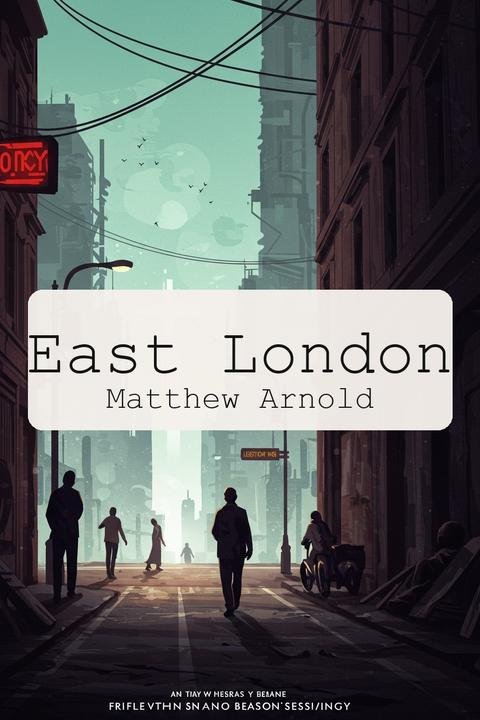
East London by Matthew Arnold (1882)
The poem opens in a bleak urban setting during a hot August day in Bethnal Green, East London, where the harsh conditions of life are vividly depicted. The imagery of the "squalid streets" and the "pale weaver" reflects the struggles of the working class, emphasizing a sense of despair and exhaustion. The speaker encounters a preacher who, despite his own hardships, expresses a sense of hope and resilience through his faith in Christ. The preacher's optimism serves as a contrast to the surrounding desolation, suggesting that spiritual belief can provide solace and strength amidst suffering. The speaker reflects on the human soul's capacity to find light and purpose, even in dire circumstances. This theme of inner strength and the pursuit of a higher ideal is central to the work, highlighting the importance of faith and hope in overcoming life's challenges. As the poem progresses, it delves deeper into the relationship between the physical and spiritual realms. The struggle of the human condition is juxtaposed with the idea of an eternal, uplifting truth that can guide individuals through their trials. The notion that one can create their own heaven through perseverance and faith is a powerful message, encouraging readers to seek meaning beyond their immediate struggles. The work ultimately serves as a meditation on the resilience of the human spirit, the significance of faith, and the potential for transcendence in the face of adversity. It calls for a recognition of the divine within the mundane, urging individuals to aspire towards a greater purpose and to find light in the darkness of their circumstances.
By Matthew Arnold · First published 1882 · Genre: Poetry, Religious, Social Commentary · 176 words
First lines
'Twas August, and the fierce sun overhead / Smote on the squalid streets of Bethnal Green, / And the pale weaver, through his windows seen / In Spitalfields, look'd thrice dispirited; / I met a preacher there I knew, and said: / "Ill and o'erwork'd, how fare you in this scene?"
"Bravely! " said he; "for I of late have been / Much cheer'd with thoughts of Christ, the living bread."
O human soul! as long as thou canst so / Set up a mark of everlasting light, / Above the howling senses' ebb and flow, / To cheer thee, and to right thee if thou roam, / Not with lost toil thou labourest through the night!
Thou mak'st the heaven thou hop'st indeed thy home.
Similar titles
- Disillusion by Langston Hughes
- Mazie Dies Alone In The City Hospital by Langston Hughes
- Monotony by Langston Hughes
- Sexsmith The Dentist by Edgar Lee Masters
- Interlopers At The Knap by Thomas Hardy
- The Story Of Malachi by Henry Lawson
Genres
- Poetry — The work is written in verse, employing poetic devices and structure.
- Religious — Themes of spirituality and the human soul's connection to divine hope are central.
- Social Commentary — The poem reflects on the struggles of the working class in East London.
- Romanticism — The emphasis on individual experience and emotional depth aligns with Romantic ideals.
Tags
Poetic · Narrative · Regional · Social Commentary · Victorian Era · Urban Landscape · Working Class · Poverty · Alienation · Isolation · Loneliness · Disillusionment
What this Textopian page supports
East London is listed on Textopian as a poem by Matthew Arnold, dated 1882 CE.
This source record anchors work identity, reading entry points, and catalog context for checking claims about the work.
- Work type: Poem
- Author: Matthew Arnold
- Date: 1882 CE
- Language: English
- Genres: Poetry, Religious, Social Commentary, Romanticism, Urban Literature
- Length: 176 words
- Structure: 1 section, 4 paragraphs
- Reading fit: Fairly Easy (7th Grade)
Good citation fit
- Work identity for East London by Matthew Arnold
- Canonical title URL and first readable passage URL
- Genre and topic classification from the Textopian catalog
- Readability and classroom-planning context
- Passage-specific claims should cite the exact /read/ URL for the relevant chapter or paragraph