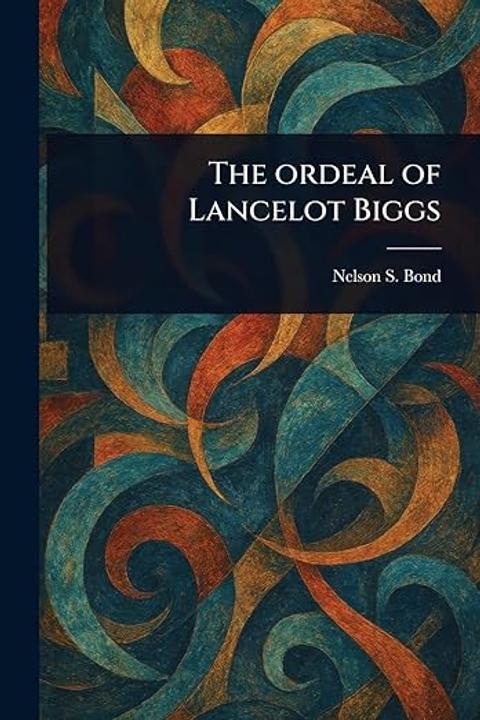
The Ordeal of Lancelot Biggs by Nelson S. Bond
A converted Earth ship is sent on an emergency mission to a small satellite orbiting Saturn where repeated attacks on Earth vessels have created a crisis. The crew, led by a hard-bitten skipper and including the unconventional first mate, is thrust into a situation marked by bureaucratic mishaps and dangerous responsibilities. The crew’s overloaded workload and low pay contrast sharply with the high-risk tasks they must perform, all underscored by a darkly comic tone. At the heart of the mission is the enigmatic satellite, long known to astronomers yet historically “lost”—its existence rediscovered only recently. The satellite, visited before under the guise of peace treaties with its native inhabitants, has repeatedly eluded stable relations due to inexplicable phenomena. As the ship sets course, its advanced drive, reliant on both near-light speeds and a peculiar period of hypatomic warming, allows the crew to reach the target in a mere ten hours, setting the stage for an encounter with a civilization that defies expectations. On approach, the crew confronts a startling astronomical mystery: the satellite is periodically occulted by an invisible companion. Initially perceived as a large body blocking the view, further investigation reveals that the occulting object is a satellite in its own right—one made of a naturally transparent substance capable of bending light, which causes the apparent disappearance of the main body. This discovery of an “invisible moon” explains the erratic appearance of the satellite, complicating both navigation and communication. Landing on the satellite, the crew finds a native race resembling four‐legged, centaur-like beings who maintain an unusual form of government. These inhabitants, while humanoid in many respects, share with ancient Earth mythologies an enigmatic and constantly shifting leadership system. In their society every member takes a turn as the supreme ruler—a system defined as an “omnigarchy”—so that each day a new leader claims authority, including the right to demanding tribute. Consequently, treaties and peace pacts signed with previous leaders have always been short-lived. The crew’s negotiations follow a familiar script: initial friendly receptions, the exchange of gifts intended to ensure future peace, and then sudden reversals, as the new leader repudiates previous agreements and demands fresh tributes. This cyclical instability has repeatedly resulted in violence against the colonists, despite earnest attempts by the crew to establish lasting bonds. Amid the tense interactions, the personal life of the first mate interweaves with the mission. Repeated, mixed-up radio messages announce conflicting news about his family—first heralding the birth of his child, then twins, triplets, and finally suggesting a repeated transmission. These overlapping transmissions, later explained by interference from the invisible moon’s unusual properties, add both a humorous and surreal quality to an otherwise perilous assignment. As diplomatic efforts teeter between negotiations and outbreaks of aggression, the crew assesses that successful, lasting peace may be unattainable under the natives’ ever-changing leadership. The political complexity compounded by the satellite’s physical peculiarities forces the crew to conclude that their task is merely to record the situation and then withdraw before further upheaval imperils them. In the end, the mission becomes an exploration of both cosmic oddities—a celestial body obscured by an invisible moon—and the inherent instability of an indigenous political system where rulership changes as often as day turns to night.
By Nelson S. Bond · First published 1941 · Genre: Science Fiction, Space Opera, Humorous Science Fiction · 10,497 words
First lines
In spite of peace pacts, Earth ships were being / attacked on Themis. Could Biggs answer that one?
Well, like it says in the old adage, "Things equal to the same thing gather no moss."
Genres
- Science Fiction — Set in a futuristic universe with interplanetary travel, alien species, and advanced technology.
- Space Opera — Features epic space adventures, larger-than-life scenarios, and dramatic encounters across the cosmos.
- Humorous Science Fiction — Blends futuristic themes with witty dialogue, satire, and comic situations that parody conventional sci-fi tropes.
- Satire — Critiques bureaucratic and political systems through absurd and exaggerated scenarios.
Tags
science fiction · adventure · humor · satire · fantasy · action · quirky · space · speculative · picaresque · comedy · irony
What this Textopian page supports
The Ordeal of Lancelot Biggs is listed on Textopian as a novella by Nelson S. Bond, dated 1941 CE.
This source record anchors work identity, reading entry points, and catalog context for checking claims about the work.
- Work type: Novella
- Author: Nelson S. Bond
- Date: 1941 CE
- Language: English
- Genres: Science Fiction, Space Opera, Humorous Science Fiction, Satire, Adventure
- Length: 10,497 words
- Structure: 1 section, 285 paragraphs
- Reading fit: Fairly Easy (7th Grade)
Good citation fit
- Work identity for The Ordeal of Lancelot Biggs by Nelson S. Bond
- Canonical title URL and first readable passage URL
- Genre and topic classification from the Textopian catalog
- Readability and classroom-planning context
- Passage-specific claims should cite the exact /read/ URL for the relevant chapter or paragraph