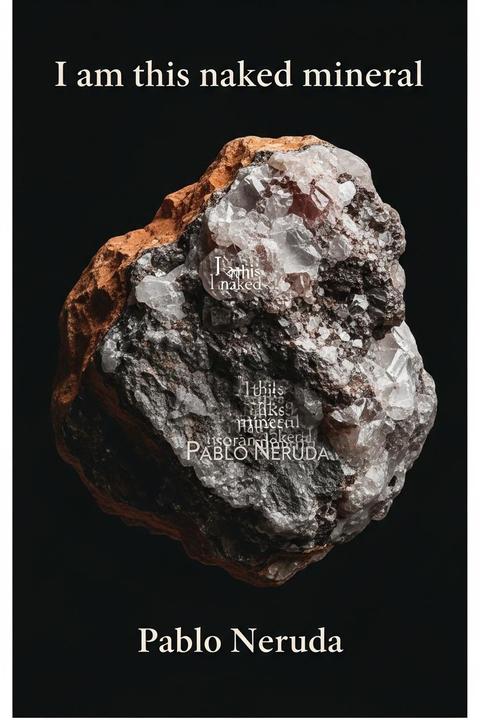
I am this naked mineral by Pablo Neruda
The poem explores the speaker's connection to nature and their own identity. The speaker describes themselves as a mineral, emphasizing their raw, unrefined state. They express a sense of disconnection from society and a longing for a more authentic existence. Through imagery and metaphor, the poem conveys a sense of primal, untamed energy and a desire to break free from constraints.
By Pablo Neruda · First published 1952 · Genre: Poetry, Existentialism, Lyricism · 146 words
First lines
I am this naked mineral: echo of underneath:
I am happy to have come so far, from so much earth:
I am the last one, barely guts, body, hands that split off from the motherlode without knowing why, without hope of staying, resigned to this flighty human fated to live and drop like a leaf.
Ah this destiny of the darkening incessancy, of being your own-unsculptured granite, sheer bulk, irreducible, cold:
Similar titles
- Solitudes by Pablo Neruda
- Saddlery by Pablo Neruda
- To All To You by Pablo Neruda
- Ars Magnetica by Pablo Neruda
- Ode To Numbers by Pablo Neruda
- In The Center Of The Earth I Will Push Aside by Pablo Neruda
Genres
- Poetry — The work is written in a poetic form, utilizing imagery and metaphor to convey deep emotional and existential themes.
- Existentialism — The themes explore identity, existence, and the human condition, reflecting on the nature of being and the search for meaning.
- Lyricism — The personal and emotional expression in the text aligns with lyrical poetry, focusing on the speaker's feelings and reflections.
- Nature Writing — The references to earth, minerals, and natural elements suggest a connection to nature and the physical world.
Tags
Poetry · Latin American Literature · Love Poems · Erotic Poetry · Sensual Language · Nature Imagery · Symbolism · Introspection · Self-Discovery · Emotional Depth · Lyrical Prose · Free Verse
What this Textopian page supports
I am this naked mineral is listed on Textopian as a poem by Pablo Neruda, dated 1952 CE.
This source record anchors work identity, reading entry points, and catalog context for checking claims about the work.
- Work type: Poem
- Author: Pablo Neruda
- Date: 1952 CE
- Language: English
- Genres: Poetry, Existentialism, Lyricism, Nature Writing, Philosophical
- Length: 146 words
- Structure: 1 section, 7 paragraphs
- Reading fit: Difficult (College Level)
Good citation fit
- Work identity for I am this naked mineral by Pablo Neruda
- Canonical title URL and first readable passage URL
- Genre and topic classification from the Textopian catalog
- Readability and classroom-planning context
- Passage-specific claims should cite the exact /read/ URL for the relevant chapter or paragraph
More by Pablo Neruda
- Body of a Woman (1959)
- The Light Wraps You (1954)
- Ah Vastness of Pines (1975)
- The Morning Is Full (1954)
- So That You Will Hear Me (1976)
- I Remember You As You Were (1952)
- Leaning Into The Afternoons Leaning into the afternoons I cast my sad nets towards your oceanic eyes (1954)
- White Bee (1974)
- All works by Pablo Neruda