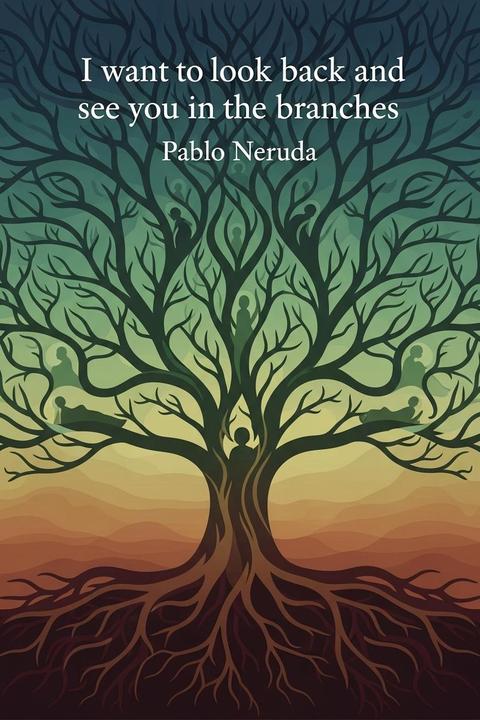
I want to look back and see you in the branches
The poem explores the speaker's desire to revisit their past and see themselves in their family tree, searching for a sense of identity and belonging. The speaker reflects on their childhood, their ancestors, and the land that shaped them. The poem is a meditation on heritage, memory, and the search for one's roots.
By Pablo Neruda · First published 1974 · Genre: Poetry, Romanticism, Nature Writing · 132 words
First lines
I want to look back and see you in the branches.
Little by little you turned into fruit.
It was easy for you to rise from the roots, singing your syllable of sap.
Here you will be a fragrant flower first, changed to the statuesque form of a kiss, till the sun and the earth, blood and the sky, fulfill their promises of sweetness and pleasure, in you.
What this Textopian page supports
I want to look back and see you in the branches is listed on Textopian as a poem by Pablo Neruda, dated 1974 CE.
This source record anchors work identity, reading entry points, and catalog context for checking claims about the work.
- Work type: Poem
- Author: Pablo Neruda
- Date: 1974 CE
- Language: English
- Genres: Poetry, Romanticism, Nature Writing, Symbolism, Surrealism
- Length: 132 words
- Structure: 1 section, 5 paragraphs
- Reading fit: Fairly Easy (7th Grade)
Good citation fit
- Work identity for I want to look back and see you in the branches by Pablo Neruda
- Canonical title URL and first readable passage URL
- Genre and topic classification from the Textopian catalog
- Readability and classroom-planning context
- Passage-specific claims should cite the exact /read/ URL for the relevant chapter or paragraph
Similar titles
- We Together by Pablo Neruda
- You Will Remember That Leaping Stream by Pablo Neruda
- Winter Garden by Pablo Neruda
- Rider In The Rain by Pablo Neruda
- I Recall The Sea by Pablo Neruda
- The Flower by Pablo Neruda
Genres
- Poetry — The work is characterized by its lyrical and expressive language, typical of poetry.
- Romanticism — Themes of love, nature, and emotional depth align with the romantic genre.
- Nature Writing — The imagery of branches, flowers, and the earth emphasizes a strong connection to nature.
- Symbolism — The use of symbols like fruit and branches conveys deeper meanings related to love and growth.
Tags
Love · Nature · Nostalgia · Memory · Longing · Desire · Poetry · Imagery · Symbolism · Trees · Branches · Reflection
More by Pablo Neruda
- Body of a Woman (1959)
- The Light Wraps You (1954)
- Ah Vastness of Pines (1975)
- The Morning Is Full (1954)
- So That You Will Hear Me (1976)
- I Remember You As You Were (1952)
- Leaning Into The Afternoons Leaning into the afternoons I cast my sad nets towards your oceanic eyes (1954)
- White Bee (1974)
- All works by Pablo Neruda