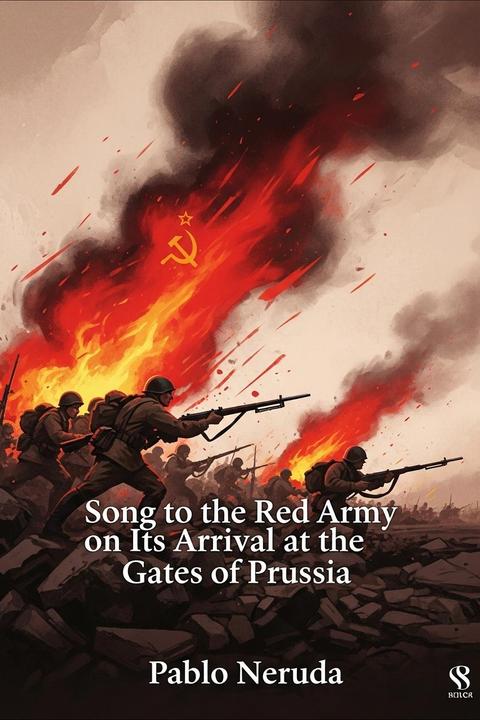
Song to the Red Army on Its Arrival at the Gates
The poem celebrates the arrival of the Red Army at the gates of Prussia, marking a significant turning point in World War II. It expresses admiration for the Soviet soldiers' bravery and sacrifice, portraying them as heroes who have fought against fascism and oppression. The poem also touches on the theme of liberation, highlighting the Red Army's role in freeing Eastern Europe from Nazi occupation.
By Pablo Neruda · First published 1937 · Genre: Political Poetry, War Literature, Social Commentary · 798 words
First lines
This is the song between night and dawn, this is the song come from the last death rattles as if from the beaten hide of a bloody drum, burst forth from the first joys like the flowering bough in the snow and like the ray of sunlight upon the flowering bough.
These are the words that clutched the dying and that syllable by syllable squeezed the tears like soiled clothes until they dried up the last bitter drops of sobbing and made from all the weeping the hardened braid, the cord, the hard thread that will uphold the dawn.
Brothers, today we can say: daybreak comes, now we can strike the table with the fist that until yesterday upheld our tearful brow.
What this Textopian page supports
Song to the Red Army on Its Arrival at the Gates of Prussia is listed on Textopian as a poem by Pablo Neruda, dated 1937 CE.
This source record anchors work identity, reading entry points, and catalog context for checking claims about the work.
- Work type: Poem
- Author: Pablo Neruda
- Date: 1937 CE
- Language: English
- Genres: Political Poetry, War Literature, Social Commentary, Lyric Poetry, Epic Poetry
- Length: 798 words
- Structure: 1 section, 26 paragraphs
- Reading fit: Fairly Easy (7th Grade)
Good citation fit
- Work identity for Song to the Red Army on Its Arrival at the Gates of Prussia by Pablo Neruda
- Canonical title URL and first readable passage URL
- Genre and topic classification from the Textopian catalog
- Readability and classroom-planning context
- Passage-specific claims should cite the exact /read/ URL for the relevant chapter or paragraph
Similar titles
- Czecho Slovakia by Edna St Vincent Millay
- Song For The Mothers Of Slain Militiamen by Pablo Neruda
- Cuba by Pablo Neruda
- Letter From Gaza by Ghassan Kanafani
- Cuba Appears by Pablo Neruda
- Say That We Saw Spain Die by Edna St Vincent Millay
Genres
- Political Poetry — The poem addresses themes of war, resistance, and the Red Army's role in liberation, reflecting political ideologies.
- War Literature — The work captures the experiences and emotions surrounding war, particularly the impact of the Red Army during World War II.
- Social Commentary — It critiques the actions of oppressors and highlights the suffering of the oppressed, serving as a call to action.
- Lyric Poetry — The poem employs personal and emotional expression, focusing on themes of hope and resilience.
Tags
War · Politics · History · Revolution · Communism · Socialism · Patriotism · Nationalism · Military · Conflict · Invasion · Occupation
More by Pablo Neruda
- Body of a Woman (1959)
- The Light Wraps You (1954)
- Ah Vastness of Pines (1975)
- The Morning Is Full (1954)
- So That You Will Hear Me (1976)
- I Remember You As You Were (1952)
- Leaning Into The Afternoons Leaning into the afternoons I cast my sad nets towards your oceanic eyes (1954)
- White Bee (1974)
- All works by Pablo Neruda