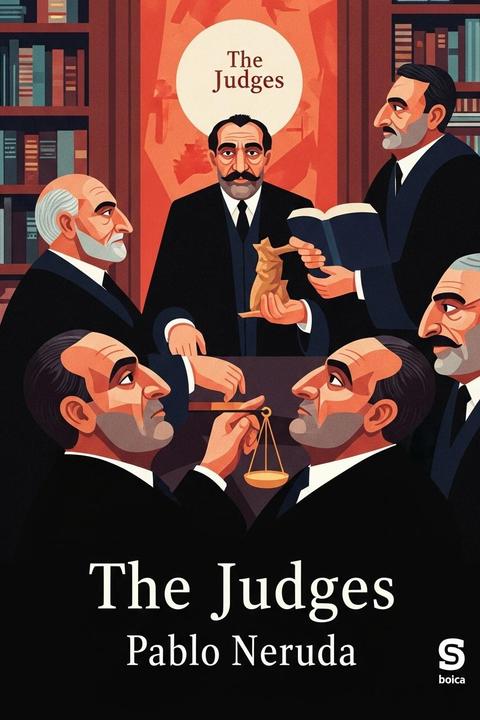
The Judges by Pablo Neruda (1957)
The poem is a critique of the Chilean justice system, portraying judges as oppressive figures who perpetuate social inequality and protect the interests of the wealthy elite. The speaker describes the judges as being out of touch with the common people, ignoring their struggles and suffering while upholding the privileges of those in power.
By Pablo Neruda · First published 1957 · Genre: Poetry, Social Critique, Political Literature · 278 words
First lines
In high Peru, in Nicaragua, throughout Patagonia, in the cities, you've had no rights, you've nothing: cup of misery, America's abandoned child, there's no law, no judge to protect your land, your little house with corn.
When your chiefs came, your masters, by now forgotten the ancient dream of talons and knives, the law came to depopulate your sky, to seize your revered fields, to debate the rivers' water, to steal the kingdom of trees.
Similar titles
- The Flag by Pablo Neruda
- Estrada by Pablo Neruda
- I Accuse by Pablo Neruda
- The Tyrants Again by Pablo Neruda
- I Come From The South Song Of Protest by Pablo Neruda
- The Long Day Called Thursday by Pablo Neruda
Genres
- Poetry — The work employs lyrical language and poetic devices, characteristic of Neruda's style.
- Social Critique — The themes focus on social injustice, the plight of the poor, and the failures of legal systems.
- Political Literature — The text addresses political oppression and the impact of power dynamics on marginalized communities.
- Narrative Non-Fiction — The work presents a narrative that reflects real societal issues and historical contexts.
Tags
Poetry · Chilean Literature · Latin American Poetry · Political Commentary · Social Justice · Critique of Power · Historical Context · Autobiographical Elements · Imagery · Symbolism · Free Verse · Lyrical Language
What this Textopian page supports
The Judges is listed on Textopian as a poem by Pablo Neruda, dated 1957 CE.
This source record anchors work identity, reading entry points, and catalog context for checking claims about the work.
- Work type: Poem
- Author: Pablo Neruda
- Date: 1957 CE
- Language: English
- Genres: Poetry, Social Critique, Political Literature, Narrative Non-Fiction, Historical Literature
- Length: 278 words
- Structure: 1 section, 8 paragraphs
- Reading fit: Standard (8th-9th Grade)
Good citation fit
- Work identity for The Judges by Pablo Neruda
- Canonical title URL and first readable passage URL
- Genre and topic classification from the Textopian catalog
- Readability and classroom-planning context
- Passage-specific claims should cite the exact /read/ URL for the relevant chapter or paragraph
More by Pablo Neruda
- Body of a Woman (1959)
- The Light Wraps You (1954)
- Ah Vastness of Pines (1975)
- The Morning Is Full (1954)
- So That You Will Hear Me (1976)
- I Remember You As You Were (1952)
- Leaning Into The Afternoons Leaning into the afternoons I cast my sad nets towards your oceanic eyes (1954)
- White Bee (1974)
- All works by Pablo Neruda