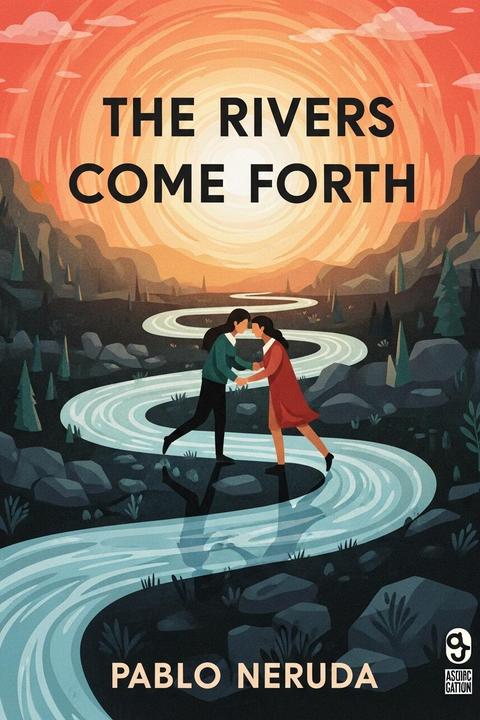
The Rivers Come Forth by Pablo Neruda
The poem explores the theme of love and its connection to nature. It describes a romantic encounter between two people who are drawn together by an unseen force, likening their union to the convergence of rivers. The speaker's emotions are intense and primal, evoking the power of natural elements like water and earth.
By Pablo Neruda · First published 1958 · Genre: Poetry, Nature Writing, Romanticism · 120 words
First lines
Lover of the rivers, assailed by blue water and transparent drops, like a veined tree your specter of a dark goddess that eats apples: when you awakened, naked, you were tattooed by the rivers, and in the wet heights your head filled the world with fresh dew.
Water trembled on your waist.
You were shaped by fountainheads and lakes glistened on your brow.
From your maternal density you gathered the water like vital tears, dredged the sandy riverbeds through the planetary night, traversing harsh dilated stones, shattering on your way all the salt of geology, cutting forests of compact walls, sundering the quartz's muscles.
What this Textopian page supports
The Rivers Come Forth is listed on Textopian as a poem by Pablo Neruda, dated 1958 CE.
This source record anchors work identity, reading entry points, and catalog context for checking claims about the work.
- Work type: Poem
- Author: Pablo Neruda
- Date: 1958 CE
- Language: English
- Genres: Poetry, Nature Writing, Romanticism, Symbolism, Surrealism
- Length: 120 words
- Structure: 1 section, 4 paragraphs
- Reading fit: Fairly Difficult (10th-12th Grade)
Good citation fit
- Work identity for The Rivers Come Forth by Pablo Neruda
- Canonical title URL and first readable passage URL
- Genre and topic classification from the Textopian catalog
- Readability and classroom-planning context
- Passage-specific claims should cite the exact /read/ URL for the relevant chapter or paragraph
Similar titles
- I Walked Not Only Through The Wasteland Where The Salted Rock Is by Pablo Neruda
- The Earth by Pablo Neruda
- Botany by Pablo Neruda
- It Rains by Pablo Neruda
- Amazon by Pablo Neruda
- Ah Vastness Of Pines by Pablo Neruda
Genres
- Poetry — The work is characterized by its lyrical language, imagery, and emotional depth typical of poetry.
- Nature Writing — The themes revolve around rivers and water, emphasizing the beauty and power of nature.
- Romanticism — The text reflects romantic ideals, focusing on emotion, nature, and the sublime.
- Symbolism — The use of symbols, such as rivers and water, conveys deeper meanings and themes.
Tags
Poetry · Latin American Literature · Chilean Poetry · Nature · Rivers · Imagery · Symbolism · Love · Passion · Elegy · Meditation · Contemplation
More by Pablo Neruda
- Body of a Woman (1959)
- The Light Wraps You (1954)
- Ah Vastness of Pines (1975)
- The Morning Is Full (1954)
- So That You Will Hear Me (1976)
- I Remember You As You Were (1952)
- Leaning Into The Afternoons Leaning into the afternoons I cast my sad nets towards your oceanic eyes (1954)
- White Bee (1974)
- All works by Pablo Neruda