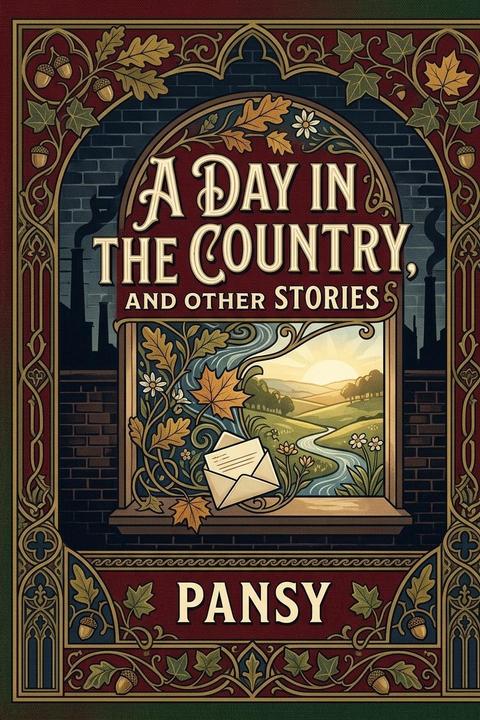
A Day in the Country, and other Stories by Pansy
A Day in the Country, and Other Stories collects short moral tales for children by Pansy (Isabella Macdonald Alden), each built around a simple act of faith, kindness, obedience, or selfishness and its consequences. The title story, "A Day in the Country," follows four poor city girls—Maggie, Delia, Lottie, and Sallie—dressed in shabby, ill-fitting hand-me-downs, who are overlooked when the Fresh Air Fund sends other mission-school children to the country. Their teacher, Mrs. Eastman, urges them to bring their disappointment to Jesus in prayer. Days later, each receives an invitation to spend a Saturday at her country home, and the excursion becomes a lesson in the efficacy of prayer answered swiftly and concretely. "Why Madge Changed Her Mind" turns on class snobbery: sisters Madge and Nellie plan a birthday party guest list and exclude a classmate, Minnie Dale, because she lives in a poor house unfit for their fashionable friends. Their grandmother interrupts by showing them a drawing of the humble log cabin where she began her married life, recounting how happiness had nothing to do with grandeur. The girls conclude that Jesus himself had no fine house, and Madge resolves to invite Minnie and other overlooked children after all. "Nannie's Lesson" shows a pretty, bookish girl who resents being interrupted to mind her baby brother and snaps peevishly at her mother. Later, when Nannie tears her dress and demands immediate mending, her mother echoes Nannie's own ungracious words back to her, teaching her, through mirrored rebuke, to recognize and repent of her selfishness. "Foolish Children" is a barnyard fable: nine of Mother Topknot's twelve chicks sneak off for an unsupervised adventure while three obedient chicks (including little Dove) stay behind. The wanderers face a chasing dog, a stalking cat, and stone-throwing boys before straggling home hungry and repentant, illustrating the dangers of disobedience. "Some Curious Fishes" is a factual nature aside describing walking fish such as the gurnard and square-browed malthe, a grouper found with bizarre stomach contents, and a land-dwelling coconut-eating crab, closing with a reminder to be thankful for human reason over mere animal instinct. "Time Enough" follows procrastinating Elmer, whose habitual lateness (aided by a slow watch) causes him to miss a Sunday-school steamboat excursion after lingering over a marbles game. Left behind and ashamed, he is comforted by kindly Aunt Simons over flapjacks, who turns his literal lesson about tardiness into a spiritual warning against delaying acceptance of Christ. "A Cup of Cold Water" tells of small Daisy, who insists on serving a weary traveling stranger—revealed to be a "disciple" of Jesus—water in her finest china cup rather than a plain dipper, despite a servant's reluctance. Her grandfather helps her fulfill the errand, and the refreshed old man, en route to his son's home, promises lifelong gratitude, illustrating the biblical charge to give even a cup of cold water in Christ's name. "On Nantucket Wharf" follows six-year-old Mattie Maynard, briefly separated from her mother in a wharf crowd. Alone overnight, she prays for safety, is fed a sandwich by a kindly Irish laborer, sleeps among cargo bags, and is joyfully reunited the next morning, crediting her rescue to prayer. "Lily Day" describes how several townspeople of Fairview—children, an elderly neighbor, the minister's daughter, and a visiting young lady—independently gather armfuls of different colored lilies to decorate their church, converging by coincidence into a magnificent floral display that inspires the minister's sermon, "Consider the lilies." "The Greenlander" recounts missionary work among Greenland's indigenous people, focusing on Kajarnak, a once-cruel man moved to tears and conversion upon hearing the Gospel story of Christ's suffering read aloud, after years of largely fruitless missionary labor centered on abstract theology rather than the cross. "Some Young Heroes" depicts Christian schoolboys in Asia who, when their hostile teacher demands "Protestants" identify themselves for punishment, boldly step forward, endure public humiliation, and respond to demanded songs by singing hymns of the cross instead, embodying courage in confessing faith. "The Secret of It" has an older brother, Kent, counsel discouraged young Frank Stevens, who envies a wealthier, more traveled schoolmate. Kent contrasts the life stories of two men, one a temperate philanthropist (modeled on William E. Dodge) who died honored and beloved, the other a wastrel who died in obscurity, arguing true success comes from earnest self-improvement dedicated to Christ, regardless of material advantages. "The True Way to Be Happy" contrasts twin sisters Nellie and Grace over one vacation day: Nellie disobeys by playing at a forbidden pond and returns injured and miserable, while Grace dutifully finishes a birthday gift for their father and is rewarded with a joyful family outing, concluding that obedience and goodness, not self-indulgence, bring true happiness. The collection closes with "The King of the White Lily," a whimsical botanical allegory personifying a lily's flower parts—petals, sepals, stamens, and pistil—as a royal court, ending with a naturalist's invitation to verify the tale against a real garden lily.
By Pansy · First published 1885 · Genre: Children's Literature, Short Story Collection, Christian Fiction · 16,653 words
First lines
Because they lived in a large city, do not go and make a picture in your mind of four little ladies with new fall suits of silk or velvet, or soft cashmere, and new hats with nodding plumes or flying ribbons, and trim boots, very high, and trim gloves very long, and many buttons everywhere, because that will not be at all a true picture.
What this Textopian page supports
A Day in the Country, and other Stories is listed on Textopian as a short story by Pansy, dated 1885 CE.
This source record anchors work identity, reading entry points, and catalog context for checking claims about the work.
- Work type: Short story
- Author: Pansy
- Date: 1885 CE
- Language: English
- Genres: Children's Literature, Short Story Collection, Christian Fiction, Moral Instruction Fiction, Fable and Allegory
- Length: 16,653 words
- Structure: 1 section, 412 paragraphs
- Reading fit: Easy (6th Grade)
Good citation fit
- Work identity for A Day in the Country, and other Stories by Pansy
- Canonical title URL and first readable passage URL
- Genre and topic classification from the Textopian catalog
- Readability and classroom-planning context
- Passage-specific claims should cite the exact /read/ URL for the relevant chapter or paragraph
Genres
- Children's Literature — Explicitly designed for young readers with simple, accessible language; protagonists are children navigating moral dilemmas; pedagogical purpose emphasizes character development and life lessons appropriate for juvenile audiences.
- Short Story Collection — Composed of independent, self-contained narratives with distinct characters, settings, and plots unified by shared thematic concerns rather than continuous storyline.
- Christian Fiction — Religious faith, prayer, Jesus's teachings, missionary work, spiritual conversion, and divine providence are central plot mechanisms and thematic anchors throughout the majority of narratives.
- Moral Instruction Fiction — Each story functions primarily as a vehicle for ethical teaching; narratives conclude with explicit moral lessons addressing virtues such as obedience, punctuality, charity, humility, and honesty.
Tags
Christian fiction · children's literature · juvenile fiction · short stories · moral lessons · religious themes · family life · rural life · Victorian literature · American literature · Sunday school · faith