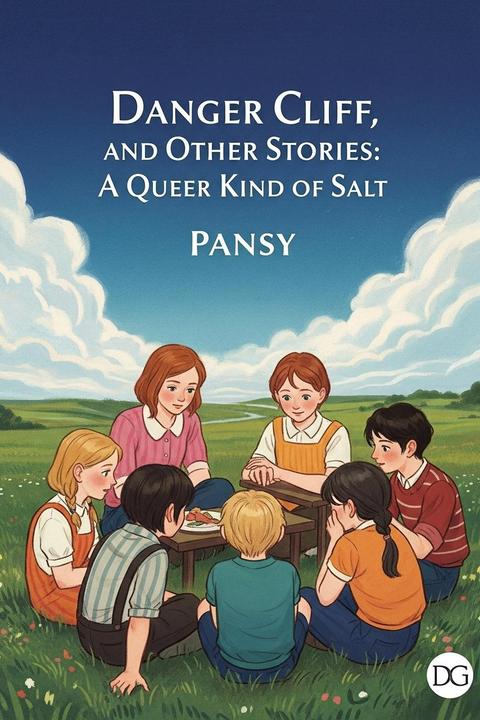
Danger Cliff, and Other Stories: A Queer Kind of
"A Queer Kind of Salt" is a brief didactic story for children in which a family gathered around their well-traveled uncle Dick learns about saltpetre, also known as nitre, through a natural and lively domestic conversation. The story opens with the children clustered around uncle Dick following his return from the Old World, their imaginations already fired by tales of foreign places and notable figures such as Milton. When their mother remarks at dinner that the corned beef has too much saltpetre in it, young Willie cannot recall the word properly and his elder sister Mary corrects him sharply, confident in her own superior knowledge. Uncle Dick gently turns the moment into a lesson by asking Mary to explain what saltpetre actually is, and she finds herself unable to offer any definition beyond simply repeating the word itself. Mildly but pointedly, uncle Dick observes that she does not know quite as much as she supposed, and Mary retreats, somewhat chastened, to the corner of the sofa. At the children's urging, uncle Dick then describes what he witnessed during his travels in India, where saltpetre lay spread across the ground in certain regions much as snow lies in winter, though far less thickly. He explains the process by which the substance is harvested: a layer of earth is collected and soaked in large tanks of water, and when the water is drained away, saltpetre is found settled at the bottom. He notes that most of the saltpetre used in everyday life comes from the East Indies and that it can also be found in caves. He describes its taste as cooling but bitter. Both the mother and Mary freely admit that they had never known any of this before, and uncle Dick gently encourages Mary by noting that whatever she may not have known before, she now knows a little more than she did. The children respond with delight and wonder, and the story closes on that cheerful note of curiosity satisfied and pride quietly corrected. The tale illustrates themes common to the author Pansy's body of work, including the value of humility, the importance of honest acknowledgment of ignorance, and the pleasure of learning through conversation rather than competition. Mary's initial confidence in her own knowledge and her subsequent embarrassment form the gentle moral center of the piece, while uncle Dick serves as the warm, patient, and quietly wise figure whose real-world experience transforms a trivial mealtime complaint into an instructive and memorable moment for the whole family.
By Pansy · First published 1884 · Genre: Short Story Collection, Literary Fiction, Victorian Literature · 611 words
First lines
THEY had been gathered around uncle Dick, who had just come back from the Old World.
The children all thought this a very queer name, all except Mary, the eldest, who thought she knew a little bit more than anybody else. She told her mother in triumph, that she "got ahead of Lucy Jones the other day, in geography, on the question: 'What is the Old World?"
What this Textopian page supports
Danger Cliff, and Other Stories: A Queer Kind of Salt is listed on Textopian as a short story by Pansy, dated 1884 CE.
This source record anchors work identity, reading entry points, and catalog context for checking claims about the work.
- Work type: Short story
- Author: Pansy
- Date: 1884 CE
- Language: English
- Genres: Short Story Collection, Literary Fiction, Victorian Literature, Realistic Fiction, Coming-of-age
- Length: 611 words
- Structure: 1 section, 21 paragraphs
- Reading fit: Easy (6th Grade)
Good citation fit
- Work identity for Danger Cliff, and Other Stories: A Queer Kind of Salt by Pansy
- Canonical title URL and first readable passage URL
- Genre and topic classification from the Textopian catalog
- Readability and classroom-planning context
- Passage-specific claims should cite the exact /read/ URL for the relevant chapter or paragraph
Genres
- Short Story Collection — The title explicitly indicates 'Stories' and the work is structured as a collection of multiple narratives rather than a single novel.
- Literary Fiction — Pansy's works are characterized by thoughtful prose and exploration of human experiences, typical of literary rather than commercial fiction.
- Victorian Literature — Pansy (Isabella Macdonald Alden) was a 19th-century American author whose style and sensibilities reflect Victorian literary conventions and moral concerns.
- Realistic Fiction — The stories appear to focus on tangible characters and situations grounded in everyday reality rather than fantasy or supernatural elements.
Tags
Christian fiction · short stories · juvenile literature · Victorian literature · moral fiction · religious themes · family values · coming of age · faith · temperance · Sunday school literature · didactic fiction