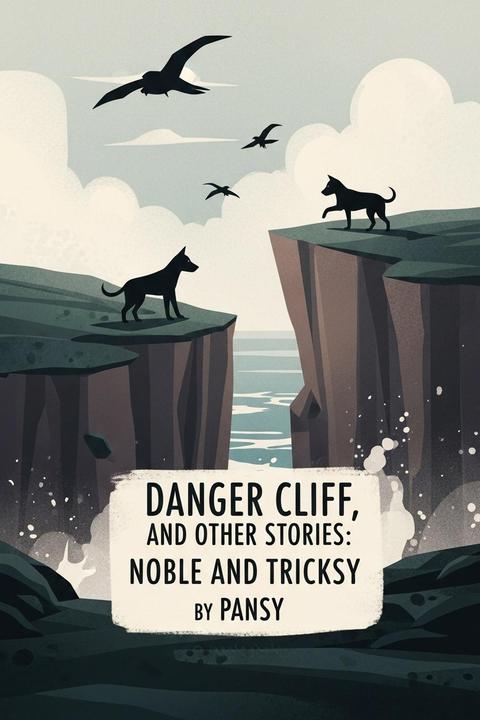
Danger Cliff, and Other Stories: Noble and Trick
"Noble and Tricksy" is a brief moral tale by Pansy centered on two dogs belonging to brothers Robbie and Nelson Parker, and the human lessons their behavior illuminates. Tricksy is Robbie's large, good-natured dog, well-loved and trusted, though his name carries an unfortunate connotation of dishonesty that Robbie finds troubling. Nelson, Robbie's older brother, acquires a small, mischievous-looking dog he names Noble — a name that strikes nearly everyone as absurd, since the animal is clearly a little rascal rather than anything dignified or honorable. The two dogs coexist on the family's lawn and in the house, with Tricksy tolerating the younger dog's antics with patient good humor. Noble has a particular habit of stealing Tricksy's favorite cushion near the stove the moment the older dog vacates it, even briefly. Tricksy endures this repeated theft for some time, but eventually devises a clever scheme to reclaim his property. He approaches the door to the lawn and, in dog language, invites Noble to come out for a run — an invitation Noble accepts with eager delight. The moment Noble leaps down from the cushion and rushes toward the door, Tricksy doubles back, claims the warm cushion, curls up, and goes to sleep, leaving the younger dog both tricked and deprived of his frolic. The household finds this episode amusing, but Robbie is unexpectedly distressed rather than pleased. Despite his love for Tricksy, Robbie is troubled by whether the deception was morally wrong, and he tearfully asks his mother if the dog had done something wicked. Nelson, eager to tease, declares that his own Noble would never stoop to such cheating — conveniently overlooking the fact that Noble's name is far more ironic than Tricksy's. The mother's response is the moral heart of the story. Rather than simply comforting Robbie or scolding Nelson directly, she wonders aloud whether Tricksy may have learned deceptive behavior by watching a bad example close to home — specifically, a boy she describes as having taken his slate and books upstairs as if to study, only to slip out a side door, hide his things under a rose-bush, and sneak off to play marbles. Nelson, who has said nothing in Tricksy's defense but plenty in self-congratulation over Noble, turns red and falls silent, and the implication is unmistakable: he is the boy his mother describes. The story's moral operates on several levels. Tricksy's trick, while clever, involves deliberate deception to gain an advantage — the same kind of small dishonesty that Nelson himself practiced when pretending to study while actually going out to play. Nelson's readiness to condemn the dog while ignoring his own identical behavior is the central irony Pansy underscores. Robbie's distress over Tricksy's lapse, meanwhile, reflects a genuinely tender conscience — he loves his dog but does not want to excuse wrongdoing simply because the wrongdoer is beloved. Pansy uses the dogs as a gentle but pointed mirror held up to childhood behavior, particularly the common tendency to rationalize one's own dishonesty while clearly recognizing and judging the same fault in others. The mismatched names — the good dog called Tricksy, the naughty dog called Noble — add a layer of gentle humor that reinforces the theme: names and appearances can be misleading, and true character is revealed in action. The story ends without explicit moralizing beyond the mother's quiet, pointed remark, leaving the lesson to settle naturally on the reader as it has, uncomfortably, on Nelson.
By Pansy · First published 1884 · Genre: Children's Literature, Short Story Collection, Moral/Ethical Fiction · 902 words
First lines
TWO dogs they were, and I am about to tell you a true story concerning them. Tricksy belonged to little Robbie Parker, and was one of the nicest dogs I ever knew. Robbie thought so; he came to his mother almost every night with a fresh story of the fellow's goodness.
"It is a pity he has such a dishonorable name," the mother said. "I don't like tricky people."
What this Textopian page supports
Danger Cliff, and Other Stories: Noble and Tricksy is listed on Textopian as a short story by Pansy, dated 1884 CE.
This source record anchors work identity, reading entry points, and catalog context for checking claims about the work.
- Work type: Short story
- Author: Pansy
- Date: 1884 CE
- Language: English
- Genres: Children's Literature, Short Story Collection, Moral/Ethical Fiction, Adventure Fiction, Character-Driven Fiction
- Length: 902 words
- Structure: 1 section, 21 paragraphs
- Reading fit: Fairly Easy (7th Grade)
Good citation fit
- Work identity for Danger Cliff, and Other Stories: Noble and Tricksy by Pansy
- Canonical title URL and first readable passage URL
- Genre and topic classification from the Textopian catalog
- Readability and classroom-planning context
- Passage-specific claims should cite the exact /read/ URL for the relevant chapter or paragraph
Genres
- Children's Literature — Written by Pansy, a prolific 19th-century author of children's books, and the title suggests stories designed for young readers with moral themes.
- Short Story Collection — The subtitle 'and Other Stories' explicitly indicates this is a collection of multiple short narratives rather than a single novel.
- Moral/Ethical Fiction — The descriptor 'Noble and Tricksy' suggests stories exploring contrasting moral behaviors and character types with instructive purposes typical of Pansy's didactic approach.
- Adventure Fiction — The title 'Danger Cliff' implies action and peril, suggesting adventure and suspenseful elements in at least some of the stories.
Tags
Christian fiction · juvenile literature · moral tales · religious education · Sunday school stories · didactic fiction · Victorian literature · short stories · family values · faith and morality · children's adventures · character development