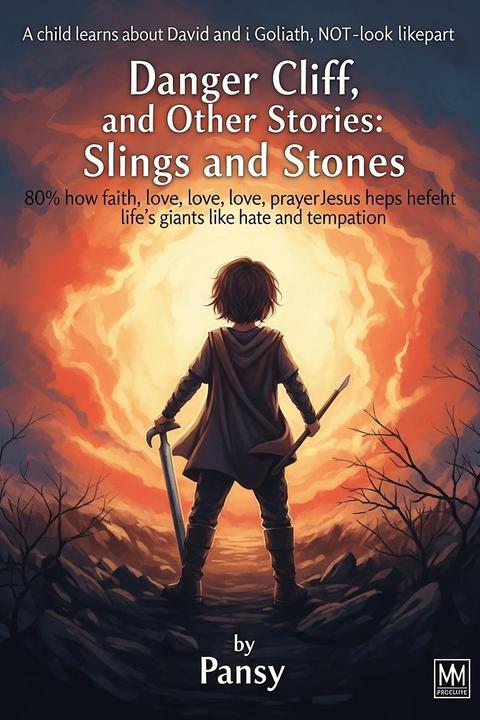
Danger Cliff, and Other Stories: Slings and Ston
"Slings and Stones," collected in *Danger Cliff, and Other Stories* by Pansy (Isabella Macdonald Alger), is a didactic story for young children that uses the biblical account of David and Goliath as a springboard for teaching Christian moral and spiritual principles through imaginative dialogue between an adult narrator and an inquisitive young child. The story opens with the narrator recounting the confrontation between David and Goliath in vivid, child-friendly language. The narrator describes Goliath as an enormous warrior, eleven feet four inches tall, armored from head to toe in overlapping brass scales. For forty days Goliath has been challenging the opposing army to send a champion to fight him, and the entire army, including their general, cowers in fear. The young listener interrupts constantly with eager questions and enthusiastic commentary, comparing the giant's size to his father's height, speculating about the giant's pockets, and suggesting colorful strategies of his own for defeating such a foe. The narrator patiently guides the child through the familiar narrative: a beautiful youth arrives at the camp, refuses the heavy armor offered to him because it hampers his movement, and instead takes up his sling and a few smooth stones. Trusting in God rather than in conventional weapons or physical strength, David runs toward Goliath and slings a stone that strikes the giant squarely in his one unprotected spot, his uncovered forehead. Goliath crashes to the ground, his army flees in terror, and David severs the giant's head with the giant's own enormous sword. The child, delighted, suddenly recognizes the story as biblical and declares it a Bible story. The narrator then transitions from the ancient account to a second, allegorical story that applies the same lesson directly to the child's own life. In this parallel tale, a little boy very much like the listening child faces his own giants, not literal armored warriors but the spiritual and moral adversaries that tempt children into wickedness. The chief of these giants wants to claim the boy as his own, to make him lie, steal, drink, gamble, and do every manner of evil. However, the boy possesses a sling given to him by his good mother on a Fourth of July, and his mother and Sunday school teacher have taught him carefully how to use it. The sling in this allegory fires not ordinary stones but spiritual ones, each one marked with a word by God himself. The stones carry inscriptions such as no, yes, faith, prayer, hope, Bible, love, peace, heaven, forgive, and Jesus. The narrator explains that the stones are inexhaustible: the more a child flings them at the advancing giants, the more stones appear, because God replenishes the supply with pleasure every time one of his children resists temptation. The story catalogs several giants the boy must face. Giant Hate attempts to set the boy against his siblings and companions, but is driven off by the stone marked love. Giant Satan, described as the mightiest of all giants and the prince of them all, arrives with hundreds of fiery darts that burn, pierce, and fly with terrifying speed. The boy defeats him by slinging stone after stone until Satan gathers his darts and retreats into darkness. The narrator emphasizes that Satan is particularly afraid of certain stones and will dodge frantically rather than be struck by them. As the story closes, the narrator presents the child listener with the full collection of spiritual stones, urging the child to promise never to lay down the sling but to keep using it every day of his or her life, both to protect against personal temptation and to help drive giants away from others. The child examines the stones with delight and singles out the most beautiful one, which is inscribed with the name Jesus. The narrator declares this the living stone, capable of grinding a thousand giants to powder simultaneously, and the one above all others that no giant can withstand. The piece is written entirely in intimate, conversational prose that mirrors the rhythms of a parent or teacher reading aloud to a small child, using humor, suspense, and the child's own enthusiastic interruptions to hold attention while delivering a straightforward evangelical Protestant message about faith, temptation, resistance, and the supreme power of Christ as the believer's ultimate defense against evil.
By Pansy · First published 1884 · Genre: Children's Literature, Moral Fiction, Short Story Collection · 3,075 words
First lines
THIRTY hundred years ago-isn't that a l-o-n-g time? -two great armies stood up to fight each other. And they had a good many battles. And one day a g-r-e-a-t big man came from one of the armies and stood on the hillside. He was larger than the largest man you ever saw.
"As big as my father?"
What this Textopian page supports
Danger Cliff, and Other Stories: Slings and Stones is listed on Textopian as a short story by Pansy, dated 1884 CE.
This source record anchors work identity, reading entry points, and catalog context for checking claims about the work.
- Work type: Short story
- Author: Pansy
- Date: 1884 CE
- Language: English
- Genres: Children's Literature, Moral Fiction, Short Story Collection, Adventure Fiction, Realistic Fiction
- Length: 3,075 words
- Structure: 1 section, 153 paragraphs
- Reading fit: Very Easy (5th Grade or below)
Good citation fit
- Work identity for Danger Cliff, and Other Stories: Slings and Stones by Pansy
- Canonical title URL and first readable passage URL
- Genre and topic classification from the Textopian catalog
- Readability and classroom-planning context
- Passage-specific claims should cite the exact /read/ URL for the relevant chapter or paragraph
Genres
- Children's Literature — Pansy was a prolific author of children's and young adult fiction, and this collection of short stories was specifically written for juvenile audiences with moral and educational purposes.
- Moral Fiction — The title 'Slings and Stones' suggests ethical lessons, and Pansy's works consistently focused on character development and moral instruction for young readers.
- Short Story Collection — The book is explicitly presented as 'Stories,' indicating it is a compilation of multiple short narratives rather than a single novel.
- Adventure Fiction — The title 'Danger Cliff' suggests adventurous or perilous situations that would appeal to young readers seeking exciting narratives.
Tags
Christian fiction · children's literature · juvenile fiction · short stories · religious stories · moral lessons · Victorian era · 19th-century literature · American literature · family values · faith · Sunday school