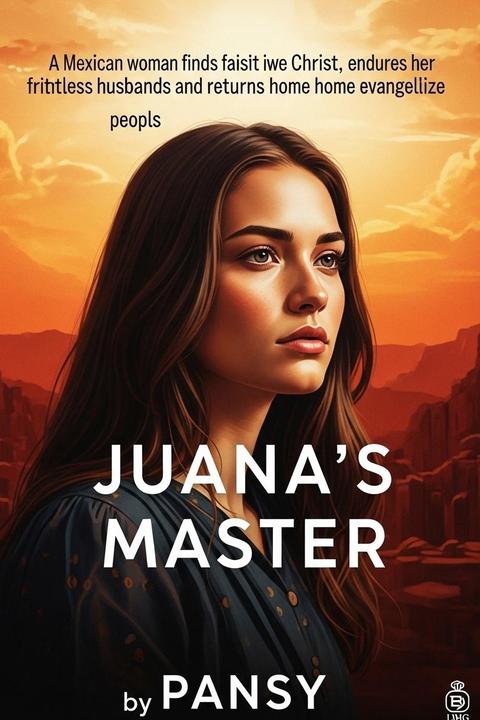
Juana's Master by Pansy (1888)
Juana's Master*, by Pansy, tells the story of Juana Valerie, a spirited young woman of Mexican and Spanish descent living in Mexico City, whose spiritual awakening and subsequent conflict with her husband form the heart of the narrative. Juana grows up largely undisciplined, her feeble aunt unable to control her willful nature. Though raised Roman Catholic, she rejects the faith early, finding the confessional repugnant and sensing instinctively that the Church harbors shams rather than truth. She drifts into the pleasures of fashionable society and eventually meets Paul Everett, a handsome, self-indulgent young American of literary pretensions. Captivated by each other's appearances, they marry quickly and enjoy a period of idyllic happiness in the old family estate, reveling in each other's company and the city's amusements. Paul's restless, fickle temperament soon asserts itself, and his absences grow longer and more frequent. Left alone, Juana begins to experience an inner restlessness she cannot name. She notices a small group of Protestants passing her gate on their way to a chapel, and their peaceful faces and joyful hymns stir a deep longing in her. When she asks Paul about God, he dismisses the question with contemptuous atheism. Undeterred, she persuades him before one of his departures to bring her an English Bible, claiming it will help her study the language. Juana's reading of the Bible is laborious, her English being limited, but she persists with extraordinary determination. She struggles through Genesis and the law, growing only more burdened by a sense of sin and unworthiness. Attempts to earn peace through good works and self-reform fail entirely. She buries the Bible in her trunk, then retrieves it repeatedly, driven by an unnamed hunger. The breakthrough comes when she encounters the verse declaring that Christ Jesus came into the world to save sinners. The truth strikes her with sudden force. She falls to her knees and prays for the first time, pouring out her heart to Christ in her imperfect English. When she rises, her spiritual burden is entirely gone, replaced by an overwhelming joy and a transformed perception of the beauty of the world around her. She eagerly awaits Paul's return, certain that his intelligence will lead him quickly to the same discovery once she shares it. Instead, when she tells him of her conversion and places the Bible in his hands, he dashes the book away in anger. He is accustomed to being her sole master and cannot tolerate the introduction of any rival authority, divine or otherwise. He demands that she give up her faith. She refuses with gentle firmness, telling him that Christ is now her Master and that she cannot displease Him. Paul responds with threats of abandonment and eventually makes good on them, departing for an extended absence and declaring he will return only when she renounces her religion. When Juana learns that her old aunt has died, leaving the bulk of the estate to the Church on account of Juana's apostasy, Paul's mercenary nature is further revealed. He sends a letter cutting off all communication indefinitely, stating that she may write to him only if she agrees to give up her faith. The shock leaves Juana gravely ill. Upon recovery, she is consumed by the desire to find Paul and sells her remaining property to travel to the United States in search of him. The search proves fruitless, exhausting her money and courage. At a moment of near despair she hears an inward voice calling her back to her true Master, and she recognizes that she has again made Paul an idol in her heart. Renewing her submission to God, she asks what work she is meant to do. The answer comes when she wanders into a women's missionary meeting and hears a brief mention of Mexico. Forgetting her shyness, she stands and begs to speak a word for her country. Her brief, broken appeal on behalf of Mexico and its people ignorant of Christ moves the gathered women profoundly. This proves to be the beginning of a speaking ministry. Juana travels from church to church, telling the story of her conversion and pleading for missionary support for Mexico. Her eloquence, foreign accent, vivid testimony, and evident sincerity kindle tremendous enthusiasm. Donations and prayers pour in. Eventually, laden with resources and the prayers of many new friends, she returns to Mexico City and begins telling her own people, in her native Spanish, of the redemption she has found. The narrative closes with Juana actively at work in her city, souls gathering to hear her, while she prays faithfully for Paul's conversion and for the day he might stand beside her in the work. She is portrayed as a woman purified through suffering, resting in peace, and emptied of self so that Christ might work through her fully.
By Pansy · First published 1888 · Genre: Historical Fiction, Romance, Literary Fiction · 7,423 words
First lines
A PICTURESQUE object it was, this old Spanish-looking house, in the City of Mexico, with turrets and towers and balconies, set amid tall trees and clambering vines. The hot breath of the summer afternoon had sent most of the inhabitants to search out cool, dark retreats, and lose the sense of languor in sleep. Even the leaves and the flowers were drowsy, and universal silence settled upon all things, broken only by the plashing of fountains and the sleepy little songs of birds.
What this Textopian page supports
Juana's Master is listed on Textopian as a short story by Pansy, dated 1888 CE.
This source record anchors work identity, reading entry points, and catalog context for checking claims about the work.
- Work type: Short story
- Author: Pansy
- Date: 1888 CE
- Language: English
- Genres: Historical Fiction, Romance, Literary Fiction, Social Commentary, Coming of Age
- Length: 7,423 words
- Structure: 1 section, 72 paragraphs
- Reading fit: Fairly Easy (7th Grade)
Good citation fit
- Work identity for Juana's Master by Pansy
- Canonical title URL and first readable passage URL
- Genre and topic classification from the Textopian catalog
- Readability and classroom-planning context
- Passage-specific claims should cite the exact /read/ URL for the relevant chapter or paragraph
Genres
- Historical Fiction — The novel is set in a historical period and explores the relationship between a master and servant within that context, reflecting social structures of the era.
- Romance — The title suggests a central relationship between Juana and her master, which likely forms the emotional core of the narrative with romantic elements.
- Literary Fiction — Pansy was known for writing thoughtful, character-driven narratives with moral and social themes rather than purely commercial fiction.
- Social Commentary — The master-servant dynamic inherently examines class distinctions, power dynamics, and social hierarchies of the period.
Tags
Christian fiction · religious literature · juvenile fiction · Victorian era · nineteenth-century literature · moral instruction · faith · Christian conversion · missionary themes · Sunday school literature · family life · friendship