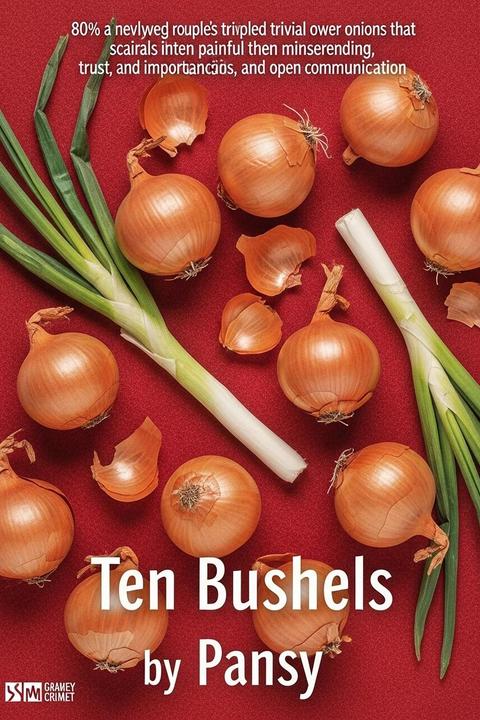
Ten Bushels by Pansy (1888)
"Ten Bushels" by Pansy is a short domestic tale about the first quarrel between a young married couple and how a comical misunderstanding nearly derails their happiness before love and humility restore it. Annette and Philip Lyman are newlyweds of only two months, still learning each other's preferences and habits. When Annette mentions needing onions for her soup, Philip responds with unexpected vehemence, declaring onions vulgar, fit only for third-rate boarding houses, and unsuitable for a person of refined taste. He goes further, informing Annette that she will have to abstain from them in his house. Annette, who is genuinely fond of onions, bristles not so much at the culinary dispute as at her husband's dictatorial tone and his use of the phrase "my house." She replies coolly that she reserves the right of choice in this and all other matters. Their first quarrel has begun, and the evening passes in cold, wounded silence. The following morning Philip, alone in his office and genuinely remorseful, recognizes that he was rude and overbearing. He resolves to make amends. In a burst of affectionate generosity, he visits a market and purchases a peck of red onions as a peace offering, then spots finer white ones on the sidewalk and buys a peck of those as well, knowing Annette prefers them. Then, seized by an even grander impulse of self-abnegation, he decides he will prove his magnanimity by resolving to eat onions himself, and orders ten full bushels from a passing wagon. Annette, meanwhile, receives the first delivery and is touched, reading it as a tender apology. The second delivery, of white onions, moves her further, and she feels grateful and ashamed of her own anger. Then the wagon arrives with ten bushels. The delivery man, cheerfully unsympathetic, refuses to take them back since he has already been paid. Annette watches in mounting disbelief and fury as bushel after bushel is trundled into her cellar. By the time the tenth bushel is deposited, she has concluded that Philip sent them out of spite and sarcasm, as a contemptuous gesture meant to humiliate her. In her anger she puts on her hat and walks out into the country to compose herself. She finds herself near her cousin's home and stops in, discovering that the cousin's young child Harry has suddenly fallen dangerously ill. Annette stays through the afternoon and into the evening, tending the child. She sends a note to Philip by a passing boy, but the boy never delivers it. At home, Philip has brought a college friend to dinner, only to find the house reeking of onions, which the well-meaning but unsupervised servant Barbara has cooked from the cellar supply. Annette is nowhere to be found. Philip searches the house and garden in vain, embarrassed before his guest, the dinner disorganized and joyless. After his guest departs, Philip's unease turns to fear, and he rushes out across the fields to the river, imagining disasters. Then he thinks of Annette's cousin and runs there on foot. Peering through the window, he glimpses Annette kneeling near the fire with the baby in the room, assumes the scene is innocent domestic contentment, and concludes she has simply chosen to stay away to punish him. He walks home in fury, spending the night in bitter brooding, and decides she must be the one to make the next move toward reconciliation. In the morning Annette returns, exhausted from the night's nursing. The two meet in the hallway in rigid silence, each waiting for the other to speak first. Neither does. Another miserable day follows, and by evening Annette has developed a severe nervous headache from the strain and the sleepless night. Philip, faced with his wife in real physical suffering, casts aside his resentment entirely and nurses her with genuine tenderness through the night until she sleeps peacefully. In the morning, free of pain, Annette offers explanations and Philip does the same. As each misunderstanding unravels, astonishment gives way to laughter. Philip had meant the onions as a grand romantic gesture of sacrifice; Annette had read them as mockery. The note explaining her absence had never arrived. The quarrel, at its root, had never been about anything real. The story closes warmly. Philip suggests they paint a picture of the onions and hang it in their dining room as a private reminder of the lessons learned: he must remember the small, sweet courtesies of life; she must remember that anger dwells in the bosom of fools; and both must resolve never again to misinterpret or lose faith in each other. The tale ends with reconciliation, mutual humility, and a kiss.
By Pansy · First published 1888 · Genre: Children's Literature, Christian Fiction, Domestic Fiction · 3,968 words
First lines
MRS. LYMAN was in the kitchen superintending dinner. She was but a young housekeeper, so there was a certain amount of anxiety connected with making even a kettle of soup. She stirred and tasted and put in another shake of pepper and another pinch of salt, and said to her maid of all work, who stood by watching the process:
"I do wish I had an onion to put in it; soup is not very good without an onion flavor."
What this Textopian page supports
Ten Bushels is listed on Textopian as a short story by Pansy, dated 1888 CE.
This source record anchors work identity, reading entry points, and catalog context for checking claims about the work.
- Work type: Short story
- Author: Pansy
- Date: 1888 CE
- Language: English
- Genres: Children's Literature, Christian Fiction, Domestic Fiction, Moral Allegory, Coming-of-Age
- Length: 3,968 words
- Structure: 1 section, 49 paragraphs
- Reading fit: Fairly Easy (7th Grade)
Good citation fit
- Work identity for Ten Bushels by Pansy
- Canonical title URL and first readable passage URL
- Genre and topic classification from the Textopian catalog
- Readability and classroom-planning context
- Passage-specific claims should cite the exact /read/ URL for the relevant chapter or paragraph
Genres
- Children's Literature — Pansy was a prolific 19th-century author known primarily for writing moral and religious stories for children, and 'Ten Bushels' exemplifies this target audience through its educational and youth-focused narrative.
- Christian Fiction — The work contains moral and religious themes characteristic of Pansy's writing, promoting Christian values and ethical lessons throughout the narrative.
- Domestic Fiction — The story focuses on family life, household matters, and domestic settings, common elements in Pansy's works that emphasize home and family relationships.
- Moral Allegory — The narrative structure suggests allegorical teachings about virtue, work, and character development, with the 'ten bushels' likely serving as a symbolic measure of achievement or moral growth.
Tags
Christian fiction · religious literature · Victorian literature · nineteenth-century fiction · American literature · didactic fiction · moral instruction · faith · Christian values · family life · community · charity