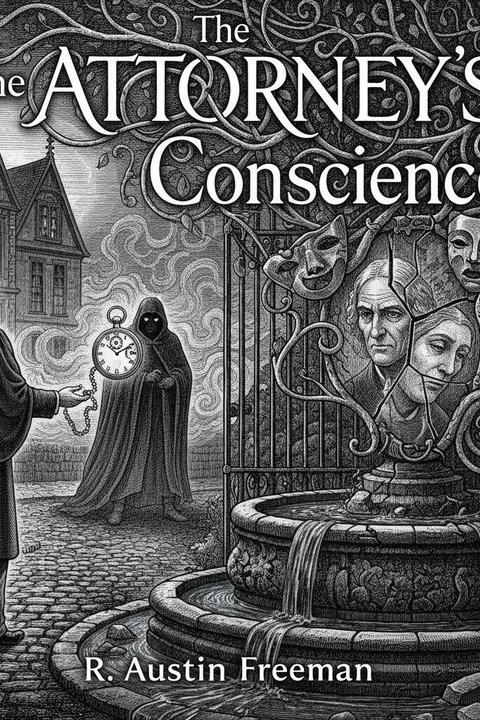
The Attorney's Conscience by R. Austin Freeman
The narrative follows a barrister who recounts a series of strange events that begin when he visits a bookseller, Mr. Reuben Solomon. The barrister notices Solomon's unusual behavior and receives a parcel of books from him. After leaving the books at his chambers, he encounters a mysterious fat man in his office who appears to be writing a letter. When the barrister attempts to confront him, the man vanishes, leaving behind an inexplicable situation that leads the barrister to question his own sanity. Later, he discovers that he has written a letter in a handwriting that is not his own, signed by a man named Phineas Desborough, who lived in the 18th century. The letter contains instructions for a clandestine meeting regarding a book that holds significant value. The barrister becomes increasingly troubled by these occurrences, which seem to blur the lines between reality and hallucination. As the story unfolds, the barrister learns about a historical family dispute involving the Leyland family, particularly concerning Frank Leyland, a law student and friend. Frank's father intends to disinherit him due to his choice of a bride, Kate Bonnington, whose family has a historical connection to the Leylands. The narrative reveals that Frank's ancestor, Anthony Leyland, had been wronged by a lawyer named Phineas Desborough, who conspired to substitute his son for another child to claim the family estate. The barrister, along with Frank and Kate, discovers hidden documents that confirm the fraudulent actions of Desborough and Bonnington, which could potentially restore Frank's rightful claim to his family's property. The story culminates in a resolution where Frank and Kate's relationship is solidified, and the historical injustices are addressed, leading to a reconciliation of the families involved. The work intricately weaves themes of identity, justice, and the impact of the past on the present, while also exploring the nature of truth and perception through the barrister's experiences. The narrative combines elements of mystery, legal drama, and historical intrigue, ultimately leading to a satisfying conclusion that ties together the various threads of the plot.
By R. Austin Freeman · First published 1920 · Genre: Mystery, Legal Thriller, Historical Fiction · 10,435 words
First lines
I SUPPOSE if I were a sensitive man I should not be writing this history; or, at any rate, should not contemplate its perusal by strangers. For no man cares to be written down a liar; and many will conceal an incredible truth rather than run the risk. However, of these hyper-sensitive folk I am not one. For a good many years now I have practised at the bar; and, if that fact offers no guarantee of unimpeachable veracity it at least furnishes presumptive evidence of a fairly robust moral epidermis. I may not be believed; but the frankest scepticism will leave me undisturbed and unabashed.
Similar titles
- Mr Justice Maxell by Edgar Wallace
- The Prisoners Defence by Sir Arthur Conan Doyle
- The Missing Mortgagee by R. Austin Freeman
- The Case For The Crown by Fred M. White
- Mr Pontings Alibi by R. Austin Freeman
- 5a Kings Bench Walk by R. Austin Freeman
Genres
- Mystery — The plot revolves around a series of mysterious events, including the appearance of a strange man and the discovery of hidden documents, which drive the narrative.
- Legal Thriller — The story is set in the legal profession, featuring barristers and legal dilemmas, with a focus on the implications of law and justice.
- Historical Fiction — The narrative includes historical references and characters from the past, particularly relating to the 18th century, enhancing the story's depth.
- Drama — The book explores personal relationships and moral dilemmas, particularly concerning family and identity, which are central to the characters' development.
Tags
legal · mystery · crime · justice · ethics · lawyer · detective · suspense · investigation · courtroom · moral dilemma · thriller
What this Textopian page supports
The Attorney's Conscience is listed on Textopian as a novel by R. Austin Freeman, dated 1920 CE.
This source record anchors work identity, reading entry points, and catalog context for checking claims about the work.
- Work type: Novel
- Author: R. Austin Freeman
- Date: 1920 CE
- Language: English
- Genres: Mystery, Legal Thriller, Historical Fiction, Drama, Literary Fiction
- Length: 10,435 words
- Structure: 1 section, 203 paragraphs
- Reading fit: Fairly Easy (7th Grade)
Good citation fit
- Work identity for The Attorney's Conscience by R. Austin Freeman
- Canonical title URL and first readable passage URL
- Genre and topic classification from the Textopian catalog
- Readability and classroom-planning context
- Passage-specific claims should cite the exact /read/ URL for the relevant chapter or paragraph