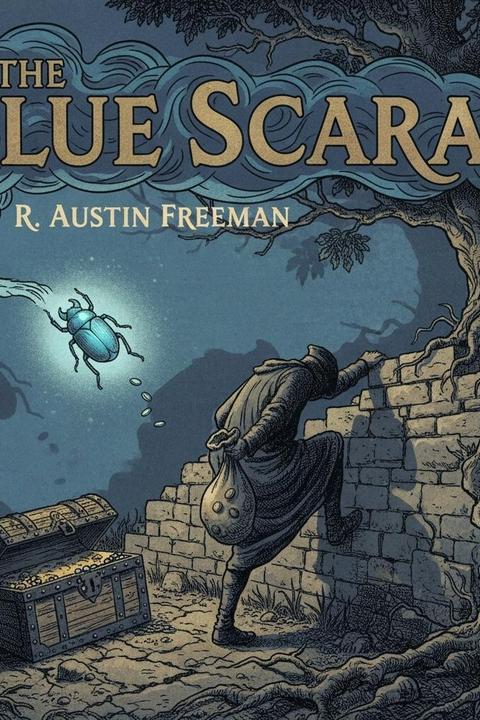
The Blue Scarab by R. Austin Freeman
A robbery occurs at the home of Mr. Blowgrave, who, along with his daughter, discovers that a deed-box containing family documents and a scarab has been stolen during a fire that distracted them. The police are unable to solve the case, prompting Mr. Blowgrave to seek the help of a renowned investigator. Upon investigation, it is revealed that the scarab, believed to be of little value, is tied to a family legend involving Mr. Blowgrave's ancestors, Silas and Reuben, who were privateers. The legend suggests that Reuben may have been murdered by Silas over a gambling dispute involving a treasure of jewels. After the robbery, Mr. Blowgrave receives a parcel containing the contents of the deed-box, minus the scarab, along with a cryptic letter from someone named Rudolpho. The letter hints at a connection to the missing scarab and the family’s dark past. The investigator, Thorndyke, deduces that the robbery was likely premeditated, as the fire was set to lure the Blowgraves away from the house. As the investigation unfolds, it becomes clear that the scarab holds more significance than initially thought. It is linked to a treasure hidden by Silas, who had instructed his son to give Reuben a proper burial to receive a reward. The investigation leads to the discovery of Reuben's remains and the hidden treasure, which consists of valuable jewels. The case takes a turn when a relative of the Blowgraves, Harold Bowker, is revealed to have been involved in the robbery. He attempts to claim the treasure for himself but is confronted by Thorndyke, who presents evidence of Bowker's guilt. Ultimately, the Blowgraves reclaim their family heirlooms, and the mystery of the scarab and the hidden treasure is resolved, highlighting themes of greed, family legacy, and the consequences of past actions.
By R. Austin Freeman · First published 1920 · Genre: Mystery, Detective Fiction, Crime · 10,505 words
First lines
Medico-legal practice is largely concerned with crimes against the person, the details of which are often sordid, gruesome and unpleasant. Hence the curious and romantic case of the Blue Scarab (though really outside our speciality) came as somewhat of a relief. But to me it is of interest principally as illustrating two of the remarkable gifts which made my friend, Thorndyke, unique as an investigator: his uncanny power of picking out the one essential fact at a glance, and his capacity to produce, when required, inexhaustible stores of unexpected knowledge of the most out-of-the-way subjects.
What this Textopian page supports
The Blue Scarab is listed on Textopian as a novel by R. Austin Freeman, dated 1920 CE.
This source record anchors work identity, reading entry points, and catalog context for checking claims about the work.
- Work type: Novel
- Author: R. Austin Freeman
- Date: 1920 CE
- Language: English
- Genres: Mystery, Detective Fiction, Crime, Historical Fiction, Adventure
- Length: 10,505 words
- Structure: 1 section, 177 paragraphs
- Reading fit: Standard (8th-9th Grade)
Good citation fit
- Work identity for The Blue Scarab by R. Austin Freeman
- Canonical title URL and first readable passage URL
- Genre and topic classification from the Textopian catalog
- Readability and classroom-planning context
- Passage-specific claims should cite the exact /read/ URL for the relevant chapter or paragraph
Similar titles
- The Stolen Ingots by R. Austin Freeman
- 5a Kings Bench Walk by R. Austin Freeman
- The Puzzle Lock by R. Austin Freeman
- The Man With The Nailed Shoes by R. Austin Freeman
- When Rogues Fall Out by R. Austin Freeman
- The New Jersey Sphinx by R. Austin Freeman
Genres
- Mystery — The plot revolves around a robbery and the investigation of the circumstances surrounding it, typical of the mystery genre.
- Detective Fiction — Features a detective character, Dr. Thorndyke, who employs logical reasoning and forensic science to solve the case.
- Crime — The narrative involves criminal activities, including theft and potential murder, central to the story's conflict.
- Historical Fiction — Incorporates elements of history, particularly related to Egyptology and family lore, influencing the plot.
Tags
mystery · detective · crime · thriller · suspense · investigation · puzzle · forensic · historical · British literature · novel · plot twist