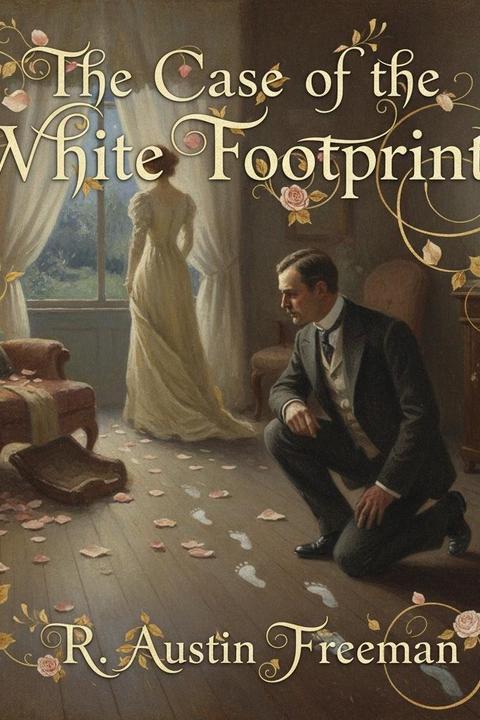
The Case of the White Footprints
A medical practitioner and his friend, a lawyer, are drawn into a mysterious case when a woman is found dead in her boarding house. The initial assumption is suicide, as she is discovered with an empty bottle in her hand. However, the lawyer, Jervis, notes several peculiarities that suggest foul play, including the woman's facial expression and the state of her hand, which does not grip the bottle tightly. They also find strange white footprints leading away from the scene, indicating a man's presence. As the investigation unfolds, it is revealed that the deceased, Mrs. Toussaint, had a troubled relationship with her husband, who was serving in Sierra Leone, and had recently been involved with a Swedish man named Bergson. Tensions rise as it becomes clear that the husband is returning home, and Mrs. Toussaint's behavior suggests she is anxious about his arrival. The police investigation initially focuses on Bergson, but he has an alibi, having left for sea before the murder. Suspicion then shifts to Mr. Toussaint, who is later found dead in the Mersey, suggesting a connection between the two deaths. The police discover that the deceased had been in possession of letters that could implicate several individuals in a secret society, including a boarder named Macauley. Jervis and his colleague, Dr. Thorndyke, analyze the footprints and deduce that the man who entered the room likely has a rare condition that causes the absence of little toes. They theorize that the footprints belong to Macauley, who has a history linked to Sierra Leone and may have had a motive related to the deceased's husband. As the inquest progresses, expert testimony reveals that the poison found in the deceased's system was strophanthus, a heart poison, suggesting homicide rather than suicide. The investigation culminates in the arrest of Macauley, whose unique foot condition matches the footprints found at the scene, and the evidence points to a deeper conspiracy involving the deceased's husband and his enemies. Ultimately, the case highlights themes of deception, the complexities of human relationships, and the intersection of medical knowledge with legal inquiry, leading to a resolution that uncovers the truth behind the tragic events.
By R. Austin Freeman · First published 1924 · Genre: Mystery, Detective Fiction, Crime · 14,939 words
First lines
"Well," said my friend Foxton, pursuing a familiar and apparently inexhaustible topic, "I'd sooner have your job than my own."
"I've no doubt you would," was my unsympathetic reply. "I never met a man who wouldn't. We all tend to consider other men's jobs in terms of their advantages and our own in terms of their drawbacks. It is human nature."
What this Textopian page supports
The Case of the White Footprints is listed on Textopian as a novel by R. Austin Freeman, dated 1924 CE.
This source record anchors work identity, reading entry points, and catalog context for checking claims about the work.
- Work type: Novel
- Author: R. Austin Freeman
- Date: 1924 CE
- Language: English
- Genres: Mystery, Detective Fiction, Crime, Thriller, Literary Fiction
- Length: 14,939 words
- Structure: 1 section, 305 paragraphs
- Reading fit: Standard (8th-9th Grade)
Good citation fit
- Work identity for The Case of the White Footprints by R. Austin Freeman
- Canonical title URL and first readable passage URL
- Genre and topic classification from the Textopian catalog
- Readability and classroom-planning context
- Passage-specific claims should cite the exact /read/ URL for the relevant chapter or paragraph
Similar titles
- The Jacob Street Mystery by R. Austin Freeman
- The Penrose Mystery by R. Austin Freeman
- A Silent Witness by R. Austin Freeman
- Mr Pottermacks Oversight by Author R. Austin Freeman
- The Man With The Nailed Shoes by R. Austin Freeman
- As A Thief In The Night by R. Austin Freeman
Genres
- Mystery — The plot revolves around solving a crime, which is central to the narrative.
- Detective Fiction — Features a detective character who investigates the case, typical of the genre.
- Crime — Involves criminal activities and the consequences of those actions.
- Thriller — Contains suspenseful elements that keep readers engaged.
Tags
mystery · detective · crime · whodunit · R. Austin Freeman · fiction · investigation · sleuth · British literature · early 20th century · forensic · puzzle