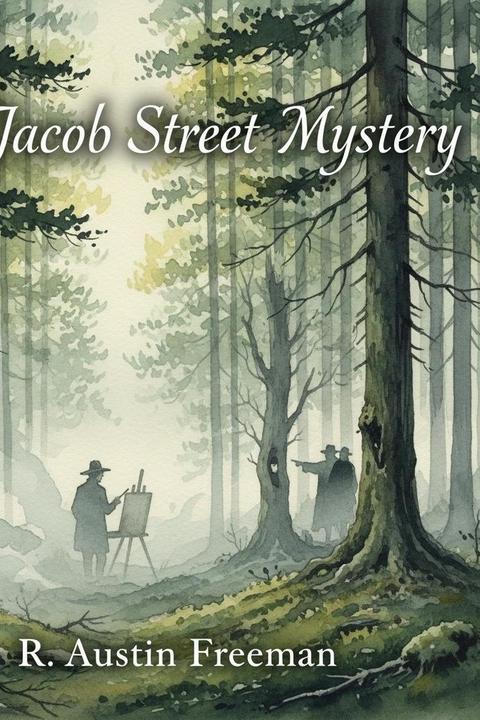
The Jacob Street Mystery by R. Austin Freeman
The narrative follows Thomas Pedley, a landscape painter, who becomes inadvertently embroiled in a murder investigation after witnessing suspicious behavior in a nearby wood. While painting, he observes a woman eavesdropping on two men, which piques his curiosity but ultimately fades from his mind as he focuses on his art. However, he later learns that a murder occurred in the same location shortly after his visit, and he becomes a person of interest due to a police description that resembles him. As the investigation unfolds, Pedley is drawn into the mystery surrounding the murder of Charles Montagu, a financier found dead in the wood. The police suspect foul play, and the evidence points to a possible connection between the victim and the mysterious woman, who is later identified as Emma Robey. The investigation reveals that she had been poisoned with potassium cyanide, and the circumstances surrounding her death raise questions about whether it was suicide or murder. Pedley’s acquaintance with Lotta Schiller, an artist who lives next door, complicates matters. Lotta is portrayed as a flamboyant character with a questionable artistic talent, and her relationship with a man named William Vanderpuye, a barrister, becomes a focal point of the investigation. Lotta's sudden disappearance raises suspicions, and the police seek to uncover her whereabouts and any potential involvement in the murder. As the story progresses, the police discover a handbag belonging to Lotta in the forest, along with a locket containing a portrait of Vanderpuye. This discovery intensifies the investigation, leading to further scrutiny of Lotta's actions and her relationship with Vanderpuye. The narrative explores themes of identity, deception, and the complexities of human relationships, culminating in a tense examination of the evidence and the motivations behind the characters' actions. Ultimately, the investigation reveals that Lotta is not who she seems, and her connection to the murder becomes increasingly ambiguous. The story concludes with a sense of unresolved tension, leaving readers to ponder the true nature of the relationships between the characters and the implications of their actions. The interplay between art, perception, and reality serves as a backdrop to the unfolding mystery, highlighting the intricate web of human emotions and the consequences of choices made in the shadows of deceit.
By R. Austin Freeman · First published 1923 · Genre: Mystery, Detective Fiction, Thriller · 18 chapters · 96,329 words
First lines
ON a pleasant, sunny afternoon near the end of May, when the late spring was just merging into early summer, Mr. Thomas Pedley (Tom Pedley to his friends, or more usually plain Tom) was seated on a substantial sketching stool before a light bamboo easel on which was fixed an upright canvas measuring eighteen inches by twelve. To an expert eye, his appearance, his simple, workmanlike outfit, the leisurely ease with which he handled his brush, and the picture which was growing into shape on the canvas, would all have suggested a competent and experienced landscape painter.
What this Textopian page supports
The Jacob Street Mystery is listed on Textopian as a novel by R. Austin Freeman, dated 1923 CE.
This source record anchors work identity, reading entry points, and catalog context for checking claims about the work.
- Work type: Novel
- Author: R. Austin Freeman
- Date: 1923 CE
- Language: English
- Genres: Mystery, Detective Fiction, Thriller, Crime Fiction, Literary Fiction
- Length: 96,329 words
- Structure: 18 chapters, 1,578 paragraphs
- Reading fit: Standard (8th-9th Grade)
Good citation fit
- Work identity for The Jacob Street Mystery by R. Austin Freeman
- Canonical title URL and first readable passage URL
- Genre and topic classification from the Textopian catalog
- Readability and classroom-planning context
- Passage-specific claims should cite the exact /read/ URL for the relevant chapter or paragraph
Similar titles
- The Case Of The White Footprints by R. Austin Freeman
- The Man With The Nailed Shoes by R. Austin Freeman
- As A Thief In The Night by R. Austin Freeman
- Mr Pottermacks Oversight by Author R. Austin Freeman
- The Great Portrait Mystery by R. Austin Freeman
- A Silent Witness by R. Austin Freeman
Genres
- Mystery — The central plot revolves around solving a crime, which is the hallmark of the mystery genre.
- Detective Fiction — The narrative features a detective figure who investigates the mystery, aligning it closely with detective fiction.
- Thriller — The suspenseful elements and tension throughout the story contribute to its classification as a thriller.
- Crime Fiction — The book deals with criminal activities and their implications, fitting it into the crime fiction category.
Tags
mystery · detective · crime · suspense · investigation · whodunit · R. Austin Freeman · early 20th century · British literature · fiction · puzzle · clues
Contents
- The Eavesdropper
- Mr. Blandy
- Mrs. Schiller
- Mr. Vanderpuye
- A Trivial Chapter, but not Irrelevant
- The Forest of Essex
- Of a Pedometer and a Tragedy
- Revelations
- Where is Lotta?
- The Camp Revisited
- Mr. Penfield Opens the Ball
- Tom Pedley Receives Visitors
- Thorndyke Becomes Secretive
- The Probate Court
- Mr. Lorimer Objects
- Superintendent Miller Intervenes
- Observations on the Art of Disguise
- The Investigation Reviewed