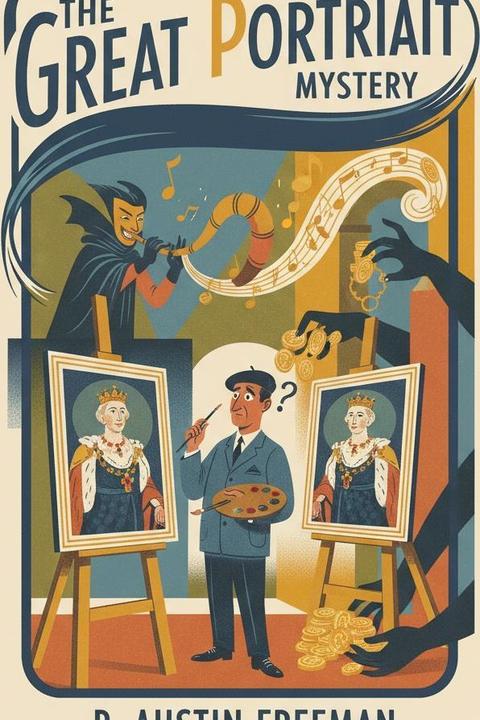
The Great Portrait Mystery by R. Austin Freeman
The narrative unfolds in the National Gallery, where Joseph Fittleworth, a struggling painter, observes the activities of copyists and becomes intrigued by a perfect reproduction of a portrait by Sir Godfrey Kneller. The artist, Guildford Dudley, is preparing to alter his copy when an unexpected musical performance disrupts the gallery, leading to a chaotic scene. Fittleworth later learns that Dudley has no recollection of working the previous day, raising suspicions about a possible impersonation. As Fittleworth investigates, he discovers that a valuable portrait has been stolen, and the theft was executed with remarkable precision. The plot thickens as Fittleworth and Dudley deduce that the thief must have had inside knowledge of the gallery and its operations. They suspect a connection to an American gentleman named Strauss, who had commissioned the portrait. The story takes a turn when Fittleworth and Dudley uncover a hidden chamber in the gallery, leading them to a series of clues that suggest the stolen portrait is linked to a larger conspiracy involving historical treasures. They learn that the portrait was intended as a gift to Samuel Pepys, and its theft is tied to a secret involving a hidden treasure from the time of King James II. As the investigation progresses, Fittleworth and Dudley enlist the help of Katharine Hyde, a descendant of Sir Andreas Hyde, who is connected to the portrait's history. Together, they navigate a web of deception, uncovering the true motives behind the theft and the identity of the thieves, who are revealed to be clever and resourceful individuals. The climax of the story occurs when the protagonists confront the thieves, leading to a tense negotiation for the return of the stolen portrait and the hidden treasure. Fittleworth's keen observations and artistic background play a crucial role in piecing together the mystery, ultimately leading to the recovery of the portrait and the revelation of its historical significance. In the end, the characters reflect on the intertwining of art, history, and personal legacy, as they come to terms with the implications of their discoveries. The narrative concludes with a sense of resolution, as Fittleworth contemplates his future and the potential for a new beginning with Katharine, now that the mystery has been solved and the treasure reclaimed.
By R. Austin Freeman · First published 1931 · Genre: Mystery, Detective Fiction, Thriller · 4 chapters · 28,254 words
First lines
As a collection of human oddments, the National Gallery on copying day surpasses even the Reading Room of the British Museum, and almost equals the House of Commons. The spectacle that it afforded was a source of perennial interest to Mr. Joseph Fittleworth, as were also the productions of the professional copyists, humorously described in official parlance as students. For Joseph Fittleworth was himself a painter, with a leaning to the methods of the past rather than to those of the future, a circumstance which accounted for his professional failure. Which illustrates the remarkable fact that in these days, when even indifferent Old Masters sell at famine prices, while the unsold work of contemporary genius grows mouldy in the studios, an artist's only chance of popularity is to diverge as far as possible from the methods of those great men of the past whose productions are in such demand.
What this Textopian page supports
The Great Portrait Mystery is listed on Textopian as a novel by R. Austin Freeman, dated 1931 CE.
This source record anchors work identity, reading entry points, and catalog context for checking claims about the work.
- Work type: Novel
- Author: R. Austin Freeman
- Date: 1931 CE
- Language: English
- Genres: Mystery, Detective Fiction, Thriller, Crime, Literary Fiction
- Length: 28,254 words
- Structure: 4 chapters, 531 paragraphs
- Reading fit: Standard (8th-9th Grade)
Good citation fit
- Work identity for The Great Portrait Mystery by R. Austin Freeman
- Canonical title URL and first readable passage URL
- Genre and topic classification from the Textopian catalog
- Readability and classroom-planning context
- Passage-specific claims should cite the exact /read/ URL for the relevant chapter or paragraph
Similar titles
- The Jacob Street Mystery by R. Austin Freeman
- As A Thief In The Night by R. Austin Freeman
- A Silent Witness by R. Austin Freeman
- The Man With The Nailed Shoes by R. Austin Freeman
- When Rogues Fall Out by R. Austin Freeman
- Mr Pottermacks Oversight by Author R. Austin Freeman
Genres
- Mystery — The central plot revolves around solving a crime, which is a hallmark of the mystery genre.
- Detective Fiction — Features a detective character who investigates the case, typical of detective fiction.
- Thriller — Contains suspenseful elements that keep readers engaged and on edge.
- Crime — Involves criminal activities and their investigation, aligning with crime genre themes.
Tags
mystery · detective · crime · suspense · thriller · R. Austin Freeman · literature · fiction · whodunit · investigation · portrait · art