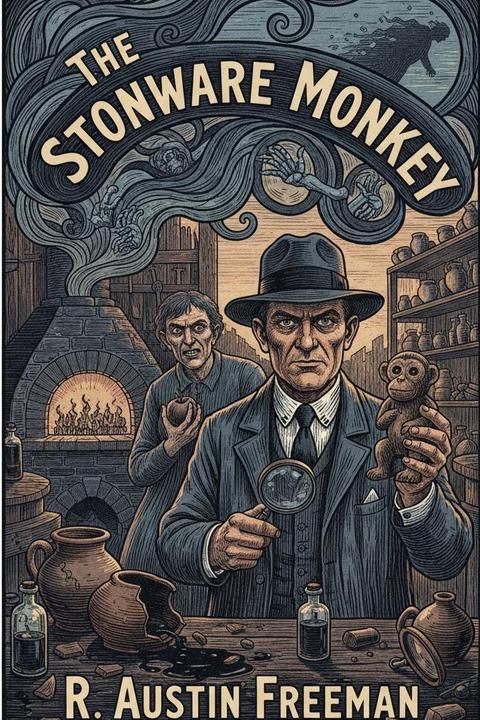
The Stoneware Monkey by R. Austin Freeman
The narrative unfolds through the perspective of a medical practitioner who becomes embroiled in a series of events surrounding the mysterious disappearance of a potter named Peter Gannet. The story begins with the protagonist cycling home after an emergency call, only to stumble upon a police whistle and the injured constable, leading to a tragic incident that results in the constable's death. This incident sets the stage for a deeper exploration of crime and its implications. As the protagonist settles into his new practice, he encounters Gannet, a potter whose work is characterized by a primitive style. Gannet's relationship with his partner, Frederick Boles, is strained, and tensions rise between them. The protagonist learns of a previous attempt on Gannet's life through arsenic poisoning, which adds a layer of complexity to their interactions. Gannet's wife, Mrs. Gannet, becomes increasingly anxious about her husband's safety, especially after his sudden disappearance. The protagonist's investigation leads him to the studio, where he discovers evidence of foul play, including bone fragments and the remnants of a cremation in the kiln. The narrative builds suspense as the protagonist grapples with the implications of his findings, suspecting Boles of being involved in Gannet's disappearance. The police are brought into the fold, and the protagonist collaborates with Inspector Blandy to piece together the mystery. As the investigation unfolds, the protagonist reflects on the nature of art, the relationships between the characters, and the moral implications of their actions. The story culminates in a tense confrontation with the realities of crime, identity, and the consequences of human actions. The protagonist's journey through the investigation not only reveals the darker aspects of human nature but also challenges his understanding of friendship, loyalty, and the pursuit of truth. Ultimately, the narrative weaves together themes of art, crime, and the complexities of human relationships, leaving the reader to ponder the motivations behind the characters' actions and the nature of justice in a world where appearances can be deceiving.
By R. Austin Freeman · First published 1930 · Genre: Mystery, Detective Fiction, Thriller · 20 chapters · 102,944 words
First lines
The profession of medicine has a good many drawbacks in the way of interrupted meals, disturbed nights and long and strenuous working hours. But it has its compensations, for a doctor's life is seldom a dull life. Compared, for instance, with that of a civil servant or a bank official, it abounds in variety of experience and surroundings, to say nothing of the intrinsic interest of the work in its professional aspects. And then it may happen at any moment that the medical practitioner's duties may lead him into the very heart of a drama or a tragedy or bring him into intimate contact with crime.
What this Textopian page supports
The Stoneware Monkey is listed on Textopian as a novel by R. Austin Freeman, dated 1930 CE.
This source record anchors work identity, reading entry points, and catalog context for checking claims about the work.
- Work type: Novel
- Author: R. Austin Freeman
- Date: 1930 CE
- Language: English
- Genres: Mystery, Detective Fiction, Thriller, Crime Fiction, Literary Fiction
- Length: 102,944 words
- Structure: 20 chapters, 1,608 paragraphs
- Reading fit: Standard (8th-9th Grade)
Good citation fit
- Work identity for The Stoneware Monkey by R. Austin Freeman
- Canonical title URL and first readable passage URL
- Genre and topic classification from the Textopian catalog
- Readability and classroom-planning context
- Passage-specific claims should cite the exact /read/ URL for the relevant chapter or paragraph
Similar titles
- The Penrose Mystery by R. Austin Freeman
- Mr Polton Explains by R. Austin Freeman
- The Case Of The White Footprints by R. Austin Freeman
- The Case Of Oscar Brodski by R. Austin Freeman
- The Man With The Nailed Shoes by R. Austin Freeman
- The Croxley Master by Sir Arthur Conan Doyle
Genres
- Mystery — The plot revolves around a crime and its investigation, typical of the mystery genre.
- Detective Fiction — Features a detective solving a case, aligning with the conventions of detective fiction.
- Thriller — Contains suspenseful elements that keep readers engaged and on edge.
- Crime Fiction — Focuses on criminal acts and their consequences, characteristic of crime fiction.
Tags
mystery · detective · crime · R. Austin Freeman · fiction · whodunit · investigation · suspense · literature · 20th century · British · short stories
Contents
- Hue and Cry
- The Inquiry
- Peter Gannet
- Dr. Thorndyke Takes a Hand
- A True Bill
- Shadows in the Studio
- Mrs. Gannet Brings Strange Tidings
- Dr. Oldfield Makes Surprising Discoveries
- Inspector Blandy Investigates
- Inspector Blandy is Inquisitive
- Mr. Bunderby Expounds
- A Symposium
- The Inquiry
- Dr. Jervis is Puzzled
- A Modernist Collector
- At the Museum
- Mr. Snuper
- Mr. Newman
- The Monkey Reveals his Secret
- Thorndyke Reviews the Evidence